Buell Wesley Frazier: Unasked Questions
By Paul Jolliffe
The vast majority of readers here are at least roughly familiar with Buell Wesley Frazier’s story: his relationship with Oswald, his description of Oswald’s infamous paper bag in the back seat of his car, his problems with the battery/generator in his 1954 Chevy Bel Air, his opinion of Oswald, his account of his movements the day of the assassination, his ordeal with Will Fritz on Friday night, and so on.
This essay will not recount any of that. Fascinating though Frazier’s story of November 22, 1963 may be. I will instead focus on evidence that Frazier likely knows more than he has divulged about people and events before the assassination. As we shall see, this is something that he himself admitted to in his book, Steering the Truth.
Before I continue, I must assure the reader that I am 100% convinced that Buell Wesley Frazier was exactly who he portrayed himself to be in 1963 - a naive 19-year-old kid, caught up in a swirl of powerful and evil forces, about which he had no prior knowledge. In no way was Frazier a witting participant in any sort of plot against anyone. He was completely innocent of any crime.
II
As we all know, on Friday night, after the assassination, Dallas Police Homicide Chief Will Fritz subjected Frazier to extreme psychological pressure (and nearly a physical beating!). This was an extended effort to coerce Frazier to (falsely) confess to abetting “Oswald”. Frazier came within an inch of being charged in the assassination. It was only after Dallas Police Chief Jesse Curry received a call from the FBI in Washington early Saturday morning that Fritz then released Frazier. (I believe the substance of that call was to inform Dallas that Washington felt they had the evidence needed to “make the case” against “Oswald.”) In any event, Frazier was a free man after that call.
The evidence indicates that Will Fritz was confident he could charge Frazier with the crime on Friday evening. Was it because the case against Oswald was rather weak at that time, and perhaps Fritz thought he could manufacture something against Frazier in case the Oswald evidence was not forthcoming? Recall, at that time, there was no fingerprint evidence, the rifle had not been linked to Oswald, and there were no autopsy results.
What about Frazier?
1. Warren Commission Document 1546 (Gemberling Report), pages 137-140.
https://www.maryferrell.org/xdoc/11941#relPageId=146
The infamous Sports Drome Rifle Range was the site of two different “Oswald” visits in November 1963, according to several witnesses at the range. One previous FBI witness, Garland Slack, was on the phone with his wife while she was being interviewed by the FBI. Note that Garland Slack reiterated that Oswald was not only at the range on November 17, but that “he had been brought there by a man named ‘Frazier’ from Irving.”
“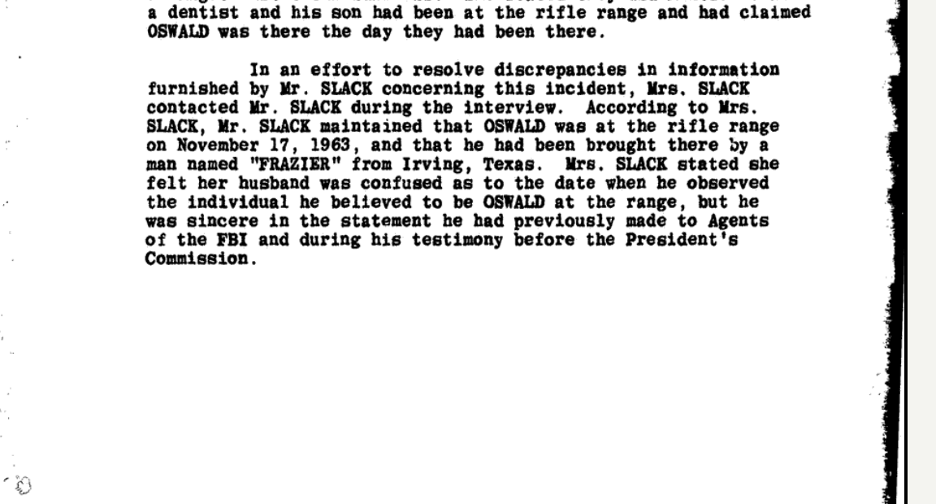
According to the following NY Times story of December 10, 1963, “Witnesses Recall Oswald Firing at a Rifle Range Near Dallas; Carried Three Rifles A Second Public Range Tells of Seeing 2 Flee. Slack believed that “Oswald” had been driven to the range twice in the company of another man (unnamed) to whom “Oswald” handed three (!) rifles over the fence as they were leaving. What is particularly striking is that Slack did NOT immediately recognize the accused assassin on television as the same “Oswald” with whom he’d interacted at the range. However, the story continues, “Mr. Slack said he was watching television after the President's assassination when Oswald was shown on the screen. "I wasn't quite sure the first time I saw him," he said, “but the second time they had that jacket and I knew it was the same man; I felt terrible.”
The Warren Commission, as all readers here know, rejected all of the Sports Drome Rifle Range witnesses as mistaken. But the Commission made no attempt to discover how the phrase “Frazier from Irving” could possibly be a “mistake”. Indeed, not only did they fail to address this crucial evidence, but no one, to my knowledge, has ever asked Frazier himself about the use of his name! The FBI did ask Frazier if he had ever taken “Oswald” to the range, which he denied, and I believe him. Frazier wasn’t there, then. But as far as I can tell, the FBI did not ask him about the suspicious use of his name! Yet someone used his name and city shortly before the assassination at that range! That person, whoever he was, was likely a conspirator!
For nearly 63 years, Frazier has not said one word about the incredibly suspicious use of his name in connection with a supposed “Oswald” at the rifle range in the days before the president’s murder. In his recent memoir, he said nothing about it.
So, on August 18, 2026, I emailed the official Buell Wesley Frazier social media account contact address and asked him directly about this. As yet, I have received no response. Maybe I will never get a reply. This is a likely sensitive issue. Surely he knows by now he was impersonated by name, and perhaps he has an idea about who did it. If so, he might be (understandably) afraid.
2. On page 48 of his memoir, Frazier wrote that he brought his British Enfield .303 rifle and a shotgun with him from Huntsville when he moved in with his sister in Irving in 1963. All readers here know well that the rifle “found” in the TSBD was not first identified by the Dallas P.D as the Mannlicher-Carcano now in the National Archives, either in verbal statements to the press or in reports written on November 22. For many hours, confusion reigned among the national media as to what exactly had been recovered by the Dallas Police. Without rehashing the entire “Mannlicher-Carcano/Mauser” issue, note that the earliest rifle identification–that I can find–came from NBC. On Friday afternoon, NBC’s David Brinkley cut to a live report from Tom Whalen at WBAP, the NBC affiliate in Fort Worth. Whalen told the national audience that “Dallas Crime Laboratory Lieutenant J.C. Day went to the building a short time after the shooting took place and he walked out with a British 303 rifle. The rifle has a telescopic sight. Now the rifle was found on the sixth floor of the building, near a corner window. Also, police searching that area found three empty 303 cartridge cases, also scraps of chicken as if a person could have been there for some time . . . ”
(Beginning at the 52:08 mark and continuing until 53:35):
https://youtu.be/1QbQM6Iyto0?si=rrD8WdOrFfqMR2Sn&t=3128
“A British 303 rifle? Three 303 cartridge cases?” What? Whalen’s Friday afternoon report could only have come from a source within the Dallas Police. Someone inside that department was telling the national media that the assassin’s rifle was identical to the make and caliber of the rifle owned by Frazier. When this report aired, it’s not clear that even Oswald had been closely questioned. Whatever one makes of this, one thing is clear: Frazier did not say anything in his memoir about this bizarre “coincidence”: namely that on Friday, November 22, 1963, NBC News told the country that the assassin’s rifle was identical to his. As far as I know, in 63 years, Frazier has never addressed this “coincidence”
(And, as readers might have guessed already, I asked Frazier about that, too. It was a long email. Perhaps he is still working his way through it.)
3. On page 31 of his memoir, Frazier wrote that his sister invited him to move from Huntsville to Dallas “sometime around the summer of 1963” and so “ without giving it a second thought, I loaded up my 1954 Chevy Bel Air and sped up Highway 75 `north, which was a two lane road with lots of curves and hills, toward Dallas-Fort Worth and moved into (her) home at 2439 West Fifth Street in Irving.”
“Sometime around the summer of 1963”? Was Frazier being purposely vague in his memoir about the time frame of his move to Irving? The old joke is that “Texas has four seasons: Almost Summer, Summer, Still Summer, and Christmas!” If we follow that adage, sometime around the summer could be construed as anytime between St. Patrick’s Day and Thanksgiving.
(If the reader will stay with this seemingly obscure line of reasoning for a while, I promise to explain why it matters.)
Consider Frazier’s Warren Commission testimony:
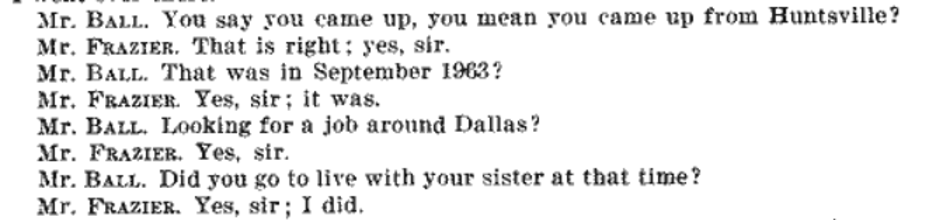
Note that it was WC attorney Joseph Ball, not Frazier, who introduced the September move date into the record. But would anyone consider September as part of the summer?
Now, Frazier’s testimony in the Clay Shaw trial was seemingly precise (“It was then around the first part of September.”) But even so, Frazier seemed to waffle. He did not want to identify the month of his move until prompted twice by DA James Alcock.
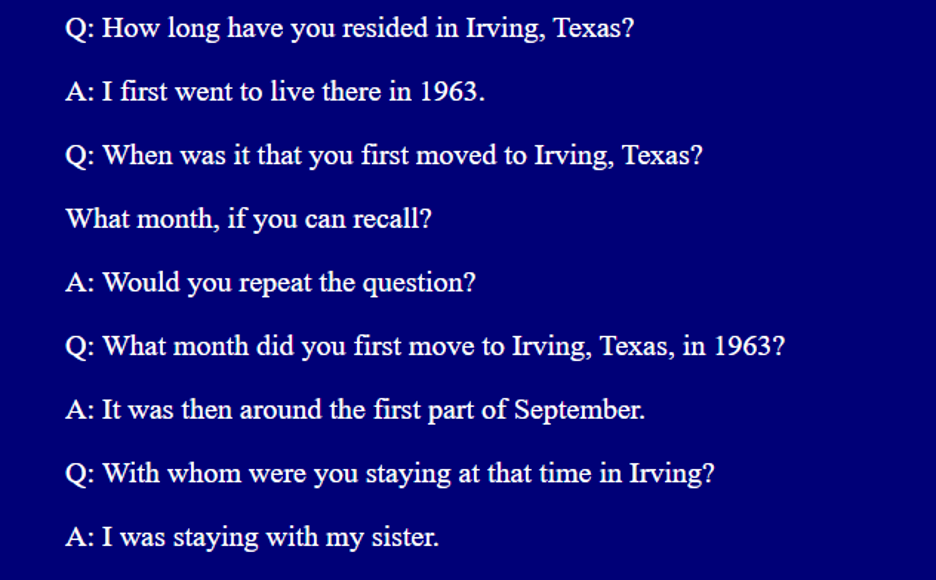
Okay - Frazier moved to Irving “around” the first part of September, right? But if the date of his move was definitive in his 1969 sworn Clay Shaw trial testimony, then why the ambiguity in his 2021 memoir?
After all, Frazier had not forgotten about his previous Clay Shaw testimony--in 2021 he reproduced it verbatim at the end of his memoir.
III
It is time to introduce the rather curious episode with Robert Adrian Taylor. Taylor was a mechanic in 1963 at the Shell Station on the southwest corner of the intersection of Rock Island and Story in Irving, Texas.
A gas station stands on that very spot to this day:
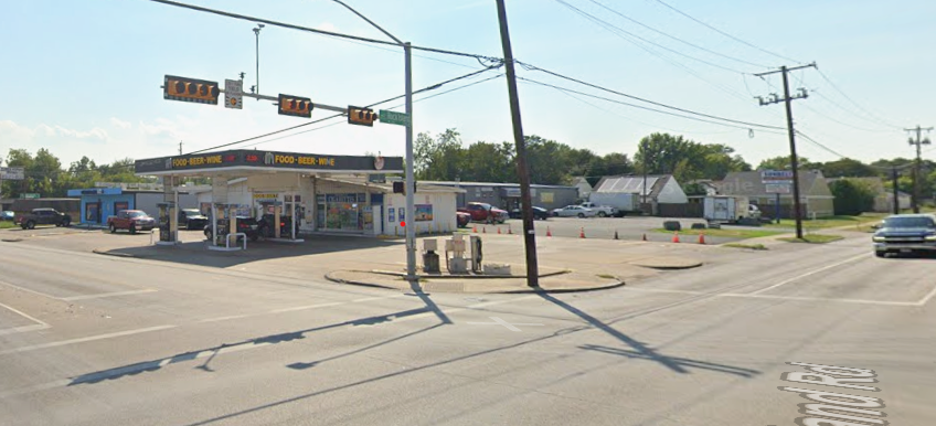
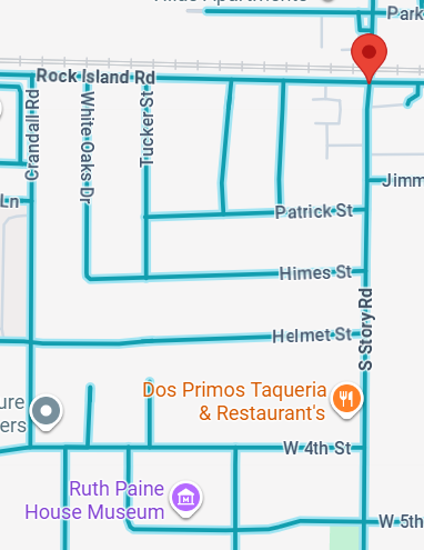
In 1963, Taylor’s Shell Station (Red Pointer on below map) was less than a ½ mile from 2439 W. Fifth (Frazier’s sister’s house) and 2515 W. Fifth (Ruth Paine’s house in purple, lower left on map). It was the closest gas station to either residence:
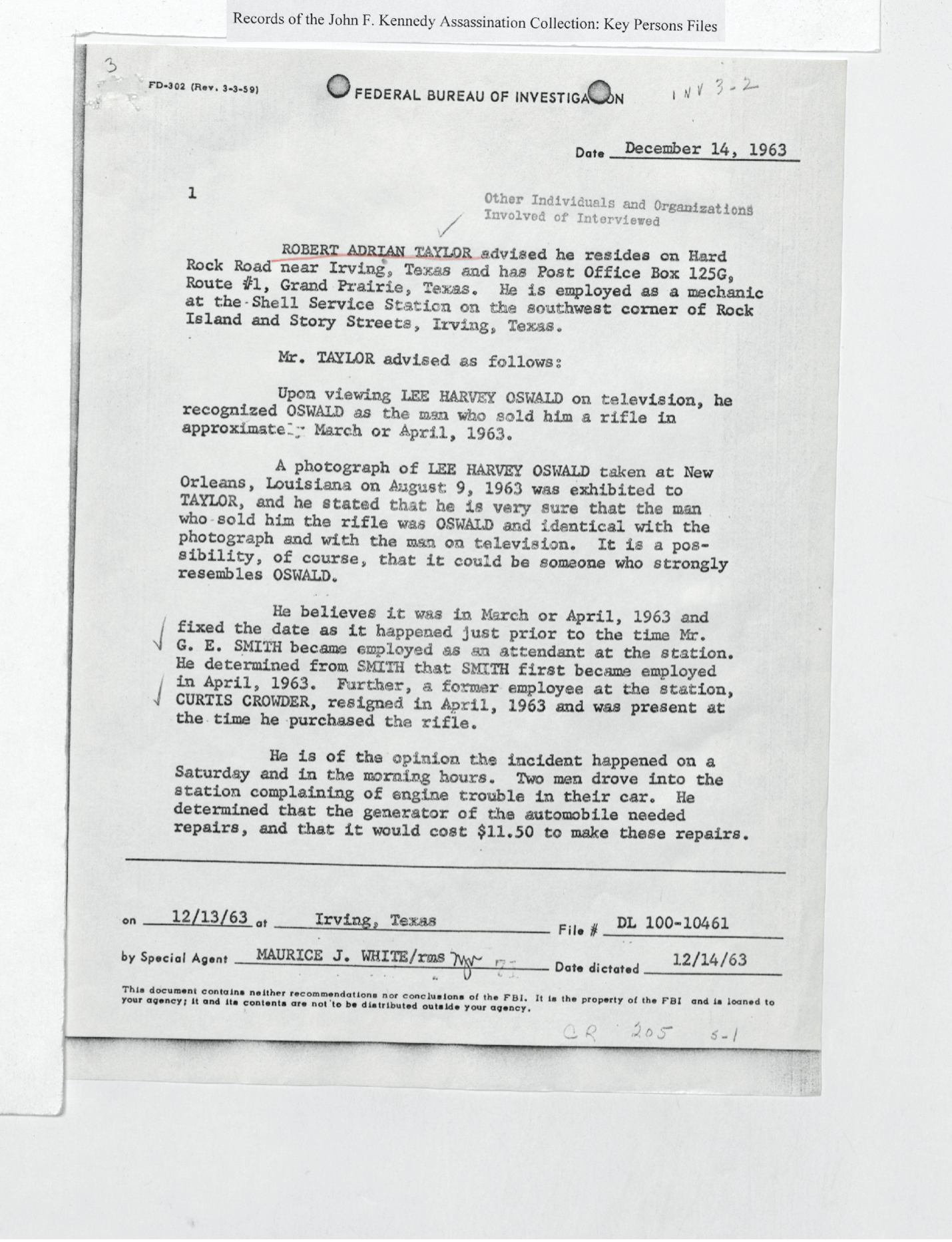
Oddly, of the first critics of the Warren Report, only Sylvia Meagher dealt with the Taylor issue at any length. (Accessories After the Fact, pp. 356-59) Meagher noted that the Warren Commission dismissed Robert Taylor’s claim that “Oswald” sold him a U.S. Army rifle in late March or April of 1963 in lieu of payment for repairs on a car in which “Oswald” was a passenger. The Commission admitted that a second employee (Curtis Crowder) witnessed the transaction at the Shell Station, and although the passenger resembled “Oswald” slightly, he was not “Oswald”. But as Meagher noted, the FBI showed Taylor a photo of “Oswald” on December 14, 1963, and Taylor was certain that it was the same man. Although the WC called a third service station employee (Glenn Emmet Smith) as a witness to Taylor’s veracity-- which he vouched for--they never called Taylor himself.
IV
Instead, the Commission asked the FBI to re-interview Taylor. At this second interview, Taylor recounted a long story about possibly seeing the same “Oswald” again some weeks after the rifle transaction, only to realize belatedly that it could not have been the same person he first met. The Commission then took Taylor’s statement “that it couldn’t have been the same man” completely out of context. They implied that Taylor had retracted his identification of the original man from whom he’d bought the rifle in April 1963: Oswald. No, what Taylor retracted was the identification of the rifle-selling “Oswald” with this second man who came to the station weeks later. The Commission knew perfectly well what Taylor meant, but they were determined to mislead the naive reader.
So the Commission played games with witness statements. We all know that. Nothing new here. But what the Commission did not do is both telling and suspicious.
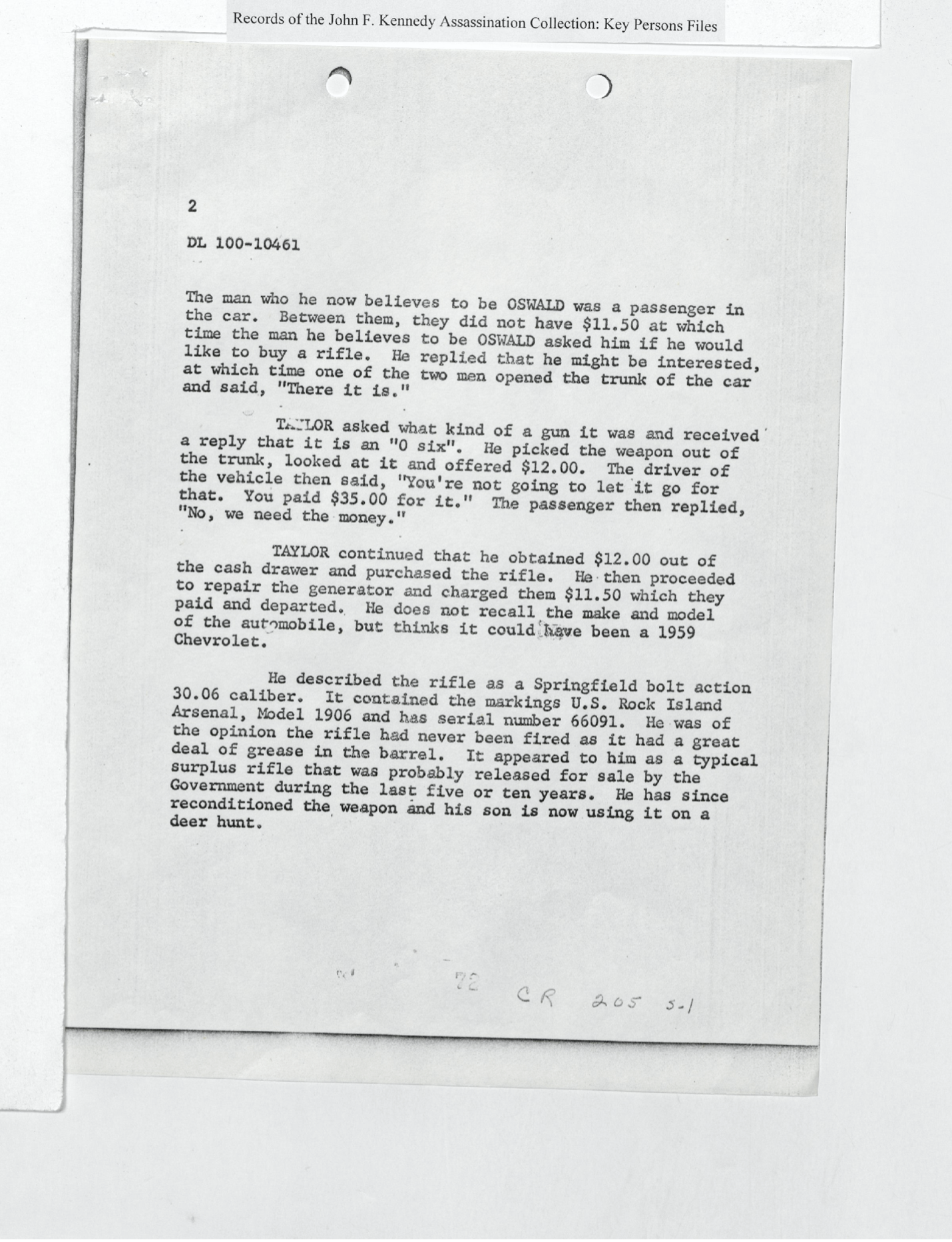
The Commission could simply have ordered the FBI to trace the rifle Taylor bought from this mysterious “Oswald”. Taylor described it to a tee, including the serial number. Taylor could have produced it for the Commission, but they wanted no part of that. If that rifle had no connection to any “Oswald”, then the Commission’s assertion of mistaken identity would have been definitive. But perhaps select members of the Commission suspected Taylor wasn’t mistaken, but that the rifle seller was someone the Commission wished desperately to avoid.
Curiously, the Commission withheld the original FBI/Taylor interview of December 14, 1963 from any of its published documents. In 1967, a frustrated Sylvia Meagher could only guess why. But we don’t have to guess. And look at the other description in that interview! Look what kind of problems that unknown driver had with his Chevy. No wonder the Warren Commission refused to publish this interview about a rifle sale involving an “Oswald” in Irving in April 1963, ½ mile from both the Ruth Paine and Linnie Mae Randle residences!
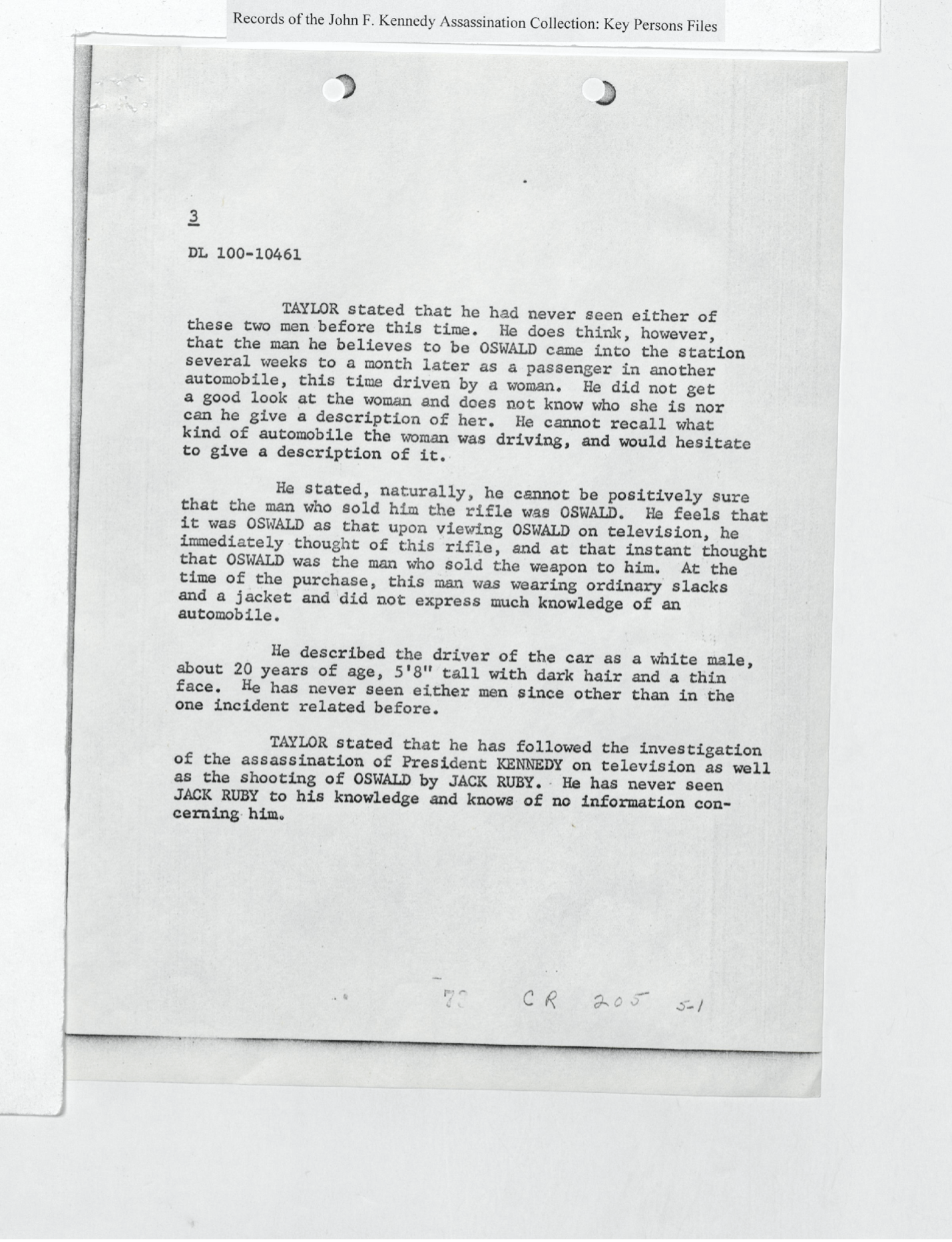
Here it is, the suppressed FBI interview with Robert Adrian Taylor from December 14, 2963. (Well worth reading in full):
V
For 63 years, this incident has generated little scrutiny from the critical community, other than speculation about the “Oswald” figure.
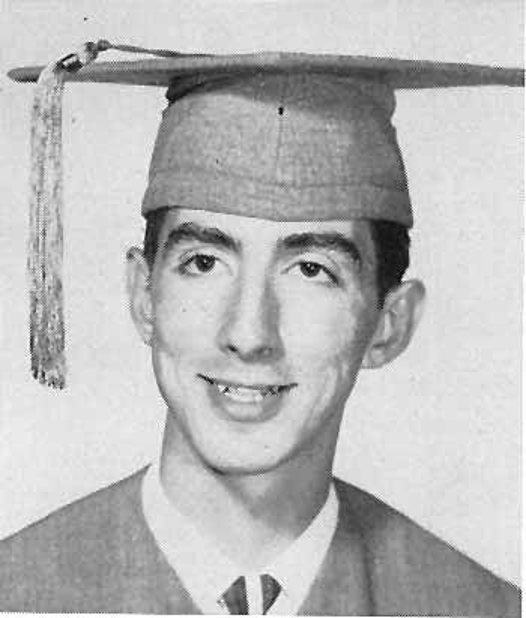
But this particular car back in March or April was maybe a “1959” Chevy with a generator that needed repairs. The driver, according to Taylor, was “about” 20 years of age, 5’8” tall with dark hair and a thin face.
Buell Wesley Frazier’s high school graduation photo from 1962 when he was 18:
As previously noted, Frazier drove a 1954 Chevy - with generator problems. Famously, he had to sit in his car for a few minutes after arriving at work on the morning of Friday, November 22, 1963, at the TSBD so that he could . . . recharge the battery in his car, which otherwise would not likely have started up later that afternoon.
Notice that Taylor remembered the driver berating the passenger’s willingness to sell the rifle for such a low price, when he paid $35 for it originally:

Again, because of the Commission’s failure to order the FBI to trace Taylor’s rifle, we can’t be sure what it was. I think it was probably this:
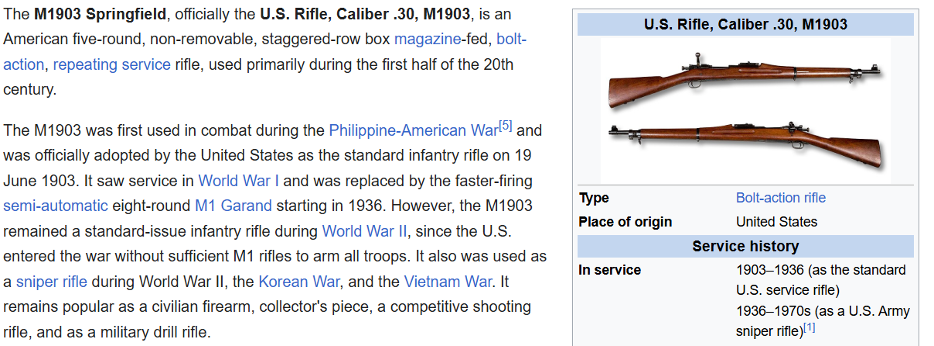
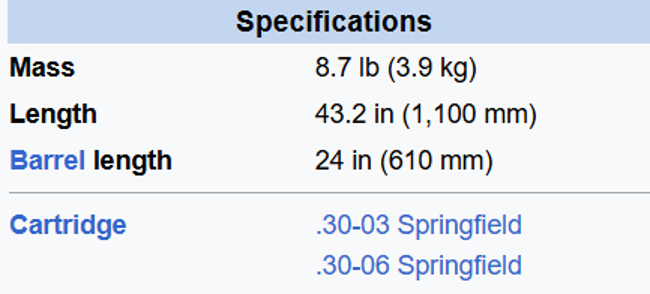
Note that this popular rifle fired a Springfield 30.06 round:
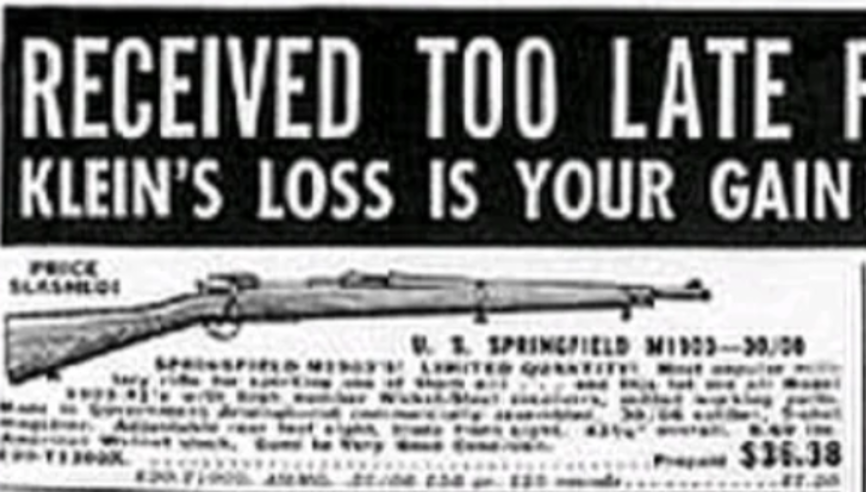
So what did surplus Springfield rifles sell for in 1963? Was the $35 price that Taylor overheard accurate?
Well, according to this 1963 ad from Klein’s Sporting Goods, it sure was!
Did Robert Adrian Taylor misremember the year of the Chevy (1959 vs 1954) with the faulty generator on which he worked some nine months earlier? Maybe, maybe not. But thanks to the Warren Commission’s deliberate malfeasance here, we can’t say for certain.
We can say, however, that the Commission deliberately suppressed Taylor’s description of a driver and a car which just may have corresponded with a real person and a real car in that very neighborhood, only a few blocks away from this Shell Station.
Did any Warren Commission attorney ever ask Frazier where he would go to get his Chevy with battery problems serviced? Had he ever been to that Shell service station in Irving? Not that I can tell.
Was it all yet another “coincidence” that some random “Oswald” lookalike and a person with suggestions of Frazier were riding around together in the same model car with battery problems in Frazier’s own immediate Irving neighborhood, but who were neither “Oswald” nor Frazier? Would that be probable?
Frazier wrote nothing about this suggestive coincidence in his 2021 autobiography. And again, as far as I can tell, he has never addressed it at all in 63 years.
Frazier wrote that he had never met his TSBD co-worker “Lee” until October 1963, and I believe him. That man, who Frazier claimed in his memoir he knew only as “Lee,” was NOT the “Oswald” of the Taylor rifle transaction back in April. There is little doubt in my mind that the FBI should have questioned Frazier about the incident. And further, they should have had Taylor look at a photo of Frazier.
Incidentally, trace evidence that this other “Oswald” was known to Roy Truly - “the bossman”- can be found in this strange exchange in Frazier’s Warren Commission testimony:
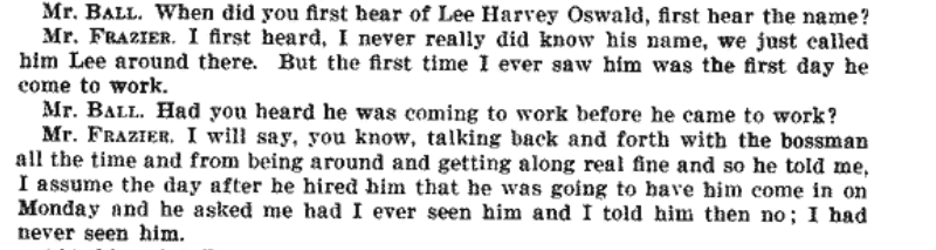
“He asked me had I ever seen him and I told him no; I had never seen him.” Which seems like a curious question for Truly to ask.
In any event, I believe the evidence suggests this unknown “Oswald” lookalike befriended Frazier, however briefly, by the spring of 1963 in Irving. It seems unlikely the April rifle transaction had anything to do with the November presidential assassination. Indeed, bizarre as it may seem to modern readers, buying and selling a rifle from the trunk of a car at a gas station from a stranger in Texas, back in 1963, was standard practice. The “Oswald” lookalike clearly wanted that Chevy fixed, and was willing to sell a surplus rifle at a discount to get that car (Frazier’s car) back on the road.
VI
To sum this up, I think all of this suggests the following: Frazier may have come to Irving by the spring of 1963 and was hanging around with someone who much resembled our “Oswald”, but was not the infamous accused assassin. The evidence shows that Frazier was impersonated by name at the Sports Drome Rifle Range in the company of a second “Oswald”. The evidence shows that someone inside the Dallas Police tipped off the national media that the rifle “found” in the TSBD was identical to Frazier’s own rifle, information which could only have come from someone close to Frazier himself. The evidence indicates Frazier was likely a party to a rifle sale in Irving in the spring of 1963 (however innocent), involving an “Oswald” lookalike.
This other “Oswald” likely was the person who tipped off the conspirators about Frazier so that he could be framed in advance. Frazier might know who this man was. If all of these are just giant “coincidences”, then why has the subject never addressed any of these, not even in his own definitive 2021 biography? Further, why has Frazier never been asked?
Let us close with a couple of curious excerpts from Frazier’s book. There he states that some declare: ”Buell knows more than he’s letting on.” He then replies with, “Guess what, You’re right.” He writes that, after the shooting, he walked down toward the grassy knoll area. He paused and turned back toward the Texas School Book Depository. He saw a man with a rifle approach him. He was staring right at him. Frazier said, “Don’t worry. I didn’t see anything.” And he described what the man was wearing in detail. He then wrote that the man opened the trunk of his car and laid down that rifle, which joined a pump shotgun there. He then heard the car drive away. (Steering the Truth, pp. 162-63)
If that is not enough to raise your eyebrows, how about this? The next day, as he walked outside, his sister yelled at him: “There’s a man down there in a car.” He looked down the street and saw a man getting out of a four-door Ford. In his hand was a rifle. Frazier later concluded that the man was there to kill him. (ibid., p. 164)
Why?
