George de Mohrenschildt’s Final Interview: Part 3
Scattered Puzzle Pieces are Fitted Together
The Other Backyard Photo, the General Walker Assassination Attempt, Epstein’s Bugged Hotel Room, and a Chilling Final Comment from George
Day Two: March 29, 1977 (Continued)
Hunter of Fascists - ha-ha-ha!!!
by Dan Carbone
As the second day of interviews continued, Epstein asked if George had any documents related to Oswald that he might be interested in. Epstein had heard from a close friend of George, a Col. Orlov, about a particular photograph that George had in his possession. A copy of the famous photograph of Oswald with his rifle allegedly taken by Marina and seen by millions on the cover of Life Magazine. But George’s copy was unique. It was signed on the back to him by Oswald himself, “To my friend, George,” and dated April 5, 1963. Another inscription in Russian read, “Hunter of Fascists – ha-ha-ha!!!” It has been speculated that Marina wrote this, but she denied it, and because the inscription was traced over by someone unknown, making identification impossible, it has never been conclusively determined who wrote it.
After George’s death, Oswald’s signature was authenticated by an HSCA handwriting expert in 1978. The HSCA also determined it was a first-generation photo made from the original negative on a professional enlarger.
It is this author’s opinion that George had initially hid the incriminating photo from the Warren Commission when he testified in 1964. George realized his Oswald-autographed photo, if revealed, would unleash a Pandora’s Box of trouble, instantly tying him to the alleged assassin, forever incriminating him as a suspected accessory. He couldn’t say he hid it or he would be accused of concealing evidence from the Warren Commission. He had to say he somehow “discovered” it later. For this, he needed to invent a vehicle to get the photo from Oswald’s possession to himself without knowing it. I believe George discovered that vehicle inside the Warren Commission Report.
During my own review of the Warren Commission witness testimonies, discussion about Marina’s record albums, which George lent to her to learn English, caught my eye, as I’m sure it did with George. Everett Glover, an oil geologist friend, testified about a record player and the record albums that George had lent to Marina that were given to him by Michael Paine (estranged husband of Ruth Paine, whom Marina was living with at the time) to store for George after the Oswalds returned them when Oswald moved to New Orleans. George was in Haiti at the time. George testified before the Commission about the albums as well, stating he presumed they were still with Marina’s possessions.
However flimsy, George found his vehicle of transport. The albums were the only items that had once been in possession of the Oswalds that had since been returned to him, and that was all that was needed to put together a tale that the albums somehow mysteriously ended up in George’s storage unit when he and Jeanne returned from Haiti to Dallas in 1967. And the shocking, never-seen signed photo fell out of one of the albums like some sort of gift from Oswald from the beyond.
Yes, George fabricated a story, but within that fabrication, he left a very big clue. He knew full well the chain of hands the albums passed through as they magically made their way to his storage locker. It’s as though he is saying, “Look not to me for the source of the photo. Look to all the others.” Follow the chain: The Oswalds… Michael & Ruth Paine… Everett Glover… nearly all who possessed the record album, supposedly containing the photo, had Intelligence connections. It’s also a nod to all those who believe the photo could have been doctored. It should also be noted there was no love lost between the de Mohrenschildts and Glover, who gave extremely unflattering testimony about them to the Warren Commission.
Michael Paine also withheld evidence from the Warren Commission, finally admitting in a 1993 interview that he had seen an 8x10 copy of the photo in the spring of 1963.[1] According to Ruth, she and her husband even met with George and Jeanne circa 1967, and they discussed the photo and, generally, of events.[2] If only one could be a fly on the wall for that conversation!
Unknown to Epstein, back in 1967, with his newly fabricated story of “finding” the photo, George wrote the editors of Life Magazine and told them about the photo, including a brief essay about his friendship with Oswald. Editor Dick Billings responded that he was interested and was coincidentally working on a story about the assassination and perhaps the photo could be incorporated.
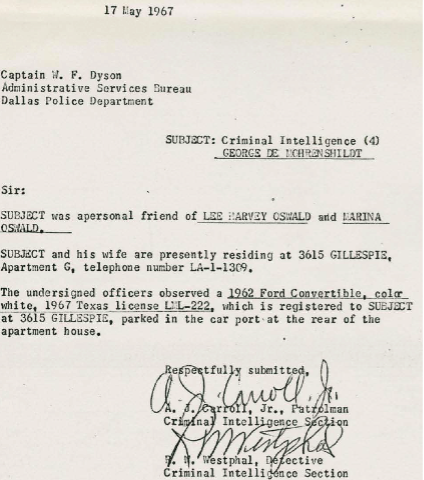
Shortly after, the de Mohrenschildts grew excited when a “Mr. Smith” called and identified himself as a reporter from Life. Smith recounted the conversations George was having with Dick Billings and asked if he could drop by the apartment for an in-person interview. George enthusiastically agreed, and Mr. Smith showed up shortly after with a photographer named “Mr. Fernandez.” Oddly enough, Smith didn’t seem to care much about the backyard photo, and while Fernandez snapped away, Smith mostly peppered the de Mohrenschildts with questions about Oswald. Finally, Smith showed the couple a series of photos of 20 Latin men and asked if they could identify any of them. They could not. Afterward, the reporter and photographer departed, promising they would contact them again soon. After waiting a while, George contacted Life and was informed that there were no such employees working there. Jeanne and George speculated that their apartment and/or phone were bugged.[3] And they were probably right. Not surprisingly, during this same time period, the FBI was once again following them, as evidenced by this “Criminal Intelligence” report dated 5-17-67 on George’s whereabouts:
Nothing ever came of the Life article.
George confirmed the photo’s existence to Epstein and indicated that he might now be willing to sell it to the Reader’s Digest, though it was currently in possession of his lawyer in Dallas. He told Epstein he’d somehow forgotten about the photo when he testified before the Warren Commission and had only rediscovered it upon returning from Haiti. Epstein later jumped all over George for this in his 1992 book The Assassination Chronicles, not understanding the absurdity of what he was writing:
Not only did I find this explanation self-serving – [George’s] prior failure to tell the FBI about the photograph could be construed as a possible obstruction of justice – but it also turned out to be untrue. Two of de Mohrenschildt’s friends told me that he had discussed the photograph, and the problems it raised for him, before he returned from Haiti…[4] [emphasis added]
George returned to Dallas from Haiti in late 1966. It’s one thing that George hid the obviously incriminating photo from the Warren Commission, but how about the two “friends” of de Mohrenschildt that told Epstein about the photo, one of which was Colonel Lawrence Orlov, and the other apparently unidentified. Both told Epstein they had discussed the photo “before he returned from Haiti.” Think about it. Lawrence Orlov, an army Colonel, knew a good friend of his had in his possession a photo signed to him by his President’s alleged assassin, and knew about it perhaps as early as 1964--and said nothing about it to anyone till he was interviewed by Epstein in 1976.
Or did he? As journalist Nancy Wertz Weiford later discovered, back in 1963 both Orlov and de Mohrenschildt were secretly reporting to CIA Chief J. Walton Moore about each other![5] Yes, in the world of espionage, no one is above suspicion, least of all one’s good friends. Intelligence memos reveal that in March, 1964 Orlov had even provided the FBI with one of George’s old resumes.[6] If so, how could he have not informed Moore about the photo? Perhaps Orlov kept his mouth shut because he already told what he knew. And since nothing came of it, years later he repeated what he knew to Epstein, hoping for some sort of action. George stated he did the same. Maybe everyone shut up because they were all already reporting back to the Government.
Crazily enough, Orlov, a retired military officer and oilman (yes, another oilman!) was overlooked by both the Warren Commission and the HSCA. His association with Oswald was considered brief and incidental, relying upon George’s Warren Commission testimony about him. As the HSCA put it, “No further information about Orlov was elicited.”[7] George told the Warren Commission that the first time he met Oswald, he was accompanied by Orlov. It wasn’t until 1976, when Epstein interviewed him, that Epstein found that Orlov’s recollection differed from George’s. Orlov insisted, “that the only time he accompanied de Mohrenschildt to the Oswalds’ home, the two were already well acquainted.”[8]
Epstein stated that on the morning of what would be his final interview:
de Mohrenschildt had promised to provide a fuller explanation for the photograph when he returned that afternoon – but he never would.[9]
One wonders what that “fuller explanation” would have been.
The General Walker Incident
In order to best understand George’s next disclosure to Epstein, one must take a dive into history. In the early ‘60s, General Edwin Walker was known as a right-wing segregationist. He had run for Texas Governor in 1962, losing to John Connally and was floating the idea of running for President. In October ’62, he was arrested for instigating a violent riot resulting in death at the University of Mississippi, and Attorney General Robert Kennedy had him institutionalized for a 90-day mental evaluation (unheard of now, this was a common tactic in those days). Walker was released after five days due to protests by the ACLU.
On April 10th 1963, Walker was injured by bullet fragments when someone took a shot at him through a window in his Dallas living room. Far-right forces considered this a broadside, an outright war between them and the Kennedy brothers, heavily contributing to the atmosphere surrounding the JFK Assassination a few months later. The Warren Commission later tied the Walker assassination attempt to Oswald. That Oswald would kill JFK, as well as the bizarre attempt to kill Walker (one of JFK’s arch enemies), was explained away by the Commission as yet another example of the wife-beating Marxist’s insanity and his lust for fame.
Much could be said about the events leading up to the Walker assassination attempt, and Oswald’s repeated engagement with his new “friends,” George’s far right, oil geologist buddies, whom I like to call “The Men from Magnolia”-- Magnolia Labs being an old subsidiary of Standard Oil)-- and the strange parties they held for Oswald to “get him out of his shell.” [10] Not to mention the contradictory eyewitness accounts surrounding the Walker incident because, as with everything else connected to Oswald, it’s a lot more nuanced than it would appear. But for the purposes of this article, we will stick with the next revelation George made to Epstein.
This much is known: something went down between Oswald and Walker, and George either knew about it beforehand, or, according to him, he simply intuited Oswald’s connection to it. With the back of Oswald’s photo personally autographed bearing the Russian inscription, “Hunter of Fascists – ha-ha-ha!!!” and Walker being the preeminent local fascist… well, one wouldn’t have to look far to put two and two together. Oswald inscribed the photo with the date April 5, 1963, only 5 days before the Walker assassination attempt.
According to Epstein:
[de Mohrenschildt] recalled that he had heard Oswald single out Walker as a "fascist" that should be dealt with, and, when one of the [Magnolia] geologists egged him on by talking of an assassination plot against Hitler, Oswald answered that Hitler should have been shot before he ever achieved power. He thus had a "pretty good suspicion who had taken the potshot" at Walker.
I interrupted. "So you knew Oswald had tried to assassinate Walker, what did you do about it?"
He said he immediately rushed over to Oswald's house to find out what had happened and if Oswald had disposed of the rifle. He recalled being very frightened, as was his wife, Jean. He feared that he could be implicated, and the CIA might cut off support for his Haitian contract. At risk, that night was the last time he ever saw Oswald. [emphasis added] [11]
The revelation is stunning in its implication. George had previously told the Warren Commission a story that he just happened to drop by to visit the Oswalds to drop off an Easter gift for their baby and blurted out, “Lee, how did you miss General Walker?” The reference to Walker was just a casual joke, and George was surprised at Oswald’s odd reaction to his joke. This new revelation made a lot more sense. It’s also revealing in that George’s first thought immediately after the shooting is not whether Oswald did it or not; he’s somehow weirdly sure of that. And to heck with General Walker, George wants to make sure that Oswald got rid of the evidence because this Walker business will screw up his impending Haitian Oil contract.
George went on to tell Epstein that he informed CIA man, J. Walton Moore, about Oswald and his rifle both before and after the shooting.
Quoting Epstein:
Were you in contact with Moore at the time of the Walker shooting in April 1963?” I asked. [George] said he told Moore about the dated photograph of Oswald with his rifle and pistol shortly after Oswald’s wife gave it to him.[12] […] He said, after a long, almost painful hesitation, ‘I spoke to the CIA both before and afterward. It was what ruined me.”[13]
Then Epstein makes the understatement of all time:
[…] if Moore passed this information to his superiors at the CIA before the Kennedy assassination, and the CIA did not inform the FBI, it might have proven embarrassing for the CIA. [14]
So there you have it. It would be impossible for George to explain the backyard photo without implicating Moore, who was the conduit to his Haitian oil contract with ultra-paranoid Papa Doc Duvalier. The Haitian government sum being offered was potentially life-changing for the eternally cash-strapped George. How could he risk that? And why does Epstein put the entire blame on George when, according to him, he just told him he reported the photo and Oswald’s diary immediately to the CIA? If so, wouldn’t the CIA be even more responsible for handing over their evidence to the FBI and the Warren Commission? George, perhaps seeing the CIA did nothing and not knowing exactly what to do, wisely kept his mouth shut, as mentioning it would further incriminate himself. After all, who would back him up? He was protecting his allegiance to Moore (as apparently was Orlov). First comes first in the land of Intelligence.
George’s Final Chilling Comment about Judge Chillingworth
George’s final comment as the meeting broke for lunch and he returned to the Manalapan mansion was related by Epstein in a Newsweek article in 2015, yet oddly missing from his books:
Then, at around 1 p.m., we broke for an hour for lunch. De Mohrenschildt drove back to Manalapan. As he departed, he told me with a wry smile that the town was best known for the mysterious disappearance and murder of Judge Curtis Chillingworth in 1955.[15]
As you are probably wondering, Municipal Judge Joseph A. Peel Jr. was convicted in April 1961 of hiring 2 mobsters to kill a rival, Judge Curtis Chillingworth, because Chillingworth had earlier threatened him about Peel’s underworld contacts. In other words, Chillingworth was eliminated because he knew too much. When he threatened to reveal what he knew - poof! He was gone.
A Bugged Hotel Room
When George departed, Epstein noticed George had left his black address book behind and mentioned it to his assistant Nancy. Epstein, as per usual, later annoyingly offered piecemeal tidbits about what happened next scattered across his various books and online diaries. Fortunately, in a 2012 interview on The Education Forum with Mark Gorton, he finally gave what I believe is the most complete version of the story:
[Epstein stated] there was a knock at the door. Ed said he knew exactly what the knock was. He said he knew it was George coming back to get the address book. So Ed went to the door, address book in hand and wordlessly handed it to George, who went off to lunch […] George did not come back to interview with Ed, but the police and local district attorney came after the death. Ed said that the only thing that the district attorney [David Bludworth] wanted to know was about the address book. Ed said that he and his assistant were repeatedly questioned about where they had the address book, but they were asked few other questions. The implication of this is that Ed's hotel room was bugged, and that someone was listening in on his interviews.[16] [emphasis added]
In Part 4 of this series we examine George’s suicide on the afternoon of his 2nd day of interviews and the aftermath, as well as Edward J. Epstein’s obfuscations and his final curveball.
(Editor’s note: deMohrenschildt might have thought that Oswald took a shot at Walker, but the evidence does not back that up. The original projectile, as reported by the police, was a 30.06, and the best witness, Kirk Coleman, saw two men leaving the scene after the shooting in cars.)
Click here to read part 1. (Part 4 coming soon)
_________
-
Jeff Carter, A new look at the enigma of the backyard photos, Part 5 (kennedysandking.com Sept 11, 2015)
-
Ruth Paine, Orleans Parish Grand Jury Testimony (April 18, 1968) pp 7-8
-
Nancy Wertz Weiford, The Faux Baron, (Lumiere, 2013) pp 545-549
-
Edward J. Epstein, The Assassination Chronicles, (Carroll & Graf Publishers, 1992) pp 560-561
-
Weiford pg 310
-
FBI Memo 3-4-64 copy of “Education and Professional Record” given to Orlov “about 1958.”
-
HSCA Vol XII p 62
-
Edward J. Epstein, Legend: The Secret World of Lee Harvey Oswald (Reader’s Digest Press/ McGraw Hill, 1979) pp175-176
-
Edward J. Epstein, The Assassination Chronicles, (Carroll & Graf Publishers, 1992) p 561
-
Edward J. Epstein, Legend: The Secret World of Lee Harvey Oswald (Reader’s Digest Press/ McGraw Hill, 1979) p 205
-
This quotation was downloaded from Epstein’s now defunct website. Although there is a version of it in his Assassination Chronicles on p 560 it frustratingly eliminates the sentence about George protecting his CIA contacts.
-
Epstein, Edward J. The JFK Assassination Diary: My Search for Answers to the Mystery of the Century (EJE Publications. Kindle Edition) p 77
-
Edward J. Epstein, The Assassination Chronicles, (Carroll & Graf Publishers, 1992) p 27
-
Epstein, Edward J. The JFK Assassination Diary: My Search for Answers to the Mystery of the Century (EJE Publications. Kindle Edition) p 77
-
Edward J. Epstein, O'Reilly's JFK Reporting Was Impossible. I Know Because I Was There (Newsweek, 3-9-15)
-
Mark Gorton, Ed Epstein's tale of George De Mohrenschildt's last day,(The Education Forum, 7-8-12)
