Angleton’s Slip: Did the National Security State
Assassinate Jack Dunlap?
Part 3: Later Revelations
By James Nicita
This is the third installment of a four-part series exploring a question generated by an apparent slip former CIA director of counterintelligence James Angleton made in his secret 1975 Church Committee testimony. Namely, whether Sergeant Jack Dunlap, the National Security Agency (NSA) courier who allegedly committed suicide after several years spying for the Soviet Union, was actually assassinated.[1]
Part 1 of this series examined the contemporaneous media accounts of the Dunlap spy scandal. Part 2 reviewed available agency records from the period, and some later commentary on and analysis of these records, to discern the story behind those initial contemporaneous media accounts. While these records revealed a more complex story than the one presented in those contemporaneous news stories, it became evident that an even deeper story lurks in the still classified and undisclosed records.
The remaining installments address later revelations regarding the Dunlap case, concerning 1) whether Dunlap betrayed Colonel Oleg Penkovsky, an American mole within Soviet intelligence; 2) the Church Committee’s interview of CIA official William King Harvey; and 3) Dunlap’s access to the CIA.
I. Did Dunlap Betray Oleg Penkovsky?
A week after former CIA director Allen Dulles died in 1969, the syndicated columnist Flora Lewis revealed, in her words, a “story not previously told:” It was Jack Dunlap who provided the Soviets with information that allowed them to pinpoint Colonel Oleg Penkovsky as the most important Western mole within the Soviet government.[2]
In the immediate aftermath of Dunlap’s death and exposure as a spy, CIA director John McCone had internally expressed precisely such a suspicion.[3]
Penkovsky became known as “The Spy Who Saved the World,” as Jerrold Schecter and Peter Deriabin entitled their book. The nickname derives from the decisive role Penkovsky played during the Cuban Missile Crisis. He provided the U.S. with plans and descriptions of nuclear missile launch sites in Cuba, as well as critical information on the weaknesses of Soviet nuclear weapons capabilities that undercut Soviet premier Nikita Kruschev’s bluster. Penkovsky was arrested during the missile crisis, on October 22, 1962, and executed in May 1963.[4]
Since Flora Lewis’s disclosure, other writers have expressed doubt as to whether it was in fact Dunlap who betrayed Penkovsky. Those who acknowledge the possibility, but minimize its likelihood, rely on a mostly-declassified internal CIA study by one of Penkovsky’s CIA handlers, Leonard McCoy, who wrote:
[T]he major task was to prepare and translate messages passed by Penkovskiy [sic] in Moscow. The processing occupied about a dozen officers, who turned it over to the SR [Soviet Russia] Division Reports Staff for reproduction, registration and distribution. NSA established a special office for handling the most sensitive material, and this was one reason it did not fall into the hands of Sergeant Jack Dunlap, then employed as a documents distribution clerk at NSA. A number of Penkovskiy’s less sensitive, non-military documents were present in Dunlap’s home in May 1962 when investigators searched the premises after his suicide. While these documents would not likely have led to identification of Penkovskiy as the source, they would certainly have indicated to the KGB that there was a penetration of the Soviet Government with access to internally controlled documents.[5]
Aside from the patently incorrect date of May 1962 for Dunlap’s alleged suicide, there are other problems with McCoy’s account that engender skepticism, including 1) reference to Dunlap as a mere “documents distribution clerk” at NSA, when in fact – as discussed in Part 2 – he was a traffic analyst as well; 2) his “pilfering ring” – also discussed in Part 2 – gave Dunlap a broader access than that first understood; and 3) as described below, his access into McCoy’s own agency, the CIA, via his role as NSA courier to counterintelligence chief James Angleton’s staff; and, possibly, as NSA liaison to Division D. In other words, perhaps Dunlap had access to more information on Penkovsky than McCoy’s foregoing passage suggests.
Ultimately, it remains an open question as to whether it was Jack Dunlap who betrayed Oleg Penkovsky.
II. The Church Committee
A. William King Harvey’s Church Committee Testimony
As noted in Part 1, when Angleton made his slip before the Church Committee on June 19, 1975, it wasn’t the first time that the Committee had heard that Dunlap’s “suicide” might in fact have been an “assassination.” The Committee’s staff director, William Miller, had instantly confronted Angleton:
Mr. Miller. You used the term assassination.
Mr. Angleton. I meant suicide.
Mr. Miller. The word is interesting, because it is charged, as you know, that he was assassinated.[6]
Having thus now heard from multiple sources the possibility that Dunlap was assassinated, the Committee seems to have taken the possibility seriously. Because on June 25, 1975, only six days after Angleton’s testimony, the Committee confronted William King Harvey about Dunlap’s death during Harvey’s own secret Church Committee testimony. Harvey’s tenure as the director of the CIA’s ZRRIFLE assassination program overlapped with the period of Dunlap’s spying.
Harvey was questioned by Frederick A.O. Schwarz, the Committee’s chief counsel, who had been part of the panel questioning Angleton when Angleton made his slip.
Mr. Schwarz. Now, to your knowledge, has the United States ever assassinated a defected agent or a third country?
Mr. Harvey. You mean an American agent who has defected or doubled?
Mr. Schwarz. Yes.
Mr. Harvey. To my personal knowledge, no.
Mr. Schwarz. What about persons who are third country enemies of the United States?
Mr. Harvey. No.
Mr. Schwarz. You don’t know of any instance of the United States assassinating any person who is in the non-political leader category?
Mr. Harvey. I do not.
Mr. Schwarz. Let me put one name to you. Mr. Dunlop [sic], Sgt. Dunlop.
Mr. Harvey. I am sorry.
Mr. Schwarz. Okay.
Mr. Harvey. This has a very faint ring, that I may have heard the name. Perhaps you can tell me who he is and I may be able to answer.
Mr. Schwarz. A person who was passing secrets from the NSA to the Soviet Union.
Mr. Harvey. I do know of the Sgt. Dunlop case. Was he the one in Paris?
Mr. Schwarz. I didn’t think he was in Paris.
Mr. Harvey. Well, that may not be the person, but I do remember the Dunlop case, at least as a case, because for a period of time I was called in on a number of NSA cases on, if you will, if nothing else, on a consultant basis, and I know of no effort whatever on Dunlop or any other penetration agent of NSA or the entire NSA complement. And I would be somewhat surprised to find one.
But you can take that as an absolute flat statement.[7]
It is striking that Schwarz would pose such a direct question to Harvey, likely knowing full well that the inevitable response would be Harvey’s firm, blanket denial. So why even bother? Basic investigative attorney due diligence? Perhaps to catch Harvey in perjury should the Committee establish through other channels that Dunlap was assassinated and Harvey knew about it?[8]
1. Reasons for Skepticism of Harvey’s Church Committee Claims
Is there reason to be skeptical of Harvey’s “absolute flat statement” that there was no “effort” whatever against Dunlap? Biographer Bayard Stockton wrote that Harvey was quite proud of his evasive answers to the Church Committee. He commented, “They didn’t ask the right questions,” implying that he might have had some answers to more pointed questions regarding the Kennedy assassination.[9]
One example of Harvey’s evasions is his misrepresentation of his relationship to Dunlap’s agency, the NSA. In the foregoing passage, he stated, “I was called in on a number of NSA cases on, if you will, if nothing else, on a consultant basis.” In fact, Harvey was much more than a “consultant” to the NSA. He worked intimately with that agency, on an ongoing basis. The ZRRIFLE assassination program emerged out of, and was housed within, the CIA’s Division D. As described in Part 1, Division D’s so-called “second-story men” executed break-ins to steal encryption codes from foreign governments for use in NSA surveillance, received communications intercepts from the NSA, and had authority to conduct wiretaps abroad. Harvey ran Division D from 1959 to 1963, precisely overlapping Dunlap’s period of NSA spying.
Earlier in his Church Committee testimony, Harvey provided fairly detailed testimony on the operations of Division D within the CIA, but he omitted any reference to the division’s mission to provide communications codes and intelligence specifically to and for the NSA.[10] On the other hand, the day before Harvey’s testimony, the Church Committee had received from the CIA a summary of the ZRRIFLE program. Certain passages illuminate the relationship between Division D and the NSA, Dunlap’s agency:
Identification: The purpose of Project ZRRIFLE is to spot, develop, and use agent assets for Division D operations…
Objectives: The objective of this project is the procurement of code and cipher materials, and information concerning such materials, in accordance with requirements levied on the Clandestine Services, primarily by the National Security Agency…The project will be conducted by Division D with assistance from area divisions as needed….
Background: In response to the increasing requirements for the operational procurement of foreign code and cipher materials, Division D in 1960 began the spotting of agent assets as a developmental activity. During the same period, requirements from NSA became more refined and in many respects more sensitive. Because most stations are not equipped to conduct this type of operation and because of the desirability of completely control [sic] over this effort, it was determined that Division D, which is in closest touch with NSA on procurement requirements, could best conduct the activity.[11]
Unfortunately, having obtained this information, the Committee did not press Harvey on the extent and nature of Harvey’s own relationship with Dunlap’s NSA, or explore whether Dunlap may have had contact with Division D once Harvey had admitted knowing about the Dunlap case.
A second example of Harvey’s likely evasion, if not outright perjury, is his statement regarding Air Force officer Jack Ledford, who, Harvey said, was “a staff officer who worked for me in Division D at the time.” Reviewing his handwritten notes on the establishment of ZRRIFLE, Harvey explained that Ledford was an expert in electronic and communications intelligence, and had prepared an “R&D” – research and development – memo on the topic. Harvey claimed that the Ledford R&D reference demonstrated that “this was not a discussion strictly within the framework of either assassination as a specific, or assassination as a general problem,” or even with ZRRIFLE.[12] As Jack Reid argues in JFK Facts, however, Harvey very likely used Ledford’s “black” budgets for the CIA’s highly-secret aerial reconnaissance projects to fund the activities of ZRRIFLE, including assassination.[13]
2. Division D’s ZRRIFLE, the NSA, and Assassination: the “Dual Purpose”
The foregoing paragraph points to a critical point: Harvey consciously chose Division D to house the CIA’s executive action assassination program.
What was the connection?
As described in Part 1, Division D’s so-called “second-story men” executed break-ins to steal encryption codes from foreign governments for use in NSA surveillance. This program itself was called ZRRIFLE even before Harvey embedded the executive action program within it.
The blunt connection between Division D and assassination was that ZRRIFLE recruited European criminals to break into foreign government buildings to steal encryption codes for use by the NSA, and it anticipated recruiting from this same pool of criminals to conduct assassinations. In his Church Committee testimony, Harvey described his deputy Arnold Silver’s recruitment of the criminal QJ/WIN “for the spotting of individuals with criminal and underworld connections for possible multi-purpose use.” Harvey continued, “I might have considered the people spotted by WIN as possibilities” for assassination.[14]
As Jack Reid commented regarding Harvey’s Church Committee testimony:
Harvey’s own account to the Church Committee casts doubt on his claim that Ledford was not witting to the signals intelligence work Division D was undertaking, much less the assassination schemes.
The Committee found that ZRRIFLE comprised two different programs, one for assassinations, the other for signals intelligence. When committee counsel Fritz Schwarz asserted that the signals intelligence program was a cover story, Harvey mostly agreed.
Mr. Schwarz: Well, just a moment. Page 1 is a cover story, not the real story, the objectives –
Mr. Harvey: It is both.
Mr. Schwarz: But it does not recite as an objective, assassination or assassination capability.
Mr. Harvey: No, it does not.
Mr. Schwarz: Instead, it cites the obtaining of code and cipher materials
Mr. Harvey: Which, I would like to point out, was a perfectly legitimate objective and was not in a sense, a cover story except that if this project had gone so far as to the actual recruitment of any agent for assassination or the targeting of any target or the mounting of any operation, it would have been under this as a cover [Emphasis added] … It’s a cover in a sense, but it’s not a phony cover, in other words.
Mr. Schwarz: Dual purpose.
Mr. Harvey: It was a dual purpose.[15]
The Church Committee does not seem to have explored with Harvey whether the NSA – the beneficiary of the ZRRIFLE operations to obtain code and cipher materials – might have had information regarding ZRRIFLE’s assassination component; and if it did, whether Jack Dunlap might have gained access to that information, even if he never accessed Division D as a liaison between NSA and CIA.
If Harvey had in fact discovered that Dunlap had gotten access to information on the assassination program, and had passed or might pass that information to the Soviets, would Harvey have felt justified in assassinating Dunlap?
3. Harvey and Assassination as Policy
Immediately after probing Harvey about Dunlap, the Committee moved into questioning Harvey regarding assassination as policy. Harvey offered two instances in which authority existed for assassination.
The first was a direct and imminent threat to the survival of the nation. Here, assassination required the authorization of the president under his constitutional powers.
As to the second, Harvey continued:
The second category of case is the one where not the Constitutionally defined treason, but treason in the ethical sense is involved, and where a given individual is guilty of such treason, either has to be eliminated or one or more other lives of a great deal more worthiness and a great deal more value obviously has to be sacrificed.
I would not personally exclude assassination or any other technique as a proper weapon under such circumstances.[16]
Harvey initially hedged on whether someone like himself might be able to carry out the second category of assassination without presidential authority:
The second case, I think it’s a little fuzzier, and I am assuming in the second case that for obviously practical reasons that you do not do this in any event, no matter what the loss is or the potential loss, unless you have the capability of doing it carefully and well, successfully in the extreme, and preferably, if you will — again, a cliche, without attribution.
Now, if you are asking me to say that if we had given a hypothetical case, an American or American agent threat that we know either has to be eliminated, the next time, or seven very key agents within the Soviet Union on whose information we are dependent for our own security will die, if you’re asking me whether that should go to the White House or not, I honestly don’t know…[17]
When pressed by Senator Howard Baker, however, Harvey appears ultimately to have taken the position that for the second category, “treason in the ethical sense,” he did in fact have the authority to undertake assassination without presidential approval:
Senator Baker. In the second case, in the case where you have a less clear situation, where your own resources may be jeopardized unless certain actions are taken, it might be that the authority would be elsewhere and the desire to keep the President in a credibly deniable position might be advantageous?
Mr. Harvey. I think that is a fair statement of what belief is [sic]. I fudged my answer on that. I did it deliberately.[18]
Authority that was “elsewhere” might include the secret 1954 agreement between the CIA and then- Deputy Attorney General William Rogers. As described by author Larry Hancock in his book Nexus: The CIA and Political Assassination, the CIA believed that in certain instances its personnel simply could not be prosecuted for violations of criminal statutes without revealing highly classified information. “It would be left to the CIA to evaluate the possibilities of prosecution – informing Justice only if they indicated prosecution was possible without revealing secure information.” According to Hancock, the agreement had the effect of “allowing CIA officers the authority to give immunity to individuals for crimes up to and including murder.” (Emphasis in original.)[19]
Under Harvey’s “treason in the ethical sense” reasoning, he might have felt that the CIA had authority to assassinate Dunlap if, for example, it had information that Dunlap did in fact betray Oleg Penkovsky, resulting in the latter’s execution, and might have defected to the Soviet Union and betrayed other American assets if he was not stopped. Such alarm might have been triggered by global headlines that appeared the morning prior to Dunlap’s purported suicide: former NSA employee Victor Norris Hamilton had just held a press conference in Moscow to announce his defection to the Soviet Union.[20]
In such a case, Harvey might have considered any later perjury to the Church Committee completely excusable, considering the higher prerogative of ensuring that Dunlap’s assassination remain “without attribution.”
Beyond Dunlap, given how many people at the time believed that President Kennedy was a “traitor,” might Harvey have believed that the “treason in the ethical sense” reasoning gave him the authority to assassinate Kennedy himself?
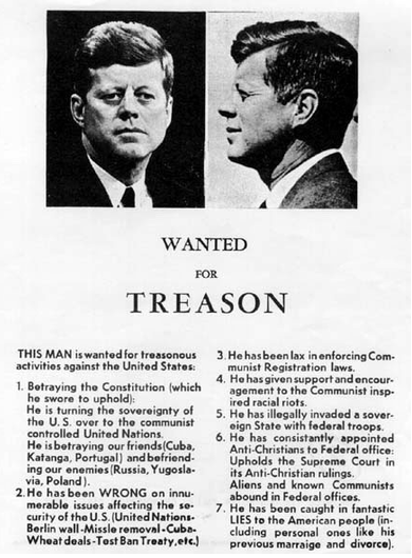
Larrie Schmidt “Wanted for Treason” poster.[21]
B. The Church Committee Final Report
Notwithstanding the Committee’s inquiries, Dunlap barely received mention in the Committee’s final report. In the first volume of the final report, he is briefly cited as an example of the practice of foreign intelligence services to recruit “agents in place” within an enemy’s intelligence agency:
Jack E. Dunlap, who worked at and spied on the National Security Agency (NSA) in the 1960s, is a well-known example of a Soviet agent-in-place within the U.S. intelligence service. His handler was a Soviet intelligence attache at the Soviet Embassy in Washington.[22]
The third volume of the final report includes a chapter entitled “National Security Agency Surveillance Affecting Americans,” which does contain a tantalizing nugget. The NSA’s Office of Security had over the years conducted four “surreptitious entries” without warrants. “The entries involved two defectors to the Soviet Union…an employee suspected of taking classified documents out of NSA, and an employee who had contact with an embassy of an unfriendly foreign power.”[23]
The latter two descriptions could each apply to Dunlap, although one can’t know for certain. If the NSA did in fact conduct a surreptitious entry against Dunlap, that would certainly change the perception of the Dunlap story as conveyed both in the public story described in Part 1 and in available agency records described in Part 2.
III. Jack Dunlap and the CIA
A. Dunlap and Angleton’s CIA Counterintelligence Staff
In Part 2, we introduced author Edward Jay Epstein’s 1989 book, Deception: The Invisible War Between the KGB and the CIA.[24] As its title implies, the book explores in detail the practice of national intelligence agencies in using sophisticated and elaborate means of deception against enemy agencies in order not only to prevail in warfare, but also to achieve national objectives and advantage without resorting to war.
Epstein relied heavily on Angleton for this book, and in the discussion that follows, one should keep in mind Philip Rexroth’s critique regarding how Angleton succeeded in influencing Epstein:
Journalist Edward Jay Epstein’s account (unwitting, in many respects) of his slow cultivation by Angleton in the years after his departure from the CIA is a fascinating demonstration of Angleton’s methodical exercise of effective influence…Epstein describes a years-long process in which Angleton provides just enough fragmentary information to encourage Epstein to continue his investigation into some of the most contested events of Angleton’s tenure, while channeling that investigation towards sources of information whom Angleton controlled or knew to be sympathetic to him personally or with his worldview…
The end result of the process led to Epstein embracing and defending the Angleton-friendly narrative in his book while being convinced that he had arrived at his conclusions through his own independent investigative efforts rather than having been led to them by Angleton himself.[25]
That said, Deception yielded important information regarding the Dunlap story that came from a credible source Epstein met independently of Angleton: Colonel Thomas Fox, former head of counterintelligence for the Defense Intelligence Agency in the 1960s.[26] As the following narrative relates, in responding to Epstein’s inquiries regarding a particular Soviet deception operation, Fox disclosed to Epstein that Dunlap gained access to Angleton’s CIA counterintelligence staff.
1. “The Telemetry Double-Cross”
From Angleton, Epstein learned about a key aspect of deception practice: feedback. Through a variety of means, whether technical surveillance or human intelligence – such as a mole placed inside enemy agencies – a national intelligence agency could receive feedback as to how the target agency of its deception practice was processing and reacting to received disinformation. Based on such feedback, the deceiving agency could adjust or calibrate the disinformation content and flow. This process was known as a “feedback loop.”[27]
Based in part on information from Colonel Fox, Epstein made the case that Jack Dunlap, as a mole within the NSA, was the Soviet Union’s source of feedback in a deception operation that for a time made the United States vulnerable to a surprise first-strike nuclear attack.
In the chapter entitled “The Telemetry Double-Cross,” Epstein described this early- to mid-1960s operation. The object was to deceive the U.S. into thinking that Soviet intercontinental ballistic missiles and nuclear warheads were very inaccurate. The aim was to manipulate the U.S. into “drastically underestimating the ability of the Soviet Union to produce intercontinental missiles that had the pinpoint accuracy necessary to threaten America's land-based missile force,” and thereby into believing that the Soviets had only a defensive deterrent, “since they could retaliate against American cities, but not a strategy for striking first and destroying American missiles on the ground which were…clustered in a half-dozen sites.”[28]
The Soviets employed three separate mechanisms to disseminate its disinformation. The first involved broadcasting false signals from the guidance systems of Soviet nuclear missiles. The Soviets equipped these missiles with redundant numbers of a key component of the guidance system, called an accelerometer.[29] The Soviets knew which accelerometers were generating accurate measurements. But multiple redundant accelerometers were broadcasting inaccurate data. This led a CIA task force studying the broadcasts into thinking that these accelerometers were inaccurate and unreliable, and that the Soviets were averaging accelerometer measurements. “The CIA thus found that the Soviets showed no intention of designing accurate missiles, a conclusion which fit in with what America wanted to believe about the Soviet Union.”[30]
Of course, the Soviets would not undertake such accelerometer deception unless they knew that the U.S. was monitoring the accelerometer data. The Soviets did know, Epstein wrote. First, “The Soviets had captured a large cache of their own telemetry data on a downed U.S. transport plane which had strayed over Soviet territory in 1957.” Second, two National Security Agency employees, Bernon Mitchell and William Martin, had defected to the Soviet Union in 1960. “Both had been working on telemetry analyses and no doubt told the KGB exactly how the United States intercepted Soviet telemetry.” The U.S. had been monitoring Soviet missile test launches through this telemetry, i.e., the measurement data broadcast back to Earth. Initially, this monitoring occurred via antennae installations in Turkey, Iran, and Pakistan. Later, the U.S. deployed signals satellites.[31]
The second means the Soviets used to disseminate their disinformation was human intelligence. A Soviet diplomat named Vadim Isakov, knowing he was being followed, led his FBI shadows to an arms dealer from whom he purchased accelerometers; Isakov was promptly arrested. The Soviet intent here was to get the U.S. to focus its attention on accelerometers, and it worked: the FBI asked its Soviet double-agent “Fedora” about Isakov’s mission. Fedora, who in fact was Soviet-controlled, fed the FBI the disinformation that “he had learned that Soviet scientists were having great difficulty gauging the exact moment to separate warheads from missiles. They needed to know, according to Fedora, how American scientists had solved this problem.”[32] Thus, human intelligence reinforced signals intelligence regarding the supposed inaccuracy of Soviet nuclear missiles.
The third disinformation mechanism was American satellite photo reconnaissance. Since World War II, U.S. photo reconnaissance experts had studied bomb and artillery craters to determine the accuracy of weapons. The Soviets would use bulldozers to fill some craters and excavate others so that American analysts examining photos of these craters would mistakenly conclude that Soviet missiles were inaccurate.[33]
Epstein wrote that the Soviets needed a source within U.S. intelligence to provide essential feedback as to how effective the deception efforts were.[34]
Here is where Colonel Fox comes in. To learn who this source might be, Epstein consulted Fox. Fox’s top candidate as a source until 1966 was Lieutenant Colonel William Henry Whalen, the intelligence adviser to the Army Chief of Staff until he retired in 1961. In 1966, Whalen was arrested and pleaded guilty to various espionage-related charges. At the time, Whalen was the highest-ranking American military officer ever to be convicted as a Soviet agent.[35]
Fox’s top post-Whalen candidate was Jack Dunlap.
________________
Part 4 coming soon. Click here to read part 1.
________________
-
James Angleton testimony, Senate Select Committee to Study Governmental Operations with Respect to Intelligence Activities (“Church Committee”), June 19, 1975, JFK Assassination System, U.S. National Archives, Record No. 157-10014-10005, p. 64.
-
Lewis, Flora, “Allen Dulles, CIA Father,” Chicago Sun-Times, February 6, 1969.
-
Memo from Daniel Brennan to William Sullivan, “Central Intelligence Agency – Director’s Meeting With J.J. [sic] McCone,” Federal Bureau of Investigation, September 11, 1963, JFK Assassination System, U.S. National Archives, Record No. 124-10325-10318, p. 6,
-
Schecter, Jerrold L., and Deriabin, Peter S., The Spy Who Saved the World: How a Soviet Colonel Changed the Course of the Cold War (New York, Charles Scribner’s Sons, 1992), pp. 347,
-
McCoy, Leonard, “The Penkovskiy Case,” declassified article from unidentified issue of Studies in Intelligence, CIA Records Search Tool (CREST), FOIA Electronic Reading Room, Central Intelligence Agency, p. 12
-
Angleton June 19, 1975 Church Committee testimony, p. 64.
-
William King Harvey testimony, testimony, Senate Select Committee to Study Governmental Operations with Respect to Intelligence Activities (“Church Committee”), June 19, 1975, JFK Assassination System, U.S. National Archives, Record No. 157-10002-10105, pp. 19-20.
-
Harvey was under oath during his testimony. Id., p. 2.
-
Stockton, Bayard, Flawed Patriot: The Rise and Fall of CIA Legend Bill Harvey (Washington, D.C., Potomac Books, Inc., 2006), p. 191.
-
Specifically, see Id., pp. 8-9.
-
Central Intelligence Agency, “Project ZRRIFLE,” undated summary, stamped “RECEIVED FROM CIA, JUN 24 1975,” by Senate Select Committee to Study Governmental Operations with Respect to Intelligence Activities (“Church Committee”), JFK Assassination System, U.S. National Archives, Record No. 157-10014-10109.
-
William King Harvey Church Committee testimony, June 25, 1975, Record No. 157-10002-10105, pp. 55-56;Senate Select Committee to Study Governmental Operations with Respect to Intelligence Activities (“Church Committee”) “Review and Meeting Summary,”p. 12, Record No. 157-10014-10102..
-
Reid, Jack, “From the JFK Files: How the CIA Channeled Money to William Harvey’s Assassination Program,” JFK Facts, December 9, 2025.
-
Harvey Church Committee testimony, June 25, 1975, p. 50.
-
Reid, Jack, “From the JFK Files: How the CIA Channeled Money to William Harvey’s Assassination Program,” JFK Facts, December 9, 2025, citing William King Harvey Church Committee testimony, June 25, 1975, p. 49.
-
William King Harvey Church Committee testimony, June 25, 1975, p. 23.
-
Id., p. 25.
-
Id., pp. 26-27.
-
Hancock, Larry, Nexus: The CIA and Political Assassination (Southlake, TX, JFK Lancer Publications, 2011), p. 17. Hancock also speaks of a so-called “death squad” within the CIA which, even before ZRRIFLE, claimed the authority to approve undertake assassinations. Hancock, Larry, and Simpich, BIll, “ZR/RIFLE: Origins and Realities,” JFK Lancer Conference, November 19, 2017, YouTube video, min. 37:20.
-
“Reds Claim Defection of Ex-NSA Man,” Washington Evening Star, July 22, 1963, p. 3.
-
Reproduced in SImpich, Bill, “Epilogue: A Path Toward Historical Resolution of the JFK Case,” The Twelve Who Built the Oswald Legend, October 1, 2020, Mary Ferrell Foundation.
-
Senate Select Committee to Study Governmental Operations with Respect to Intelligence Activities (“Church Committee”), Foreign and Military Intelligence, Book I, Final Report of the Select Committee to Study Governmental Operations with Respect to Intelligence Activities (Washington, D.C, U.S. Government Printing Office, 1976), p. 167.
-
Senate Select Committee to Study Governmental Operations with Respect to Intelligence Activities (“Church Committee”), Supplementary Detailed Staff Reports on Intelligence Activities and the Rights of Americans, Book III, (Washington, D.C, U.S. Government Printing Office, 1976), pp. 782-783.
-
Epstein, Edward Jay, Deception: The Invisible War Between the KGB and the CIA (New York, NY: Simon & Schuster, 1989).
-
Rexroth, Philip D., “Deception Unbounded: Counterintelligence and the Angleton Worldview,” American Intelligence Journal, Vol 35, No. 2 (National Military Intelligence Foundation, 2018) p. 48. (Citations omitted.)
-
Epstein, Deception, p. 172.
-
Id., pp. 30, 106-110.
-
Id., pp. 164-165.
-
“[A]ccelerometers act as a sort of high-precision gyroscope that, by measuring the pull of gravity, indicates exactly how fast an object is accelerating at any moment. From this information a computer can then calculate the object's precise position and speed. This is crucially important on missiles because it allows a computer to determine when to release the warheads, which then, with no further guidance, proceed by gravity toward their targets thousands of miles away.” Id., p. 165.
-
Id., pp. 165-166.
-
Id., pp. 165-166.
-
Id., p. 169.
-
Id., p. 170.
-
Id., pp. 171-172.
-
Id., pp. 172-173; Kenworthy, E.W., “Officials Say F.B.I. Agents Shadowed Spying Suspect From 1959 to 1961,” New York Times, July 14, 1966, p. 19; “Retired Colonel Pleads Guilty in Soviet Agent Plot,” New York Times, December 17, 1966, p. 14.
