
Angleton’s Slip: Did the National Security State
Assassinate Jack Dunlap?
Part 2: The Available Agency Record, and the Still-Hidden Record
By James Nicita
This is the second installment of a three-part series that explores a question generated by an apparent slip former CIA director of counterintelligence James Angleton made in his secret 1975 Church Committee testimony. Namely that Sergeant Jack Dunlap, the National Security Agency (NSA) courier who allegedly committed suicide after several years spying for the Soviet Union, was actually assassinated.[1]
Part 1 of this series examined the contemporaneous media accounts of the Dunlap spy scandal. This installment reviews the available agency records — with a focus on the CIA, the NSA, the FBI, and the President’s Foreign Intelligence Advisory Board (PFIAB) — to discern the story behind the headlines. The available records reveals a deeper and more complex story than the one presented in those contemporaneous news stories.
“Available” is an important qualifier. The research for this installment highlights just how much of the agency record regarding the Dunlap case remains classified and undisclosed, more than sixty years later. The larger truth of the Dunlap story likely lies in these secret documents. This article presents a summary of key still-classified documents, for possible use in future official declassification efforts, or for researcher Freedom of Information Act (FOIA) requests.
I. The Central Intelligence Agency: The Dunlap Resume
Although Dunlap was an employee of the NSA, it is useful to begin with the CIA, because in 2003 the latter declassified a document that provides a detailed summary of the Dunlap case.[2] Described in the text as a “resume,” the CIA has posted this document on its “CIA Records Research Tool (CREST),” otherwise known as the CIA “Freedom of Information Act Electronic Reading Room.”
Neither the document itself nor the CREST metadata provides context for the resume’s generation, except that it is “Attachment A” to another unknown document. It does not identify an author.
However, the document’s date provokes a double-take: November 22, 1963, the date of President Kennedy’s Assassination. As will be discussed below, this date suggests that the CIA’s Dunlap resume was Attachment A to the PFIAB’s own report on the Dunlap matter.
A. Dunlap in Sinop
One contemporaneous news report had mentioned, in passing, Dunlap’s service in Turkey. The CIA’s Dunlap resume, on the other hand, discussed it in detail; and in light of later revelations, this period emerges as central to the Dunlap case.
Sinop is Turkey’s northernmost town. It juts off of the Boztepe Peninsula, on the south shoreline of the Black Sea. Geographically, it was an ideal place to intercept signals communications from the Soviet Union, on the opposite shoreline. During the Cold War, the Army Security Agency (ASA) — the Army’s cryptologic and signals intelligence agency — maintained a site at Sinop to do just that, on behalf of the NSA.
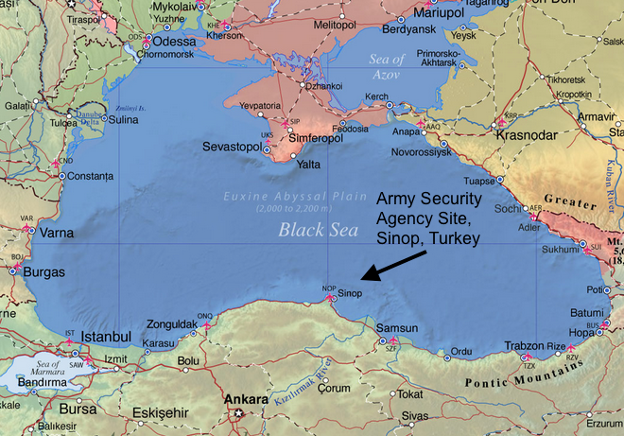
In 1957-1958 Jack Dunlap was stationed at the Army Security Agency site in Sinop, Turkey, which intercepted military and intelligence communications traffic emanating from the Soviet Union on the opposite coast of the Black Sea. Map credit: Nations Online Project.
From April 1957 to March 1958, Dunlap worked as a utility foreman in Sinop. The ASA first granted Dunlap interim security clearance based only on a name check with various government security agencies, then granted him final Top Secret Cryptographic clearance based on a background investigation that yielded no adverse information. The Dunlap resume appears to confirm contemporaneous news reports mentioned in Part 1: the ASA evidently did not require Dunlap to submit to a polygraph examination.
Dunlap’s Sinop tenure ended when his efficient performance caught the attention and favor of the NSA’s chief of staff, Major General Garrison Coverdale, when the latter visited Sinop in 1958. After writing a letter of commendation on behalf of Dunlap, Coverdale arranged for Dunlap’s transfer to the NSA’s Fort Meade, Maryland headquarters as a utilities foreman. “Within a short time, Dunlap was assigned as a driver for General Coverdale, and was issued a National Security Agency badge on the basis of security clearances given to Dunlap by the Army Security Agency.”
Perhaps the most consequential passage in the Dunlap resume is also its most opaque. During Dunlap’s Sinop tour of duty, he “employed as maintenance man and interpreter an indigenous employee named Alex Klopstock — a man subsequently identified as being a Soviet intelligence agent in 1954 and reported as such by CIA to NSA in 1960.”
The Dunlap resume adopted the position that evidence of Dunlap’s spying for the Soviet Union did not emerge until after his alleged suicide. However, subsequent commentary and revelations recast the foregoing Klopstock passage as a veiled transmission of the actual truth: namely, that Klopstock was the first to recruit Dunlap as a spy. And that the CIA was aware of that fact at least as early as 1960, which contemporaneous press reports mentioned in Part 1 had given as the earliest beginning of the timeline of Dunlap’s spying for the Soviet Union.
For his 1989 book Deception, author Edward Jay Epstein interviewed a highly-credible source, Colonel Thomas Fox, former head of counterintelligence for the Defense Intelligence Agency during the late 1960s, about a range of matters including the Dunlap case. Based on Fox’s information, Epstein wrote that “Dunlap was a Soviet agent, having been compromised and recruited in Turkey in 1957.”[3]
In 2003, a newsletter for ASA veterans who surved in Turkey published the recollections of Jim Baker, a friend and colleague of Dunlap both in Sinop and at Fort Meade. Baker’s narrative provided clarification to the Dunlap resume’s confusing description of Alex Klopstock as “an indigenous employee.” Of course, “Alex Klopstock” does not sound like an “indigenous” Turkish name. Rather, Klopstock was “a blond-haired Eastern European,” according to Baker. “Because his physical appearance was so much different than the Turks, he certainly stood out. I learned much later, back in the States, that he was a Hungarian Intelligence agent who was assigned to learn about the mission at Sinop.” Later, Baker ultimately concluded that Klopstock had recruited Dunlap. “I believe that Jack Dunlap was targeted and recruited into spying for the KGB while in Sinop and working daily with [Klopstock] and not after he was assigned to NSA.”[4]
Finally, the Dunlap resume’s Klopstock passage, Epstein’s information from Fox, and Jim Baker’s narrative all dovetail with the following assertion from JFK assassination researcher Bill Simpich in his e-book, The Twelve Who Built the Oswald Legend: “CI chief James Angleton realized that Dunlap was a mole in 1959…”[5] (Emphasis added.)
Needless to say, if this provocative assertion is true, and Angleton knew that Dunlap was a mole during the entire time the latter was pilfering documents for the Soviets from the NSA’s Fort Meade headquarters, it begs the crucial question: just what did Angleton do about it?
The available agency record does not remotely answer this question.
B. Dunlap at NSA: More Than a Clerk/Messenger
The Dunlap resume also revealed a story deeper than the contemporaneous news reports mentioned in Part 1, in another aspect. These news reports described Dunlap as a lowly driver and clerk/messenger. He was more than that. During the period that Dunlap served as Major General Coverdale’s driver at Fort Meade, he also received on-the-job training as a “traffic analyst” with duties involving handling and analysis of intercepted communications from foreign governments and military organizations. In February 1960, and up to the end of his NSA tenure in May 1963, Dunlap served as such a “traffic analyst” in an NSA headquarters unit that processed intercepts of Soviet governmental and military communications.
Dunlap did, however, also act as a courier between his unit and other units with the NSA division in which he worked. According to the Dunlap resume:
He also visited the Central Files office to pick up for his division various dealing with U.S. and allied operations, military exercises, and other U.S. operations likely to stimulate Soviet signals intelligence efforts against the United States. These reference materials to which Dunlap had access included substantive U.S. intelligence operations. Sensitive collateral information to which he had access included reports prepared by the Department of State, the Atomic Energy Commission, the Defense Intelligence Agency, the Central Intelligence Agency, National Security Agency and intelligence elements of the military services. Dunlap was issued a National Security Agency identification badge which gave him access to various National Security Agency areas in which sensitive information is processed and stored. He was authorized to draw a key for the area in which he worked, and access to his assigned office also permitted him access to operational areas contiguous to his own.
In light of later disclosures, there appears to be a huge gap in the story presented by the Dunlap resume. This will be discussed in detail in Part 3, but as a preview, the Dunlap resume discloses only Dunlap’s work within the NSA’s Fort Meade headquarters. But this CIA document omits a critical fact that the CIA certainly knew, and which Colonel Fox later disclosed to Edward Epstein: that beginning in 1961 Dunlap was personally shuttling information between the NSA and Angleton’s counterintelligence staff at CIA headquarters.[6]
In other words, Dunlap was frequently at the doorstep of the very individual who in 1975 made a slip and told the Church Committee that Dunlap was “assassinated.”
Aside from the Dunlap resume, there is another noteworthy document in the CREST system, a memo entitled “Noteworthy Accomplishments of the Office of Security During Fiscal Year 1964.” The first listed accomplishment is the preparation of a damage assessment concerning CIA information, sources and methods that Dunlap may have compromised. This damage assessment appears to have never been disclosed and apparently remains classified.
II. The National Security Agency: The Carroll Report
Air Force Lieutenant General Joseph Carroll, director of the Defense Intelligence Agency, oversaw the internal investigation of the Dunlap affair for the NSA, known as the “Carroll Report on Security Review of Dunlap Espionage Case,” or simply, the Carroll Report.[7]
The bulk of the Carroll Report appears to be classified more than sixty years later. A partial copy held by Princeton University’s Seeley G. Mudd Manuscript Library includes none of the principal text, and only two of the appendices.
Here again, we have the benefit of Colonel Fox’s supplementary disclosures to flesh out the skimpy information contained in the publicly-available appendices of the Carroll Report. As noted, Fox served as the DIA’s head of counterintelligence in the late 1960s. It is possible that earlier in his career he served on DIA director Carroll’s staff in the preparation of the Carroll Report. Fox’s information appears highly credible and authoritative.
Two disclosures within the Carroll Report, as supplemented by Fox, are of interest to this discussion.
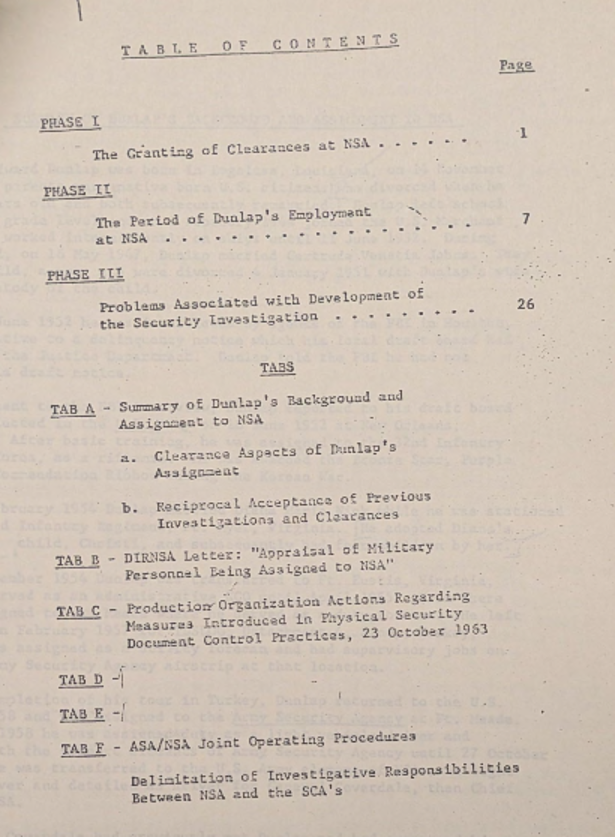
The table of contents of a copy of the Carroll Report held by Princeton University. The folder containing the report includes only Tabs A and F. It does not include the principal text. Note also that the titles of Tabs D and E are fully redacted.
A. Driving Coverdale and Watlington
Similarly to other sources, the Carroll Report describes Dunlap becoming a driver for NSA chief of staff Garrison Coverdale. The Carroll Report adds an additional name: a General Watlington. This was Major General Thomas Watlington, who succeeded Coverdale in 1960 and served as chief of staff until April 1961, and for whom Dunlap also served as a driver.[8]
None of the sources that describe Dunlap’s duties as a driver for the chief of staff, including the Carroll Report, ascribe any particular significance of this driver role in Dunlap’s espionage activities. Colonel Fox, however, told Epstein that the driver role was central to Dunlap’s spying:
Jack E. Dunlap was merely a sergeant in the National Security Agency. But he had access to the “kings of the kingdom” as the chauffeur for Major General Garrison B. Coverdale, the chief of staff of the National Security Agency. Fox explained that at NSA headquarters in Fort Meade, Maryland, where the total product of U.S. electronic interceptions — the data vacuum-cleaned from antennae in space satellites, naval spy ships, and planted listening devices in hostile countries — is processed and analyzed, security is based on preventing anyone from taking any data from the base. Everyone is searched at the gates — with one exception. As the driver of the chief of staff’s car, Dunlap was permitted to drive on and off the base without being searched. It was, according to Fox, the only vehicle that could leave the base without being inspected.[9]
The foregoing revelation from Colonel Fox has two profound implications. First, it significantly pushes back the initial date of Dunlap’s spying at the NSA. As detailed in Part 1, the contemporaneous press reports identified 1960 as the earliest date that Dunlap had commenced his NSA espionage. But by 1960 Major General Coverdale was long gone. According to the Carroll Report, Dunlap served as Coverdale’s driver from late October 1958 until Coverdale’s departure in August 1959.[10] Thus Dunlap’s spying potentially began up to two years prior to the date given by the press reports, which supports claims that Dunlap had been recruited as early as 1957 in Sinop.
Second, Fox’s information raises a mystery that neither he nor Epstein explain. If the no-inspection status of the NSA chief of staff’s vehicle was so fundamental to Dunlap’s ability to remove documents from NSA headquarters, what happened after Coverdale left? The Carroll report suggests that Dunlap continued on as Major General Watlington’s driver, but, as noted above, Watlington left in 1961.
The Carroll Report also said, “The records are not clear when Dunlap actually quit being a driver and commenced full-time duties as a traffic analyst with NSA.”[11] The Dunlap resume suggested the possibility that Dunlap continued driving chiefs of staff even after he started full-time as a traffic analyst: “Dunlap was formally assigned by the Army Security Agency to the National Security Agency as a ‘traffic analyst’ with additional duties as a driver for the general officer serving as the National Security Agency’s Chief of Staff.”
If Dunlap did not continue as a driver after Major General Watlington’s departure in 1961, then how was he able to get documents off the Fort Meade base between 1961 and 1963? It does not seem that his private vehicle would have had “no-inspection” status.
If Dunlap did continue as a driver for Watlington’s successor or successors, who were they? In particular, for whom would Dunlap have been driving at the time he came under suspicion, and at the time he was relieved of his duties at NSA?[12]
B. Dunlap’s NSA Pilfering Ring
The Carroll Report briefly mentions an episode in which a colonel, whose name is redacted, suborned Dunlap into pilfering NSA property for the colonel’s personal use. Thus, early in his tenure, “Dunlap had already had experience in circumventing NSA procedures under relatively high-level tutelage..”[13]
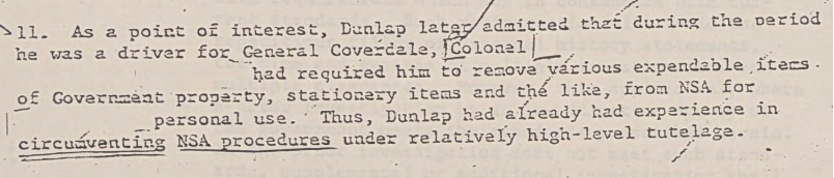
An excerpt from the Carroll Report describing Dunlap’s removing NSA property for the personal use of a colonel, whose name is redacted.
As detailed by Colonel Fox to Epstein, this initiation into petty theft expanded into an elaborate pilfering ring, with dire national security consequences:
Dunlap also opened up a small business which vastly increased his access. Since his car had unique “no inspection” status, he volunteered to help senior officers at NSA pilfer from the base various items, such as typewriters and furniture, which they wanted at home. At least six of the officers accepted the offer, and, with Dunlap’s help, continued smuggling articles out for at least two years…
…While pretending to be merely assisting his superiors get their effects off the base, Dunlap and his KGB controllers got virtually the complete run of America’s most secret intelligence base. The pilfering ring not only provided Dunlap with keys to offices and combinations to safes; it also gave him a plausible rationale for his after-hour visits. Dunlap was thus able to deliver to his Soviet contacts microfilmed copies of virtually all the instruction books, repair manuals, mathematical models, and design plans for the machinery used to encrypt American codes.[14]
Perhaps here we can add to Part 1’s initial catalogue of hypothetical motives for the assassination of Jack Dunlap, if that is in fact what happened: the NSA pilfering ring’s desire not to be exposed by Dunlap for theft or for — even if unwittingly — having abetted Dunlap’s betrayal of national security secrets. As Epstein put it, “The NSA pilfering ring could not be fully investigated because of [Dunlap’s] untimely death.”[15]
III. The Federal Bureau of Investigation: The Dunlap and Oswald Cases Intersect
If Angleton and the CIA did in fact know that Dunlap was a mole as early as 1959, they never communicated this fact to the FBI. Available FBI records suggest that the FBI did not get into the Dunlap case until after his death.[16] A notable aspect emerging from available FBI records is the intersection of the Dunlap and Oswald cases, in two instances.
A. Dunlap, Tophat, Oswald, and the U-2
Part 1 described the Kennedy administration’s efforts to suppress the Dunlap spy scandal, out of fear that its publicity would endanger ratification of the Limited Test Ban Treaty. A 1963 FBI memo reveals the agency’s belief that similar concerns over the test ban treaty negotiations prevented the FBI from learning about Dunlap’s spying prior to his death, and therefore from entering the case early enough to investigate it effectively.
The FBI had developed a source within the Soviet intelligence services who went by the codename “Tophat.” According to the FBI, in August 1963 — after Dunlap’s death — the CIA picked up a drop in Moscow left by Tophat that exposed Dunlap. Tophat wrote: “Most important agent Jack Edward Dunlap, 1 Gilmore Street, Glen Burnie, Maryland, at NSA. He came to Kostyuk himself in May, 1961.” Mikhail Kostyuk was the Air Attache at the Soviet embassy in Washington, DC from July, 1958 to August, 1962.[17] The FBI complained, however:
We have told CIA that Tophat may have loaded the drop as early as June, 1963. [I.e., prior to Dunlap’s death.] The delay in obtaining the communication prevented us from getting into the Dunlap Case well before the subject committed suicide…CIA was unable to service the drop until August because State Department adamantly refused to give CIA clearance to conduct any activity in Moscow. This position was taken by State because it felt that any operational activity might jeopardize the test ban talks.[18]
Later, a 1966 FBI memo indicated that Tophat disclosed to the FBI that Dunlap had provided information to the Soviets that enabled the latter to shoot down the U-2 flight of Frances Gary Powers on May 1, 1960.[19] Here is where Bill Simpich picked up the story, in his e-book The Twelve Who Built the Oswald Legend:
The story behind the shootdown of the U-2, and how it played into Oswald's decision to return to the USA
An NSA agent named Jack Dunlap now enters our story in a most dramatic fashion. "An extremely sensitive and reliable source" is quoted in an FBI letterhead memo that "Dunlap gave the Soviets important information regarding the U-2 flights over the USSR and that Dunlap's information provided the Soviet Union with the capability of shooting down the Powers U-2 aircraft...as a result of Dunlap's information, the Soviets were well aware of when the U-2 planes crossed over the Soviet Union. The Soviets always had their anti-aircraft guns trained on those planes." This source was known as TOPHAT. TOPHAT was Lt. General Dmitri Fedorovich Polyakov, exposed by Aldrich Ames - a real mole inside the CIA.
The FBI memo that recounts TOPHAT's story then adds that "Khrushchev held back from allowing them to shoot down the planes, waiting for an appropriate political time to do this. Khrushchev eventually "gave the okay" to shoot down the Powers U-2 aircraft at a time when he thought it would do the most good for Soviet prestige and at a time when he was being pressed by China to show their hand."
Dunlap succeeded in his mission even though CI chief James Angleton realized that Dunlap was a mole in 1959, a year before what is known as the U-2 affair. After Dunlap committed suicide in July 1963, and numerous classified documents turned up in his possession, his widow admitted to the FBI on August 20, 1963 that Dunlap told her before his suicide that he had been selling secrets to the Soviets.[20]
Simpich offered Dunlap’s role in providing information that enabled the downing of Powers’s U-2 flight as a contrast to Oswald. Notwithstanding Oswald’s stint as a radar operator tracking U-2 flights at the CIA’s Atsugi airbase in Japan, Simpich emphasized that Oswald did not, and could not, have information to offer the Soviets after his defection that would have enabled the latter to shoot down Powers’s U-2. Oswald’s purported possession of such knowledge was, instead, a necessary part of Oswald’s “legend” created by American intelligence. Simpich concluded that Alexander Ziger, Oswald’s friend and boss at the Minsk factory where he worked after defecting, and one of Simpich’s twelve who built the Oswald “legend,” was likely “a long-time American asset.” Simpich pointed out that on the very evening of the U-2 shootdown, May 1, 1960, Ziger advised Oswald to return to the U.S. At that point, Simpich wrote, “Oswald’s work in the Soviet Union was done.”[21]
B. Dunlap Distracts the FBI From Oswald
The Mary Ferrell Foundation archive contains the personnel file of Elbert “Bert” Turner.[22] In 1963, Turner was the Supervisor in Charge of the Officials Unit in the Soviet Section of the FBI's Domestic Intelligence Division at FBI headquarters in Washington, DC.[23]
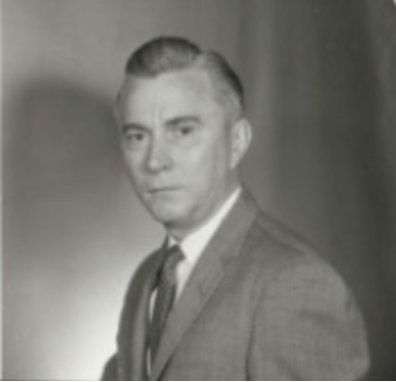
Elbert Turner, May, 1964 [24]
After President Kennedy’s assassination, Turner was one of several FBI agents identified for discipline for dereliction of duty in the weeks and months leading up to the assassination.[25] An extensive internal FBI review dated December 10, 1963 found as to Turner:
On 10/10/63 Central Intelligence Agency (CIA) sent teletype to Bureau advising Oswald in contact with Soviet Embassy in Mexico City. This was routed to Supervisor Elbert T. Turner of the Espionage Section to whom case then assigned, who initialed same and then took no action…it did not appear to him any action warranted…Inspector feels that Turner should have [advised interested offices] and also [should have] instructed field to intensify investigation in light of Oswald’s contacting Soviet Embassy, Mexico. Turner also failed to put subject on SI [Security Index], stating he did not feel that Oswald met criteria. Turner advised that although case assigned to him on 10/10/63 he did not review file until after assassination…[26]
What was Turner’s excuse? He blamed the Jack Dunlap matter. According to the internal review, Turner “explained that his preoccupation with the Dunlap Espionage Case precluded his reviewing complete file.”[27]
Recall from Part 1 that October 10, 1963 was the precise day that the Dunlap scandal erupted into international news.[28] This was also the precise day that the CIA teletype from Mexico City landed on Turner’s desk. On November 26, 1963, four days after to the assassination, Turner had explained to the internal investigators,
During this time the work on my desk was extremely heavy. The publicity on the Jack Edward Dunlap espionage case broke in the newspapers on 10-10-63 and for the next 3 or 4 weeks a major portion of my time was involved in handling that case…
…On receipt of the WFO [the FBI’s Washington Field Office] airtel dated 11-19-63 indicating a contact with the Soviet Embassy in Washington, I called the file for the purpose of reviewing it in detail and to analyze the case. The file had been received but had not yet been reviewed on 11-22-63.[29]
The December 10 internal review recommended that Turner be censured and placed on probation, which occurred on December 13 and lasted until March 19, 1964.[30]
The Warren Commission Report issued in late September blistered the FBI. Hoover complained, “Chapter 8 tears us to pieces.”[31] Some of the supervisory FBI agents like Turner thereafter came under renewed scrutiny for further discipline. During this subsequent investigation, Turner repeated his assertion that the Dunlap case prevented him from reviewing the Oswald file.[32] Turner endured particularly harsh discipline. He was again placed on probation, removed from supervisory responsibility, demoted from GS-14 to GS-13 with a corresponding pay cut, and ordered transferred from headquarters to the Washington Field Office.[33]
Turner then made a bold move. He appealed directly to Hoover, in a lengthy November 10, 1964 letter, which included substantive attachments.[34] Yet again, Turner relied on the Dunlap case in his accounting of his actions. He went so far as to detail some documentation regarding Dunlap that appears still to be classified or unreleased:
Dunlap Case – This case was assigned as a “special” to me in August, 1963. It did not relate to my desk. The investigation had been substantially completed by October 10, 1963 when publicity regarding Dunlap hit the newspapers. (Note that this was the same date of the CIA teletype in the Oswald case.) During the next 8 days I processed 21 incoming pieces of mail consisting of 49 pages and prepared 5 outgoing of 18 pages on this case which included a 11 page summary for the Director and a 2 page summary for Mr. Tolson.
Between October 18 and November 22 1963 I processed 37 incoming communications of 151 pages and prepared 7 outgoing of 9 pages on this one case.[35]
In closing his letter, Turner apologized for its length, but insisted, “[T]o me this is an extremely important matter. By implication I am charged with contributing to the assassination of the President.”[36]
Hoover was unmoved. His handwritten notation below Turner’s foregoing comment reads, “That is exactly what the Commission charged the Bureau with. This Supervisor was one of the chain of supervisors who failed.”[37] Hoover coldly wrote Turner on November 18, “This is to advise you that the Bureau does not propose to make any change at this time in the action taken in your case.”[38] Hoover finally lifted Turner’s probation on April 23, 1965.[39]
But, Turner did have one particular admirer, none other than James Angleton. In the same secret Church Committee testimony in 1975, during which Angleton slipped and said that Dunlap had been “assassinated,” Angleton said of Turner:
One of the best men [the FBI] had in my view is a professional man, Burt [sic] Turner…And Burt Turner was one of the finest men on Soviet KGB activities in the US, one of the analysts…And it is my understanding…that Burt Turner was handling the Oswald or related matters at the time the President made the trip down to Texas, and that there was some confusion that the Bureau had not turned over, or had not taken enough initiative in turning over, all the information on Oswald to the local police. I had been told that there was a black mark put against Turner’s name, and that he confronted Mr. Hoover and stated he was not going to permit, or have it be known to his children, that his negligence was responsible for the death of the President. And as a result, this was expunged or something to that effect.[40]
It would be interesting to know whether in 1963 Turner and Angleton had any discussions regarding Oswald and/or Dunlap prior to President Kennedy’s assassination.
IV. The President’s Foreign Intelligence Advisory Board – Kennedy Does Not Live to See Its Dunlap Report
When news broke of the Dunlap scandal, President Kennedy “called a meeting at the White House to go over the ramifications of the security leak.” One of the meeting’s participants was Clark Clifford, the chair of the President’s Foreign Intelligence Advisory Board (PFIAB).[41] Clifford would launch an investigation into the Dunlap case to culminate in a report for the president’s review and action.
Kennedy never saw the report. He was assassinated on the very day the PFIAB was meeting to discuss it.
The Dunlap story as contained in minutes of the PFIAB suffers from incompleteness, due to a significant records-disclosure issue. As will be noted, many of the minutes – even those released in 2025 pursuant to President Trump’s Executive Order 14176, have numerous relevant pages missing from them.[42]
On September 12, 1963, Angleton’s deputy Raymond Rocca appeared before the PFIAB to discuss the CIA’s counterintelligence program. Based on the recent Dunlap breach — regarding which, it will be recalled, the NSA had accepted Dunlap’s ASA security clearance, even though the ASA had never subjected Dunlap to a polygraph examination — the board queried Rocca on the nature and effectiveness of the CIA’s own personnel security program. After his disclaimer that such matters were the responsibility not of the Counterintelligence Division but rather the Office of Security,
Rocca endeavored to be of assistance to the Board in response to various members’ questions which he answered to the effect that (1) efforts to uncover a “Dunlap” in CIA would involve the personnel security and physical protective security measures administered by CIA’s Office of Security whose programs include thorough background investigations and the use of polygraph interviews, (2) the identification of a “Dunlap” in CIA might also result from the CI program carried on outside of the United States in an effort to cover foreign intelligence efforts to penetrate the United States.[43]
Rocca’s framing the security question as whether there might ever be a “Dunlap” inside the CIA is ironic in light of Colonel Fox’s information shared with Edward Jay Epstein, alluded to above and discussed in detail in Part 3, that Dunlap interacted with Angleton’s counterintelligence staff at CIA.
That is, if Fox’s information is true, then there was in fact a “Dunlap” inside the CIA…namely, Dunlap. Part 3 will discuss the CIA security question as it pertains to Dunlap.
Several pages are missing from the minutes of the September 12 PFIAB meeting. The foregoing quote from Rocca is on pp. 31-32. There is a subsequent p. 33, but then the page numbering jumps all the way to a p. 53, as if twenty pages of these minutes are missing. It is impossible to tell if these twenty pages may or may not include information regarding Dunlap.
The Dunlap case was the principal scheduled topic of discussion for the PFIAB meeting held on November 21-22, 1963. As the meeting agenda demonstrates, the first day, November 21, was devoted solely to Dunlap:
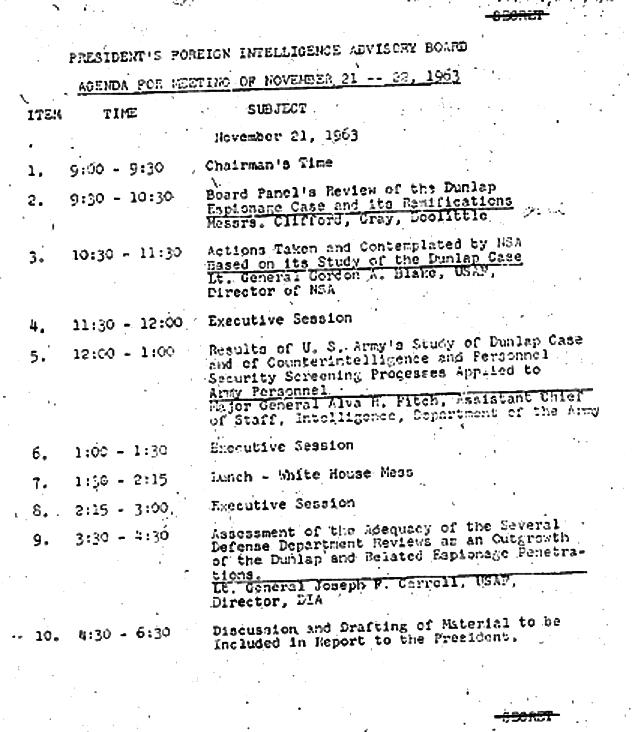
Agenda for November 21-22, 1963 meeting of the PFIAB.[44]
However, except for the first page, the actual minutes for November 21 are completely absent. The minutes for November 22 begin at p. 33, suggesting that 31 pages of the minutes for November 21 have not been disclosed. Even that one page of the November 21 minutes hints at the significance of that day’s discussion of the Dunlap case. Clifford said that the Board “was the only Government entity engaged in a detailed, full-time review of the counterintelligence and national security ramifications of the case…” and “...advised Board members that some of the facts involved are extremely sensitive and must be given extreme security.” Clifford then mentioned a communication from FBI director Hoover that appears to be a reference to Tophat. The 31 missing pages almost certainly include discussions of the respective studies referenced in the agenda for November 21 by the NSA (Director Blake), the Army (Maj. Gen. Fitch) and the DIA (Lieut. Gen. Carroll).[45]
The minutes for the morning of November 22 include more pages, and more information. “Clifford announced that General Carroll [Lieut. Gen. Joseph Carroll of the DIA, who was drafting the Carroll Report discussed above] had called to emphasize that during his remarks yesterday he did not intend to be critical of corrective measures taken by General Blake (Director of NSA) after the Dunlap case, rather, his criticisms were directed at the situation existing prior thereto.”[46]
Later, CIA director John McCone recommended that the NSA adopt a polygraph requirement for its employees from the military just as it did for civilian employees. Pertinent to Dunlap’s access to CIA files, McCone also said that he was looking into the need-to-know by NSA with respect to the large number of sensitive CIA documents used by CIA. “Some 135,000 such documents were at NSA during Dunlap’s employment there.”[47]
Highly pertinent to Dunlap’s potential access to the CIA itself, McCone was asked whether the CIA investigated military personnel assigned to the CIA if derogatory information was developed on such personnel. “McCone replied that before a military assignee comes to CIA, the CIA…”[48]
Frustratingly, the sentence continues from p. 41 onto p. 42, but p. 42 is missing, as are pp. 43-48; very likely, Dunlap appears in these missing pages.
Just before breaking for lunch, Clifford told board members that they “should plan to convene for half a day at the next Board meeting and then meet with the President for an hour on the Dunlap case report. In view of the serious nature of the counterintelligence problems involved, Mr. Clifford expressed the opinion that the Board’s report and recommendations may well constitute one of the most important contributions which the Board has made.”[49]
That would never happen. The minutes continue:
Having heard the report of the assassination of President Kennedy, which had just occurred at 2:00 p.m. EST in Dallas, Chairman Clifford reconvened the Board in executive session. Mr. Clifford expressed the keen sense of personal loss which he felt upon the President’s death. He joined Board members in their individual expressions of profound sorrow occasioned by the tragic circumstances of the President’s death, and their deep sympathy and concern for the President’s family.
Chairman Clifford announced that at this point the Board’s meeting of the past two days was at a close, and that completion of the Board’s report which was in preparation for submission to President Kennedy would be suspended pending further developments.
It was Chairman Clifford’s feeling that it would be inappropriate and premature, during the transition period following President Kennedy’s death, for the Board to present to President Johnson the Board’s recommendations calling for substantial changes in the U.S. intelligence effort.[50]
Clifford was even uncertain as to whether President Johnson would maintain the PFIAB as an institution.[51]
Johnson did maintain the PFIAB, and met with the board in person on January 30, 1964, at which time “Clifford presented to the President the report on the Dunlap case which had been prepared by the Board, noting that it was dated as of November 22, 1963.”[52]
This retrospective dating of the PFIAB’s Dunlap report to November 22, 1963 might solve the mystery of the identical date on the CIA’s Dunlap resume, mentioned above as “Attachment A” to some unknown document. Such a summary history might certainly have made a useful “Attachment A” to the PFIAB’s Dunlap report.
The 2025 release of JFK assassination records included no further PFIAB minutes indicating any discussion of the Dunlap report between November 22, 1963, and June 30, 1964, the day the PFIAB handed its report to Johnson. It is therefore unknown whether the assassination resulted in a change of the report’s focus or in any of its recommendations.
Over sixty years later, that report still remains classified and undisclosed.
V. Summary
Available agency records described in this article, supplementary by subsequent commentary on them, reveal the Dunlap case to be much deeper than that presented in the contemporaneous news accounts. In particular, information in the DIA/NSA Carroll Report on the dates of Dunlap’s service as a driver for Maj. Gen. Coverdale stretches Dunlap’s tenure as a spy within NSA back from 1960 to as early as 1958, and the CIA’s Dunlap resume raises the possibility that the Hungarian spy Alex Klopstock recruited Dunlap in Sinop, Turkey as early as 1957. The Carroll Report’s disclosure of the initiation of what became Dunlap’s pilfering ring counters the picture in initial press reports that Dunlap was a lone wolf, even if his pilfering ring colleagues were unwitting to his spy activities.
On the other hand, the available record further references numerous documents that are still hidden and undisclosed. These documents, if ever revealed, likely would radically change the perception of the Dunlap case created by the partial agency record, in summary, such documents include:
- The NSA’s and CIA’s damage assessments
- The complete, unredacted Carroll Report and attachments
- The FBI investigation files and report spearheaded by Bert Turner
- NSA Director Blake’s study of the Dunlap case mentioned in the agenda of the November 21, 1963 PFIAB meeting
- Maj. Gen. Fitch’s U.S. Army study of the Dunlap case mentioned in the agenda of the November 21, 1963 PFIAB meeting
- The PFIAB’s final report on the Dunlap matter
- Complete and unredacted minutes of all PFIAB meetings during which the board discussed the Dunlap case, as well as pertinent staff files
One could certainly add to the foregoing list the files of investigations mentioned in Part 1, including those of the Anne Arundel County police and medical examiner, the Walter Reed Army Hospital, NSA investigators, and the U.S. Army’s Criminal Investigation Division (CID), Counterintelligence Corps (CIC), and military police. Finally, NSA and ASA archives might still contain personnel files on Dunlap.
None of the available agency records discuss whether Dunlap actually had access to the Angleton’s CIA Counterintelligence staff, as indicated by Colonel Fox, or to Staff D, as suggested by another, anonymous source. Those claims, to be discussed in detail in Part 3, may hold the key as to whether Angleton’s slip to the Church Committee revealed the truth, that Dunlap’s “suicide” was in fact an “assassination.”
_____________
-
James Angleton testimony, Senate Select Committee to Study Governmental Operations with Respect to Intelligence Activities (“Church Committee”), June 19, 1975, JFK Assassination System, U.S. National Archives, Record No. 157-10014-10005, p. 64.
-
Central Intelligence Agency, “Sergeant Jack Dunlap, U. S. Army,” November 22, 1963, approved for release August 8, 2003, CIA-RDP83-01022R000100010002-1
-
Epstein, Edward Jay, Deception: The Invisible War Between the KGB and the CIA (New York, NY: Simon & Schuster, 1989), p. 174; “Thomas Fox Dies,” Washington Post, October 13, 1999.
-
Green, R.C., “Jack Edward Dunlap, American Spy for Soviets (1928 – 1963)” Days of Our Lives, #99, January 10, 2003, quoting Jim Baker.
-
Simpich, Bill, The Twelve Who Built the Oswald Legend: Part 4: When the U-2 Goes Down, Oswald is Ready to Return, Mary Ferrell Foundation, November 16, 2010. See, Hitz, Frederick P., "The Importance and Future of Espionage," in Johnson, Loch K., Strategic Intelligence, Vol. 2. (Westport, CT., Praeger Security International, 2007), p. 82. ("By 1959, Angleton had unearthed Jack Dunlap as a mole in the NSA who had reached high-level 'no-inspection' clearances.") The author thanks Bill Simpich for this reference. Hitz does not cite a source for his information; however the "no-inspection" reference lends credibility to his assertion, as this time period corresponds with that described below when Dunlap had "no-inspection" status as the driver for Maj. Gen. Coverdale and Maj. Gen. Watlington. If an identifiable source were to emerge for Hitz's information, that source would be a significant research lead.
-
Epstein, Deception, pp. 174-175.
-
Lieut. Gen. Joseph F. Carroll, Defense Intelligence Agency, “Carroll Report on Security Review of Dunlap Espionage Case,” February 12, 1964; MC001 Box 4252, Folder A-11d, American Civil Liberties Union Records: Subgroup 3, Seeley G. Mudd Manuscript Library, Princeton University.
-
Carroll Report, Tab A, pp. 1-2; Dent, Evelyn M., “Parties Galore Listed in Military Circles,” Evening Star (Washington, D.C.), April 16, 1961, p. G-4; death notice, Thomas M. Watlington, San Antonio Express-News (San Antonio, TX), July 25, 1990, p. 5-C.
-
Epstein, Deception, pp. 173-174. The British spy Peter Wright added a further twist. In addition to Dunlap’s using the chief of staff’s vehicle to sneak documents out of NSA headquarters, Wright claimed that Dunlap betrayed to the Soviets the contents of conversations in his car between high NSA officials whom he was chauffeuring. Wright, Peter with Greengrass, Paul, Spycatcher: The Candid Autobiography of a Senior Intelligence Officer (New York, NY, Viking Penguin, Inc., 1987), p. 207.
-
Carroll Report, Tab A, pp. 1-2.
-
Carroll Report, Tab A, p. 2
-
Jim Baker, Dunlap’s friend and colleague cited above suggested that the NSA chief of staff position later became known as the deputy director for operations. The author has not been able to discover in an internet search who served as either the NSA chief of staff or the NSA deputy director for operations from Major General Watlington’s 1961 departure until Jack Dunlap’s death in 1963.
-
Carroll Report, Tab A, p. 2.
-
Epstein, Deception, p. 174.
-
Epstein, Edward Jay, How America Lost Its Secrets: Edward Snowden, the Man and the Theft (New York, NY, Alfred A. Knopf, 2017), p. 224.
-
However, an internal NSA history suggests that the FBI interrogated Dunlap on July 17, 1963, approximately one week prior to his death. Thomas R. Johnson, American Cryptology During the Cold War: 1949 to 1989, Book II: Centralization Wins, 1960-1972 (Center for Cryptologic History, National Security Agency, 1995), p. 471. Aside from this one particular fact, this NSA history generally adheres to the previously known public accounts of the Dunlap case.
-
Memo from W.C. Sullivan to A.H. Belmont, Federal Bureau of Investigation, December 4, 1963, Subject: “Recent FBI Highlights;” JFK Assassination System, U.S. National Archives, Record No. 124-10287-10185, pp. 9-10.
-
Memo from C.D. Brennan to W.C. Sullivan, Federal Bureau of Investigation, September 11, 1963, JFK Assassination System, U.S. National Archives, Record No. 124-10325-10318, pp. 7-8.
-
Memo to file from “LIAISON,” Federal Bureau of Investigation, Subject: “Jack Edward Dunlap,” April 21, 1966, JFK Assassination System, U.S. National Archives, Record No. 104-10309-10022, courtesy Mary Ferrel Foundation.
-
Simpich, Bill, The Twelve Who Built the Oswald Legend: Part 4: When the U-2 Goes Down, Oswald is Ready to Return, Mary Ferrell Foundation, November 16, 2010
-
Id.
-
Elbert Turner Personnel File, Federal Bureau of Investigation, File 67-HQ-182287, Volume 4, Serials 248-Open [2 of 2], Mary Ferrell Foundation, released by FBI on June 27, 2025. In this section, footnotes will refer simply to “Turner Personnel File,” and the pdf page number.
-
Branigan, W.A., et. al., “Report of Performance Rating – Elbert T. Turner,” April 15, 1964; Turner Personnel File, p. 215/428.
-
Turner Personnel File, pp. 407/428 to 408/428.
-
Memorandum from J.H. Gale to C.A. Tolson, Subject: “Lee Harvey Oswald – Internal Security – R,” December 10, 1963, Turner Personnel File, p. 267/428.
-
Id., p. 275/428.
-
Id.
-
Voss, Earl H. “U. S. Secrets Sold to Russians by Security Agency Sergeant,” The Evening Star (Washington, DC), October 10, 1963, p. 1.
-
Memorandum from E.T. Turner to J.H. Gale, Subject: “Lee Harvey Oswald Internal Security — Russia,” November 26, 1963, Turner Personnel File, p. 291/428.
-
Memorandum from C.R. Davidson to Mr. Callahan, Subject: “SA Elbert T. Turner,” April 6, 1964, Turner Personnel File, p. 225.
-
Memorandum from J.H. Gale to C.A. Tolson, Subject: “Shortcomings in Handling Lee Harvey Oswald,” September 30, 1964, Turner Personnel File, p. 149/248.
-
Memorandum from E.T. Turner to J.H. Gale, Subject: “Lee Harvey Oswald Espionage — Russia,” September 29, 1964, Turner Personnel File, p. 169/428.
-
Letter from J. Edgar Hoover to Elbert T. Turner, October 5, 1964, Turner Personnel File, p. 203/428; Letter from J. Edgar Hoover to Elbert T. Turner, October 8, 1964, Turner Personnel File, p. 195/428.
-
Letter from Elbert T. Turner to J. Edgar Hoover, November 10, 1964, Turner Personnel File, p. 75/428.
-
Turner, Elbert, “Specials Handled – October 10 to November 22, 1963,” Turner Personnel File, p. 89/248. This page is part of an appendix to Turner’s November 10 letter to Hoover.
-
Letter from Elbert T. Turner to J. Edgar Hoover, November 10, 1964, Turner Personnel File, p. 75/428.
-
Id.
-
Letter from J. Edgar Hoover to Elbert T. Turner, November 18, 1964, Turner Personnel File, p. 85/428
-
Letter from J. Edgar Hoover to Elbert T. Turner, April 21, 1965, Turner Personnel File, p. 21/428
-
James Angleton testimony, Senate Select Committee to Study Governmental Operations with Respect to Intelligence Activities (“Church Committee”), June 19, 1975, JFK Assassination System, U.S. National Archives, Record No. 157-10014-10005, pp. 78-79. As the Turner Personnel File makes clear, Hoover did not lift Turner’s probation as a result of Turner’s November 10, 1964 letter of appeal to him.
-
Voss, Earl H. “U. S. Secrets Sold to Russians by Security Agency Sergeant,” The Evening Star (Washington, DC), October 10, 1963, p. 1.
-
The alternative to improper agency withholding in violation of the executive order might be that the Assassination Records Review Board had originally made an earlier final determination that the missing pages from PFIAB were not JFK assassination records. By that logic, however, numerous pages of disclosed PFIAB minutes that, in isolation, mention the Dunlap scandal but not the Kennedy assassination, would also not be JFK assassination records.
-
PFIAB Minutes, September 12-13, 1963, JFK Assassination System, U.S. National Archives, Record No. 206-10001-10001, pp. 31-32.
-
PFIAB Minutes, November 22-23, 1963, JFK Assassination System, U.S. National Archives, Record No. 206-10001-10003.
-
Id., p. 1.
-
Id., p. 33.
-
Id., p. 41.
-
Id. p. 41.
-
Id., p. 54.
-
Id. p. 55.
-
Id., p. 56.
-
The White House, Memorandum for File, Subject: “Board Meeting With the President,” January 30, 1964, p. 7; attachment to PFIAB Minutes, January 30, 1964, JFK Assassination System, U.S. National Archives, Record No. 206-10001-10002.


