
ASSASSINATION INC. - Part 1
Paul Bleau
"We had been operating a damned Murder Inc. in the Caribbean." LBJ (near his death)

Just how much do we need to see to get the picture?
In the opening statement, LBJ was referring to JFK and suggested that there was a conspiracy involving Castro in retaliation for murder attempts against him. He really should have used the term Assassination Inc., as these types of murders were pre-planned and cold-blooded. Assassination Inc. preceded JFK, flourished during the Johnson presidency and continued long after he resigned. It is today enjoying a revival. The shadowy 1963 group is now identifiable in much greater detail than ever before.
In this essay, the author argues that one can deduce the most important facts about the conspiracy to assassinate JFK by answering the following questions: 1) What skills were required to pull it off? 2) Who possessed the skill, authority and connections required to accomplish it?
Key to the research is: 1) Similar case analysis about both suspicious activity during the year before the assassination and its aftermath, as well as other covert regime changes and assassinations carried out by persons related to the JMWAVE network. 2) An analysis of 1963 CIA org-charts.
Based on this we can conclude: that the power brokers of the Cold War era saw JFK as a threat to the U.S.; that by no later than the Missile Crisis they wanted him removed from power; that the focal point for carrying out the assassination was a regime change specialist linked to the JMWAVE station in Miami who recruited propaganda, assault and assassination experts from his established network; and, that they honed regime change tactics that were part of their covert activities playbook of the day.
Essay notes and limitations
On a few occasions, websites like Spartacus, Britannica and Wikipedia are referred to. This is done to allow readers to link to summary information about a topic, and also when these sites refer to reliable sources. It has been done when other sources have been looked at to counter-verify the key thrust of the information put forth. The entirety of the information from these reference materials may contain information that needs to be updated. The org-charts and spreadsheet used represent work in progress. It is hoped that the research community can help perfect these. Eleven-digit RIF numbers (use Mary Ferrell or NARA websites to access these), along with hyperlinks to sources, are used throughout the essay.
The basic structure behind the coup
When it came to assassinations of foreign leaders, an ad hoc structure was used to carry out missions. Former Deputy Director of Plans, Dick Bissell, in his Church Committee testimony (135-10001-10297), described how the CIA decision-making hierarchy would be bypassed to ensure compartmentalization and plausible deniability. Those who ordered the hit (Fletcher Prouty called them the Gold Key Club) would communicate directly with a focal point within the Covert Action operations of the CIA, who would take measures to shield the U.S. and the perpetrators from blame. Bissell affirmed that William Harvey was the focal point for the assassination missions of Lumumba, Sukarno and Castro. In other words, a special Assassination Inc. structure existed on an as-needed basis that superseded existing units when a hit became policy.
There are three levels of responsibility in such a structure:
- At the top of the pyramid, there are the decision-makers who green-lighted an Executive Action. Through a conduit, the focal point is given his mission. This tier would offer assurances that perpetrators would escape justice and use their sway to manipulate the media, sabotage security, and orchestrate the ensuing cover-up if required;
- The second level is headed by the focal point and may include a small team of regime change specialists that he judges to be indispensable to the success of the mission;
- At the bottom of the pyramid are the operatives who carry out basic tasks related to the assassination. They include hitmen, radio operators, drivers, misinformation specialists, propaganda assets, informants, etc.
The skill set required to carry out the JFK assassination mission
The perpetrators had the skill set required to:
- Have Oswald impersonated at least a dozen times to make him appear to be unhinged and pro-Castro;
- Connect Oswald with intel-linked personalities such as Ruth Paine, David Ferrie, George de Mohrenschildt, Carlos Bringuier, Ed Butler, Guy Banister, Carlos Quiroga and many others;
- Create a misinformation scheme in Mexico City where Oswald was being set up as a fall guy who supposedly exchanged with Russian and Cuban agents;
- Get Oswald to start a Fair Play for Cuba Committee chapter in New Orleans at the peak of the Cold War;
- Concoct incriminatory Black Letters from Cuba on multiple occasions to link patsies with Cuban agents;
- Recruit Cuban Exiles and Mafia-linked assets;
- Eliminate JFK in a military-style ambush;
- Ensure weak security during the deadly motorcade;
- Block Oswald from being on the security watch list;
- Harness other Oswald-like useful idiots used in prior, similar incidents;
- See that Jack Ruby was recruited to eliminate Oswald, the most important witness;
- Control the narrative on day one of the assassination;
- Manipulate the media and writers of history books;
- Rig the President’s autopsy;
- Stage corrupt inquiries;
- Obstruct justice for decades.
Only the regime-change specialists of that era, involved in anti-Castro Black Ops, could oversee such a project… specifically those who mastered Executive Action. As for the focal point to create and lead the task force, the number of candidates is down to just a few people… if that many!
CIA 1963 org-charts
Through dogged efforts by researcher David Boylan for the research project we are involved in, along with Jeff Meek, we have been able to recreate 1963 CIA org-charts that are based on identifications of personnel, job titles and department names that can be found in primary documents from the NARA, Mary Ferrell and Black Vault websites, as well as books written by CIA personnel about the 1960s. Dave still has access to a living member from that era who gives him input.
The following information helps reveal the Covert Operators and assassination experts of that era:
1) Special Group Augmented (SGA) (file 104-10301-10000)
At the very top of the chain of command of the Anti-Castro operations was a unit called SGA:
From Spartacus: “After the Bay of Pigs disaster, President John F. Kennedy created a committee called Special Group Augmented (SGA) charged with overthrowing Castro's government. The SGA, chaired by Robert F. Kennedy (Attorney General), included John McCone (CIA Director), McGeorge Bundy (National Security Adviser), Alexis Johnson (State Department), Roswell Gilpatric (Defense Department), General Lyman Lemnitzer (Joint Chiefs of Staff) and General Maxwell Taylor. Although not officially members, Dean Rusk (Secretary of State) and Robert S. McNamara (Secretary of Defense) were also attending meetings.
At a meeting of this committee at the White House on 4th November 1961, it was decided to call this Covert Action program for sabotage and subversion against Cuba, Operation Mongoose. Attorney General Robert F. Kennedy also decided that General Edward Lansdale (Staff Member of the President's Committee on Military Assistance) should be placed in charge of the operation.”
2) Task Force W (TFW)/ Special Affairs Staff (SAS) org chart. (Also State Secret Chapter 2)
After setting policy, Ed Lansdale would act as the conduit to assign responsibilities to William Harvey (Head of Task Force W) until he was exiled to Rome after almost sabotaging the Missile Crisis diplomacy by launching a provocative, unsanctioned mission against Cuba when tensions were at a peak. After his departure, TFW was renamed SAS, which Desmond Fitzgerald headed.
As the chief of Task Force W—the heavily funded CIA division executing the actual sabotage and intelligence operations for Mongoose—Bill Harvey was frequently called before the Special Group Augmented to draft operational agendas, pitch sabotage targets, and deliver field briefings.
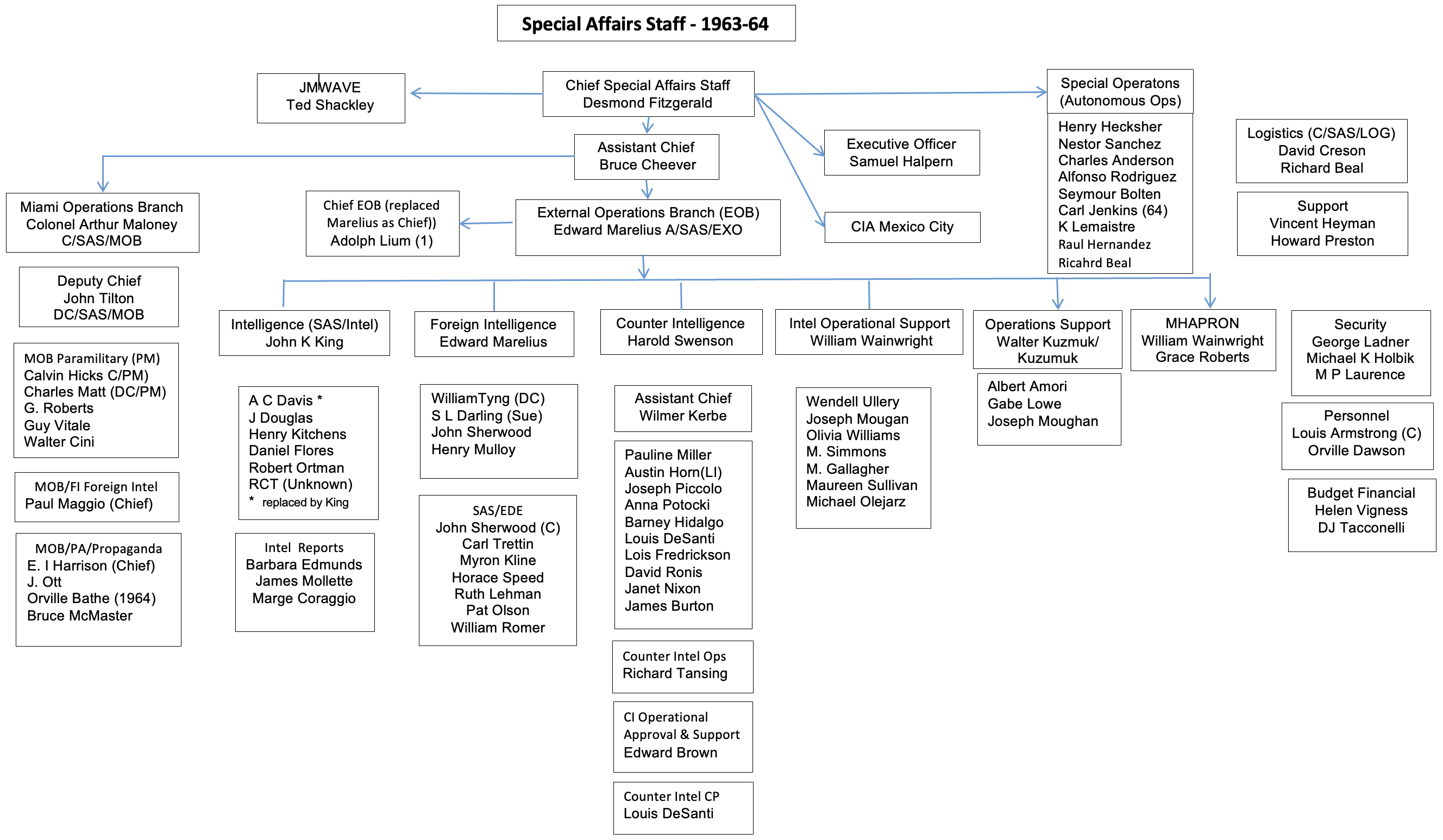
Chart Notes:
1. Adolf Lium CIA friend of James Angleton. Replaced Marelius as Chief/SAS/EOB when Marelius became A/EXO - http://jfk.hood.edu/Collection/White%20%20Files/CIA-Domestic%20Intelligence/CIA-D%200144.pdf
2. Special Operations reported dirctly to Fitzgerald
Answering directly to Harvey (and later Fitzgerald) was the Special Operations Department:
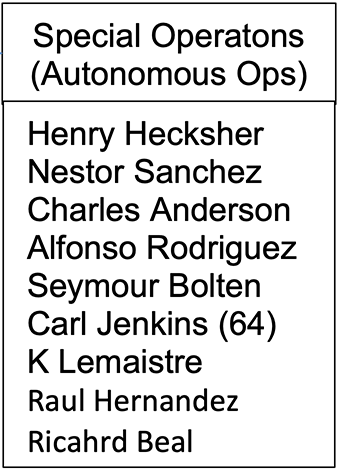
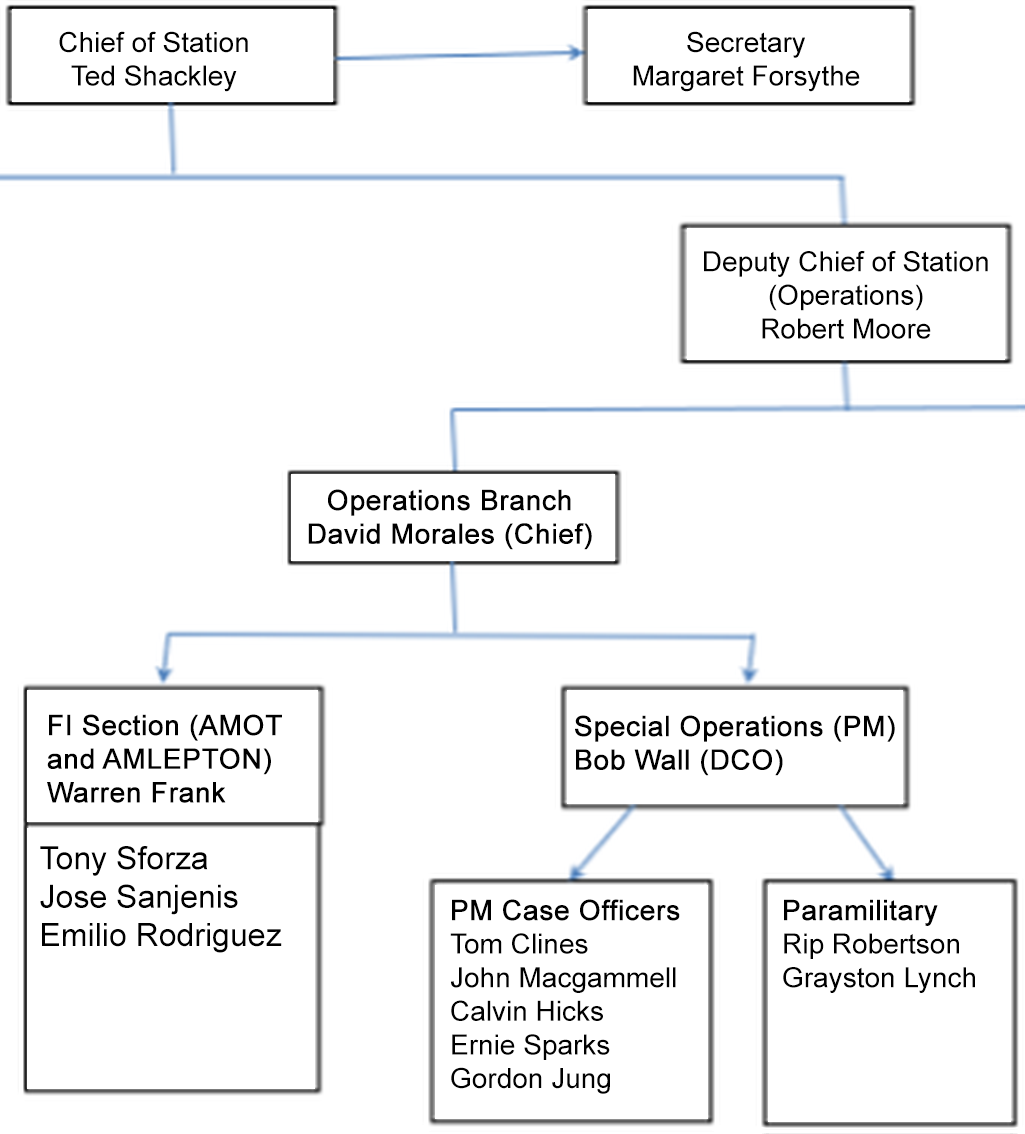
These people were the key operatives involved in clandestine operations directed at Cuba. Many of them were stationed at the JMWAVE CIA station in Miami, which spearheaded the Anti-Castro offensives. From the org-chart, we can see that Ted Shackley, who headed JMWAVE, answered directly to Harvey.
JMWAVE org-chart (Hyperlinks to Mary Ferrell data)
From Spartacus: “The CIA JMWAVE station in Miami served as the operational headquarters for Operation Mongoose. The head of the station was Ted Shackley and over the next few months became very involved in the attempt to overthrow Fidel Castro. One of Lansdale's first decisions was to appoint William Harvey as head of Task Force W. Harvey's brief was to organize a broad range of activities that would help to bring down Castro's government.
By the spring of 1962, JMWAVE employed more than 200 CIA officers. They, in turn, ran over 2,200 Cuban agents. JMWAVE had a navy of over 100 craft, including the 174-foot Rex, that had the latest electronic equipment and 40-millimeter and 20-millimeter cannons. The CIA station also had a large number of V-20 Swift craft and access to F-4 Phantoms from nearby Homestead Air Force Base.
William Harvey was ordered to activate an assassination plot against Fidel Castro. This became known as the ZRRIFLE project. Harvey arranged for David Sanchez Morales to move from Mexico City to join the project based at the JMWAVE station.”
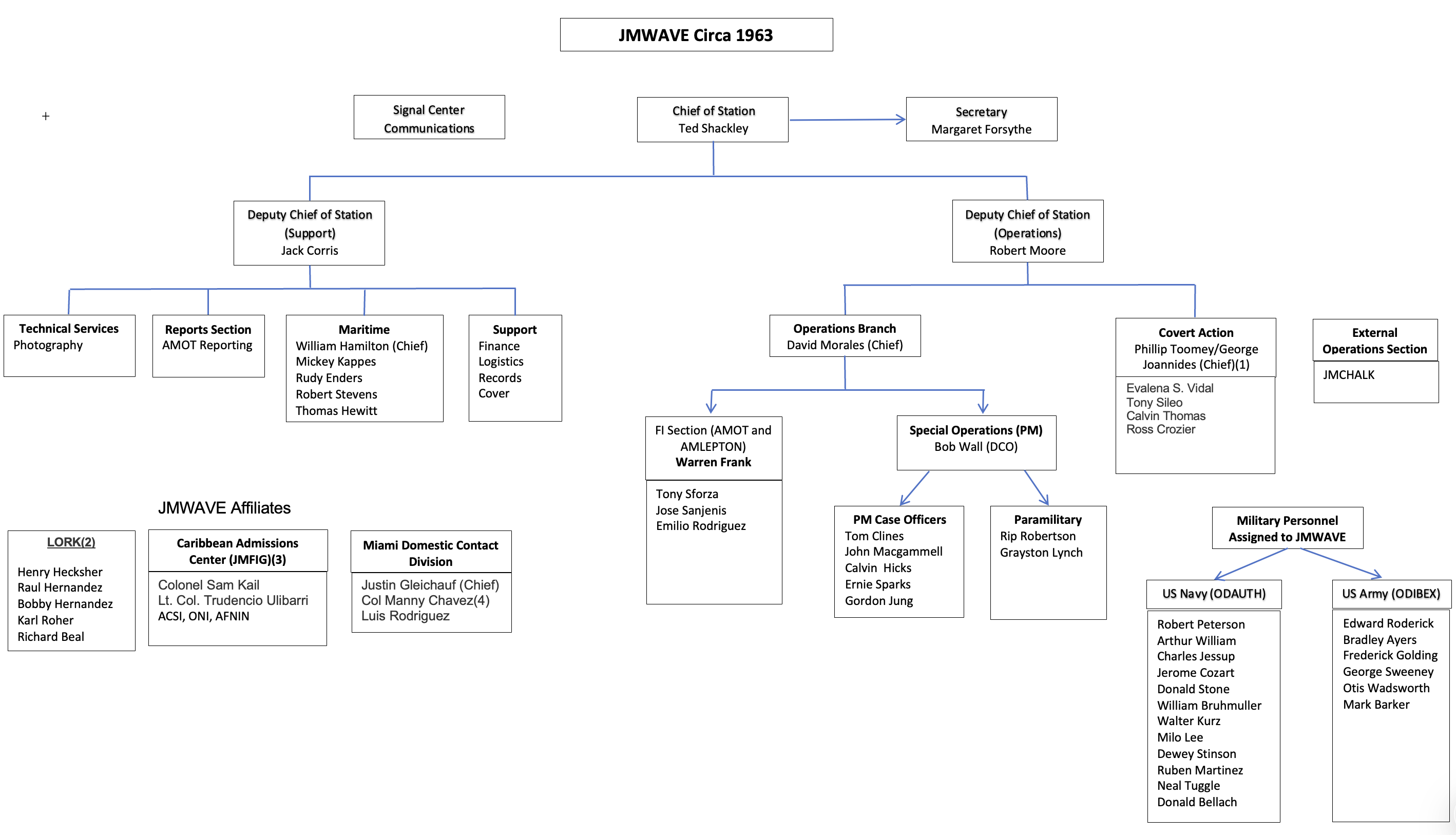
Chart Notes:
1. George Joannides replaced Philip A. Toomey around 8/1/63
2. LORK was a segregated area at JMWAVE for the AMWORLD Project
3. The CAC originally operated out of Opa-locka Naval Base before moving to Miami Field Office adjacent to the I&NS office. There was another office manned by 7 Army pesonnel stationed on the South campus of the University of Miami (JMWAVE). The CAC moved back to Opa Locka by the end of June 1963 where Justin Gleichauf, chief of DCD was placed in charge.
4. Colonel Manny Chavez was the Miami contact for “Colonel William Bishop.” Bishop’s true name was Clarence Ward Bishop.
This organizational chart reveals other Black Ops specialists who worked in close collaboration with their TFW counterparts. The most action-oriented operatives are those who answered to David Morales of the Operations Branch. We will see later that Morales, some of his subordinates and his superiors, Robert Moore and Ted Shackley, have an all-star pedigree in regime change and Executive Action. They are the ones who recruited and case-officered the Cuban Exiles (AMOTs), oversaw Mafia-linked assassination plots of Castro, and networked with soldiers of fortune. Other officers like David Phillips (Western Hemisphere 4) in Mexico City, and assets such as Felix Rodriguez, William Pawley and John Martino also worked closely with this highly specialized group. It is within this group and the SAS OPERATIONS Branch that one would find the only options that could handle most of the tasks described earlier:
3) QJWIN, the Mafia, Soldiers of Fortune and the AMOTs
To enlist members of the actual assassination teams and other ground-floor operatives, Covert Operations officers had several talent pools they could recruit from:
A) AMOTs
After Castro took power, many Cuban Exiles fled and coalesced in Florida… Among these were Batista loyalists, those disillusioned by Castro and Castro spies. Through David Morales, the CIA backed those who wanted to contribute to the overthrow of Castro, organizing them into different counter-revolutionary groups that received financing and training from David Morales and his team of case officers. These exiles were given the cryptonym AMOT. To help with recruitment, Jose Sanjenis was tasked with evaluating candidates. He had access to lie detectors (LCFLUTTER).
Cuban Exile Groups Note: Cuban Revolutionary Council, the CRC was a superstructure which sits atop all the groups willing to follow its direction and guidance in exchange for their portions of U.S. support, for which the CRC is the principal channel. The following were the leading groups.
Movimiento Revolucionario 30 de Noviembre - 30 Nov, MRTN, M-30-11-- 30 Nov. Revol. Movement
Movimiento de Recuperación Revolucionario - MRR -- Movement for Revolutionary Recovery
Unidad Revolucionaria - U. R., Unidad -- Revolutionary Unity
Directorio Revolucionario Estudiantil D.R.E. -- Students Revolutionary Directorate
Rescate Democrático Revolucionario RDR -- Revolutionary Democratic Rescue
Movimiento Revolucionario del Pueblo -- Revolutionary Movement of the People
Movimiento Democrata Cristiano MDC -- Christian Democrat Movement
Operación ALFA 66 -- Operation ALPHA 66
Other Cuban Exile resources were associated with Brigade 2506, the mysterious Operation 40 and participants of operations AMHINT and AMWORLD. There was a lot of participant overlap.
Brigade 2506: From Wikipedia: Brigade 2506 (Brigada Asalto 2506) was made up of Cuban Exile counterrevolutionaries. It was sponsored by the CIA in 1960 for the overthrow of the Castro government in Cuba. It spearheaded the catastrophic Bay of Pigs invasion on April 17, 1961. “About 1,334 men traveled on a seaborne force from Guatemala, of which about 1,297 landed in Cuba, plus an additional 177 airborne paratroops. Some 114 drowned or were killed in action, and 1,183 were captured, tried and imprisoned.”
Operation 40: From Spartacus: “The first meeting (of Operation 40), chaired by (Tracy) Barnes, took place in his office on 18th January, 1960, and was attended by David Atlee Phillips, E. Howard Hunt, and Frank Bender… Virtually every one of the field agents of Operation 40 was a Cuban. This included Antonio Veciana, Luis Posada, Orlando Bosch, Rafael Quintero, Roland Masferrer, Eladio del Valle, Guillermo Novo, Rafael Villaverde, Virgilio Gonzalez, Carlos Bringuier, Eugenio Martinez, Antonio Cuesta, Hermino Diaz Garcia, Barry Seal, Felix Rodriguez, Ricardo Morales Navarrete, Juan Manuel Salvat, Isidro Borjas, Virgilio Paz, Jose Dionisio Suarez, Felipe Rivero, Gaspar Jimenez Escobedo, Nazario Sargent, Pedro Luis Diaz Lanz, Jose Basulto, and Paulino Sierra.
However, Larry Hancock, in his book Someone Would Have Talked (2006), provides evidence that Operation 40 did not come to an end after the failed Bay of Pigs operation. Hancock reveals that Jose Sanjenis Perdomo was closely involved with David Morales in 1962 and 1963. He points out that "new documents provided by researcher Malcolm Blunt confirm that Jose Sanjenis, who was in charge of Operation 40, was the number one exile in the AMOT organization trained and prepared by Morales."
On 9th June 1961, Arthur Schlesinger sent a memo to Richard Goodwin: “(Sam) Halper says that CIA set up something called Operation 40 under the direction of a man named (as he recalled) Captain Luis Sanjenis, who was also chief of intelligence… It was called Operation 40 because originally only 40 men were involved; later, the group was enlarged to 70. The ostensible purpose of Operation 40 was to administer liberated territories in Cuba. But the CIA agent in charge, a man known as Felix, trained the members of the group in methods of third-degree interrogation, torture and general terrorism. The liberal Cuban Exiles believe that the real purpose of Operation 40 was to "kill Communists" and, after eliminating hard-core Fidelistas, to go on to eliminate first the followers of Ray, then the followers of Varona, and finally to set up a right-wing dictatorship, presumably under Artime.”
Note: Information about Operation 40 has been muddied through less-than-reliable declarations from people such as Marita Lorentz. Some of the writings about Operation 40 are dated. Its composition is therefore difficult to establish with certainty. Operation 40 primary RIF documents: 180-10073-10072, 104-10235-10109 (Blanco is Sanjenis), 104-10310-10020. One thing is certain: it existed for the purpose of sanitizing undesirables, and it was managed by David Morales and his subordinate, Sanjenis.
AMHINT participants: From Mary Ferrell: “(AMHINT) was a branch of the DRE that conducted paramilitary and infiltration operations in Cuba. Their case officer was JMWAVE chief of operations, David Morales…
"One of the principals of WH/4 (Richard Drain) recorded that on 24 February 1961 he 'asked Ed (Stanulis), Dave P (Phillips), Ed (Hinkle), (Robert) Moore, and Jake (Esterline) why not proceed with Operation AMHINT to set up a program of assassination?'...the author of that remark was Chief of Operations for Project JMATE... (there was) an AMHINT request of 14 January 1961 for 'Silenciadores Rifles de marilla telescopica' (a request for rifles with telescopic sights). This might have had to do with a DRE plan to assassinate the Soviet Ambassador to Cuba rather than a plan to kill Castro…”
AMWORLD, launched by the CIA on June 28, 1963, offered the ideal setting for preparing for November 22nd, 1963. Its main participants are the who's who of Assassination Inc. Ted Shackley chose Manuel Artime to run AMWORLD. The training grounds used for AMWORLD are murky, but research done by Larry Hancock and Dave Boylan points to various Caribbean settings, Mexico, Texas and Miami.
AMWORLD participants: From Spartacus: “The AMWORLD memo (104-10315-10004) was declassified on 27th January 1999, and discovered by Stuart Wexler in 2004, and he showed it to Larry Hancock. With the help of researchers such as Malcolm Blunt, Hancock obtained the names of other CIA officers involved in AMWORLD. Hancock points out that AMWORLD had its own separate operations staff based in Miami and Mexico City. The head of AMWORLD and Artime's case officer was Henry Hecksher. The ranking exile under Artime was Rafael 'Chi Chi' Quintero, who worked closely with CIA paramilitary officer Carl E. Jenkins, who was a military advisor to the AMWORLD project. David Atlee Phillips was designated to organize safe houses and related activities for AMWORLD. Other CIA officers who attended AMWORLD and AMTRUCK (an effort to produce an internal revolution against Castro in Cuba) meetings included Ted Shackley and David Sanchez Morales. … David Sanchez Morales, with his key role heading CIA Operations in Miami, had a hand in all the CIA actions against Fidel Castro in 1963. Bradley Ayers, a US Army Ranger (Special Forces) Captain who was assigned to the CIA JMWAVE station to train Cuban commandos and who worked for the Special Group Augmented (SGA), later claimed that "Morales held sway with Ted Shackley and dominated the entire operational agenda at the CIA Station.... Morales was often demonstrably irritated with changes to planned covert/paramilitary operations that were handed down by CIA headquarters at Langley or by orders from Bobby Kennedy's Special Group that seemed to be micro-managing the secret war against Castro."
B) Soldiers of Fortune
The counter-revolutionary force included mercenaries who were closely tied to the JMWAVE network of intelligence officers, exiles and their mafiosi collaborators. Like their partners, many of these were anti-Kennedy. The main group was the International Anti-Communist Brigade, organized by Frank Sturgis in late 1959. From this organization, the sub-group Interpen was formed. From Tipping Point Part 1: “The activist American anti-Castro community in Miami included highly public figures such as Frank Sturgis, Gerry Hemming, Roy Hargraves, William Seymour, Larry DeJoseph, Lawrence Hall, Steve Wilson, and Larry Howard. All were frequently in the news in Miami during 1962 and into 1963, either due to abortive attempts to run boat missions against Cuba or more often in publicity and fund-raising efforts. For some months in 1962, Hemming and Fiorini consolidated their efforts, forming a "virtual" commando group designated as INTERPEN (Intercontinental Penetration Force). [ 76 ] While it carried out no successful missions, it did conduct training for several of the smaller and less experienced Cuban Exile groups. In contrast, groups such as DRE maintained their own military cadre, supported by CIA funding. DRE, MRR and JURE also managed to raise private monies, and maintained small anti-Castro forces both inside Cuba and elsewhere in the Caribbean.”
C) The Mafia and QJWIN (157-10014-10109) (135-10001-10246)
For the assassination of foreign leaders, the preference was to keep CIA involvement to a minimum and outsource to hitmen. For the removal of Castro, the CIA partnered with the Mafia, which had the motive as well as contacts in America and in Cuba. Mafioso Johnny Roselli worked closely with Harvey and some of the JMWAVE officers. When it came to overseas targets, Harvey used an asset (likely Jose Marie Andre Mankel), with close ties to the Corsican Mafia and other hitmen, to spot talent. Given the cryptonym QJWIN, he was recruited by Harvey for the assassination of Lumumba. Harvey can be linked to both QJWIN and Roselli during a trip he made in the Keys in May 1963.
The analysis of org-charts is a good first step to identify a universe of regime change specialists who had the skill set and the contacts to assassinate JFK. The list of candidates who could have taken coordination roles consists of: William Harvey, head of Task Force W; Ted Shackley, Head of JMWAVE; Robert Moore, the Deputy Chief of Station; David Morales, Head of the Operations Branch at JMWAVE; George Joannides and Phil Toomey, who headed the Covert Action Department… David Atlee Phillips, who was part of Western Hemisphere 4, also figured prominently in this group. Out of this set of officers, there is only William Harvey who could have qualified to be the focal point; Harvey’s subordinates were simply too low in the hierarchy to be considered persons of trust for the policy makers above Harvey.
Click here to read part 2.


