The Enigma of Oswald’s ‘Missing Letter’: From the Russia File
By Chad Nagle and Rami Smatt
The dossier on the assassination of President Kennedy that representatives of the Russian Embassy delivered to Rep. Anna Paulina Luna last year contains a handwritten letter that Lee Harvey Oswald supposedly sent to the U.S. Embassy in Moscow while he was living in the USSR. The general public has never seen this letter before, and successive U.S. investigations denied that it ever existed. It does not answer any of the many lingering questions left behind by these investigations, but for the sake of informing the official record, it is worth subjecting the document to a thorough deconstruction. We will thus attempt to provide the full historical context of Oswald’s “missing letter” here.
Oswald and the U.S. Embassy
Document No. 61 in the Russian dossier provides a chronology of Lee Harvey Oswald’s life in the Soviet Union. Dated Dec. 4, 1963, and addressed to the first deputy minister of foreign affairs from the chairman of the Soviet Committee for State Security (KGB), it begins on p. 161 of the Russia file. The last paragraph of p. 164 of the dossier begins with the following three sentences:
In December 1960, Oswald began correspondence with the U.S. Embassy in Moscow, seeking to return to America, and to resolve this question the American consulate invited him to Moscow. In June 1961, Oswald and his wife visited the embassy and began the process of leaving the USSR. They kept their intentions secret from their acquaintances.
The KGB report in the Russian dossier features no further discussion of any Oswald correspondence, but the Appendix does include a copy of a letter from Oswald to the U.S. Embassy in Moscow, dated Dec. 1, 1960, as documents 6-1, 6-2 and 6-3.
The newly disclosed letter reads as follows:
Dear Sirs,
I would like information concerding [sic] my position in regard to my American citizenship, particularly the question of returning to the United States, and the settlement of any legal problems which might hold consequent’s [sic] for me if I did desire to return to America.
I am asking only for information. I am suggesting that we discuss the matter fully before any steps are taken by me or anyone else.
I also want this correspondence to be kepm [sic] confidential, since the publicity I recived [sic] in October 1959 when I entered an application for the dissolving of my present American citizenship only served to aggravate the situation.
You may send any personal letters of mine which may be at your offices to me, at the address below.
Thank you,
Lee Harvey Oswald
Минск
Ул. Калинина
Дом 4, Кв. 24
А. Х. Освальд

Copy of a letter purporting to be from Lee Harvey Oswald to the U.S. Embassy in Moscow, Dec. 1, 1960, identified as Documents 6-2 and 6-3 (Credit: Rosarkhiv)
The assertion that Oswald began corresponding with the U.S. Embassy in December 1960 contradicts the official U.S. history of the assassination. The Warren Report, published in September 1964, says this about Oswald’s communications with the U.S. Embassy in Moscow:
On February 13, 1961, the American Embassy in Moscow received a letter from Oswald postmarked Minsk, February 5, asking that he be readmitted to the United States. This was the first time that the Embassy had heard from or about Oswald since November 16, 1959. [emphasis added] (Warren Report, pp. 274-275)
Yet Oswald’s letter of February 1961, included in Warren Report Vol. XVII as Commission Exhibit (C.E.) 931, begins as follows:
Dear Sirs,
Since I have not received a reply to my letter of December 1960, I am writing again asking that you consider my request for the return of my American passport.
C.E. 931 is listed as “Undated letter from Lee Harvey Oswald to the American Embassy in Moscow,” but it bears a U.S. Embassy stamp reading “FEB. 13, 1961.”

C.E. 931, as it appears on pp. 131-132 of Vol. XVIII of the Warren Report
The reply from U.S. consul Richard Snyder (C.E. 933), dated Feb. 28, 1961, begins:
Dear Mr. Oswald:
We have received your recent letter concerning your desire to return to the United States. Your earlier letter of December, 1960 which you mentioned in your present letter does not appear to have been received at the Embassy.
The Warren Report stresses that the February 1961 letter from Oswald was the “first time” the embassy had heard from Oswald since November 1959 and dismisses Oswald’s own reference to a December 1960 letter without explanation. The Warren Commission had presumably uncovered no earlier letter from the man it posthumously convicted of single-handedly murdering the president. It gave no credence to Oswald’s own statement that he had sent a letter before February 1961 either. Then, in its biographical section on Oswald in Appendix XIII, the Warren Report returns to the issue somewhat defensively, saying that in the February 1961 letter,
Oswald referred to a previous letter which he said had gone unanswered; there is evidence that such a letter was never sent. (Warren Report, p. 701)
The Warren Report provides no “evidence” apart from an entry for February 1, 1961, in Oswald’s so-called “Historic Diary” (C.E. 24), which reads:
Make my first request to American Embassy, Moscow for reconsidering my position, I stated “I would like to go back to U.S.”
The apparent contradictions naturally generate confusion. If Oswald — as he claimed in his February 1961 letter — had already written to the embassy in December 1960, why would he write in his “Historic Diary” of having made his “first request” on Feb. 1, 1961? Compounding the mystery, this supposed “first request” is postmarked Feb. 5, 1961. Even assuming that Oswald’s letter sat in Minsk for four days before the post office there stamped and sent it, February 5 fell on a Sunday in 1961. Post offices were closed all day on Sundays in most parts of the world in 1961, including the Soviet Union.
The Letter First Surfaces
On Nov. 22, 1991, the ABC television network’s “Nightline” program aired an episode entitled “Investigation: The KGB Oswald Files.” In it, the narrator claims that in the final year of the USSR’s existence, the KGB showed Nightline’s reporters the December 1960 letter:
“Theorists have speculated that he never did write it, that he was simply unstable or lying. In fact, the KGB intercepted Oswald’s missing first letter, and the original still exists inside the Oswald file.”
Since ABC never showed the letter onscreen, as it did with the one stamped Feb. 13, 1961, viewers couldn’t judge authenticity, even accepting that the 1960 letter existed. The viewing public had to take ABC reporters’ word for it that they had seen a genuine letter.

Still from “Investigation: The KGB Oswald Files,” which aired on ABC’s Nightline program on Nov. 22, 1991, showing a page from the Feb. 13, 1961 letter (Credit: ABC)
Now, courtesy of the Russian government, we can see a photocopy of the envelope and its two-page contents, dated Dec. 1, 1960, from Oswald to the U.S. Embassy in Moscow.
Evasive Action
According to the official record of the assassination, nobody in the U.S. government had any idea that Oswald wanted to return to America until Feb. 13, 1961, when U.S. consul Snyder in Moscow received Oswald’s undated letter postmarked Feb. 5. But controversy arose a couple of years after the ABC Nightline special, in July 1993, when the Assassination Records Review Board (ARRB) declassified a CIA memorandum sent by CIA counterintelligence chief George Kalaris to the office of the deputy director of operations. Dated Sep. 18, 1975, it referred to the CIA having opened a “personality” (201) file on Oswald on Dec. 9, 1960 — in response to Oswald’s “queries” about coming home.

Excerpt from a CIA memorandum dated Sep. 18, 1975 (RIF: 104-10051-10173), made available to the HSCA (Credit: Mary Ferrell Foundation)
The CIA shared the 1975 memo with the House Select Committee on Assassinations (HSCA), which convened from 1976-1979 to reinvestigate JFK’s murder. But six months after writing his memo citing Oswald’s “renewed interest” in returning to America as the reason the CIA had opened the defector’s 201 file, Kalaris composed another memo omitting any mention of Oswald’s inquiries about “reentry to the United States.”

Excerpt from CIA memorandum dated Mar. 9, 1976 (RIF: 104-10310-10055), entitled “SCC Staff Query on Oswald File” (Credit: Mary Ferrell Foundation)
A few years later still, an undated CIA document entitled “Footnotes to Report on Pre-Assassination Docs in Oswald File” specifically labeled “inaccurate” Kalaris’ statement that the CIA had opened Oswald’s 201 file in response to his inquiries about coming home. An asterisk follows “inaccurate,” and at the bottom of the same page is written:
*OSWALD did not make inquiries about returning to the United States until early February 1961, two months after a 201 was opened on him.

Excerpt from undated CIA document (RIF: 104-10051-10075) correcting earlier statements that Oswald had contacted the U.S. Embassy in Moscow before February 1961 for information about coming home (Credit: Mary Ferrell Foundation)
Yet, as noted, Oswald himself said he had made such an inquiry. In the end, the HSCA shut down discussion of whether Oswald had sent any letters to the U.S. Embassy prior to February 1961, concluding in its final report:
There is no indication … that Oswald expressed to any U.S. government official an intention to return to the United States until mid-February 1961. (p. 201)
The “no indication” phrase thus feels a bit extreme. John Newman covers the episode extensively in the second edition of “Oswald and the CIA” (2008), in the chapter entitled “The Riddle of Oswald’s 201 File.” About the HSCA and the Kalaris memo, Dr. Newman concludes:
The HSCA was unwilling to draw a firm conclusion. In the end, they abandoned the issue, insinuating that it was because of the CIA’s refusal to turn over the internal routing sheets. “In the absence of dissemination records,” the HSCA noted, “the issue could not be resolved.” That comment was wise; what was not wise was to glibly dismiss a memorandum by the chief of the CIA’s Counterintelligence Staff. The two questions the HSCA should have asked are: Did Oswald, in December 1960, express an interest in coming home? If so, did the CIA learn of it? The answer to both questions appears to be yes. (p. 177)
Kalaris’ slip-up in his September 1975 memo compounded mistrust of the official findings. Did someone in the CIA know of a December 1960 letter withheld from investigators? The ultimate reason the CIA gave for opening Oswald’s 201 file was that it was responding to the U.S. State Department’s request for information on American defectors in the USSR. This feels entirely plausible, but it also conveniently allows for complacent dismissal of Kalaris’ initial statement as mere bureaucratic error.
The proximity of the date of the Dec. 1, 1960, letter to the date the 201 file was opened, Dec. 9, may have been only coincidental. Maybe Kalaris had simply seen Oswald’s February 1961 letter and made a premature conclusion. But Newman thinks it was not. In an interview Newman did with Jim DiEugenio for JFK Revisited, the professor said that this was about the time that Oswald made overtures that he wanted to return. Therefore the 201 file charade was now terminated. But suspicions of cover-up endured. Apart from the written statement of a dead man convicted as a “lone gunman” in JFK’s death, the public lacked any hard evidence that a December 1960 letter ever existed — until the Russian government released its JFK dossier in October 2025.
Forgery vs. The Real Deal
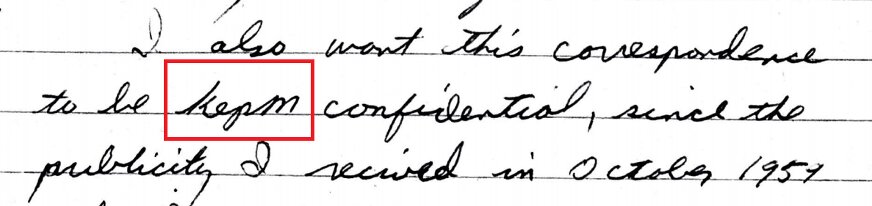
A couple of the letter’s characteristics indicate that the letter is a forgery. First, a letter from the Cyrillic alphabet appears once. The cursive form of the letter that is pronounced as a ‘t’ looks more like an ‘m’ in English:
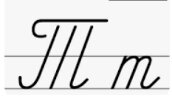
It appears in the word “kept”:
Also, the author seems to have spelled Oswald’s middle name “Harvy,” without the ‘e’:
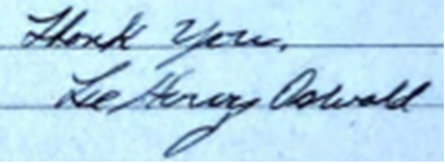
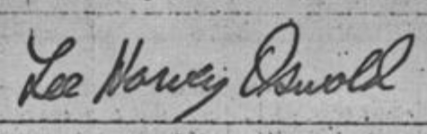
Although Oswald seldom wrote out his full name in handwritten correspondence, usually opting for the initial ‘H’ or simply “Lee Oswald,” there are a few instances in which he did write out his name to include the middle name. In most cases, the ‘e’ is quite clearly discernible, as in the signature at the bottom of his declaration of Nov. 3, 1959, requesting that his citizenship be revoked (C.E. 912):
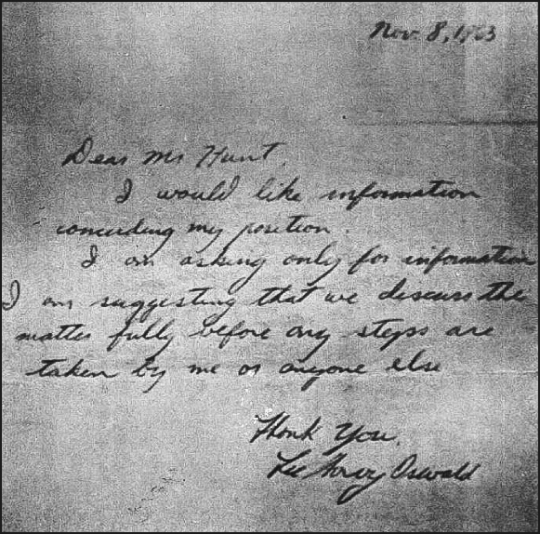
Notably, a letter purporting to be from Oswald to a “Mr. Hunt,” dated Nov. 8, 1963, features the same signature as the Dec. 1, 1960, letter, which has never been authenticated and is considered by some a forgery:
Supporting the 1960 letter’s authenticity is that Oswald himself referred to earlier correspondence in his letter of Feb. 13, 1961, accepted as genuine by U.S. government investigators. Would Oswald have lied about mailing a letter on the same subject earlier? Was he trying to get a quicker response from the embassy by making up a story that he had already attempted to obtain information months earlier? We also note that Oswald suffered from dyslexia, a condition that results in inconsistent spelling and handwriting. The peculiar spelling of the word “received” as “recived,” for example, appears in both the Dec. 1, 1960, letter and a letter Oswald penned after his return to America:


Finally, it appears as though Oswald did address the envelope of the Dec. 1, 1960, letter, whether or not he authored its contents. The Cyrillic handwriting exhibits clear idiosyncrasies to those who can read Russian. Most notably, the letter that corresponds to the “N” sound, which appears in Russian as ‘H,’ is oversized in both the handwriting on the envelope and in other handwriting of Oswald’s. Likewise, both the letter ‘K’ (which sounds like ‘K’ in English) and the letter that corresponds to the “L” sound are written as capitals (oversized) in the envelope address and other Oswald handwriting.
Warren Report defender and CIA apologist Fred Litwin published his own analysis of the letter on his busy, free-of-charge blog “On the Trail of Delusion,” which understandably permits no comments from readers or visitors. In the article, entitled “Soviet File Given to Luna Proves a KGB Operation” (Oct. 18, 2025), Litwin asserts that the appearance of the letter in the Russian dossier “proves” that the mysterious “Mr. Hunt” letter was part of a “KGB operation.” That is, the “Mr. Hunt” letter, appearing as it did during the period of U.S. government reinvestigation into the assassination of President Kennedy in the 1970s, represented an attempt by Soviet intelligence to associate Oswald with the CIA and thus deflect suspicion from the notion that Oswald had any relations with the Soviet KGB. Since the letter to the U.S. Embassy dated Dec. 1, 1960, begins with the same opening words – “I would like information concerding [sic] my position” (Litwin mistakenly claims that the first paragraphs are identical) – and is furthermore clearly a forgery, Litwin concludes, the 1960 letter is part of a KGB operation too. He writes:
So, this is confirmation that the Dear Mr. Hunt letter was indeed a KGB operation. They forged the writing, language and spelling of the 1960 Oswald letter to try and prove that E. Howard Hunt, and thus the CIA, was tied to the JFK assassination.
What the leaping Litwin overlooks are two facts. The Dear Mr. Hunt letter was mailed from Mexico City in 1975. In 1977, the Dallas Morning News was in receipt of the letter. They had it analyzed by three professional handwriting authorities. They came to a unanimous verdict. The writing was that of Oswald. (Henry Hurt, Reasonable Doubt, p. 236) The second point Litwin ignores is that Vasili Mitrokhin, the KGB defector used to discredit the letter, had been peddling his wares since 1992. He hand-copied instead of photocopying his stolen KGB documents. Even the CIA had doubts about them and turned his defection down in 1992. But MI5 representative Christopher Andrew accepted them. It turned out that Mark Lane exposed Mitrokhin as producing baubles that would make him more enticing to Western intelligence. Namely that Mark Lane’s landmark volume Rush to Judgment was being secretly funded by the Russians. Lane completely vitiated this tall tale in his book Last Word. And that section includes a challenging letter to Mr. Andrew. To which the British author did not reply. (pp. 89-97)
In fact, neither letter “proves” what Litwin alleges. He assumes that “Mr. Hunt” refers to CIA officer E. Howard Hunt, when many have speculated it might just as easily have addressed Texas oil man and notorious JFK-hater H. L. Hunt (Chinese Communist leader Mao Tse-tung reputedly blamed the assassination on an “oil king”). Furthermore, for those of us who seriously doubt that Lee Harvey Oswald could have murdered President Kennedy, the “Dear Mr. Hunt letter” could never “prove” that the CIA as an institution was tied to the JFK assassination by virtue of its ties to the accused assassin. On the one hand, we know that the CIA concealed the extent of those ties for decades. On the other hand, we know that Oswald’s alleged lethal act in Dealey Plaza on Nov. 22, 1963, was far-fetched—and the Soviets agreed.
The only noteworthy manifestation of Soviet KGB endorsement of the Warren Report is the memoir of retired KGB Col. Oleg Nechiporenko, “Passport to Assassination” (1993), a book that does not represent the official position of Nechiporenko’s erstwhile employer. In fact, Nechiporenko’s former KGB colleague in the Soviet Embassy in Mexico City, Nikolai Leonov, resolutely and repeatedly denied in print in his own memoirs that Oswald could have committed the crime. Leonov reached the rank of lieutenant general, eventually holding the No. 3 position in the KGB. We cannot ignore Leonov’s opinion any more than we can take seriously Nechiporenko’s theory that Oswald killed JFK because the U.S. president reminded him of one of his wife Marina’s ex-lovers.
Prior to the publication of the Warren Commission’s final report, the Soviet government worried that the U.S. government might use Oswald’s time in the USSR to depict him as a Soviet agent and blame the Soviets for the assassination itself. Moscow then bent over backwards to preserve some semblance of good relations by accommodating Washington with information on Oswald during the investigation. But when the Warren Commission published its “lone gunman” conclusion, the Soviets rejected it. As such, disseminating these two letters in the 1970s might have constituted a defensive disinformation action, deflecting an anticipated attempt to blame Moscow, just as much as an offensive one, aimed proactively at undermining U.S. government institutions. In other words, even assuming the Soviet KGB forged both letters, Litwin has failed to establish the motive that forms the sole basis of his assumption.
That said, it is worth noting that the appearance of the “Mr. Hunt” letter roughly coincides with the date of George Kalaris’ internal memorandum. That means that both the December 1960 and the November 1963 letters might originally have surfaced in the U.S. at the same time, and that the December 1960 letter was totally suppressed. Kalaris, by this reasoning, prepared his memorandum in reliance on the December 1960 letter, which came into his hands courtesy of a KGB disinformation operation. This compelled the CIA to then bury any notion that Oswald attempted to contact the U.S. Embassy in Moscow prior to February 1961. This makes sense, even if Litwin lacks the proof he claims to possess. But all we know, still, is that Oswald referred – in his February 1961 letter – to a December 1960 attempt to contact the embassy. Either Oswald was lying then, or the CIA lied later that it knew nothing about such an attempt.
Enduring Mystery
The significance of the December 1960 letter lies in its confirmation by the Russians that the KGB carried out mail surveillance on Oswald in the Soviet Union, and that this particular piece of mail apparently never reached its intended destination. It also implies that the KGB not only intercepted the letter but held on to it instead of reading it, copying it, and sending it on. Furthermore, since the letter doesn’t look authentic, we are confronted with the possibility that the KGB intercepted Oswald’s letter and replaced it with a forgery. Why they would do such a thing is beyond the scope of this analysis, but why would anyone in U.S. intelligence think it was worth covering up anyway? Even in 1960, most informed observers would have assumed Soviet intelligence was surveilling an American defector living and working in the USSR. Yet for some reason, official U.S. investigators in the 1960s and 1970s were having none of it.
Simply acknowledging that the embassy never received a letter from Oswald before February 1961 would have sufficed in chronicling the defector’s correspondence. Why go even further and insist that Oswald had never even tried to make any inquiries before then? We can’t fathom why Lee Harvey Oswald might “invent” a December 1960 attempt to contact the U.S. Embassy. At the same time, we can’t understand why U.S. authorities would go to great lengths to insist he never tried, especially when the contents of the letter appear to be so innocuous. It is obvious that the Soviets were reading his mail inside the USSR just as the CIA was reading letters he sent and received internationally.
In the final analysis, the Dec. 1, 1960, letter raises more questions than it answers. If this is the letter that the Soviet KGB told ABC Nightline in 1991 it had intercepted in 1960 and showed to the network’s reporters, it looks as if the Russian government released it in 2025 just to show the world that it had resided in its archives all this time. The current Russian leaders, who were children at the time of the assassination, have probably done no handwriting analysis of their own and probably have no interest in revisiting the crime to uncover the truth 63 years later. Perhaps the CIA might like to make an official statement about the letter now, over 65 years after Lee Harvey Oswald allegedly wrote and sent it.