The War On Oliver Stone’s JFK Records Act
By: Mark Adamczyk and Andrew Iler
April 1, 2026
INTRODUCTION
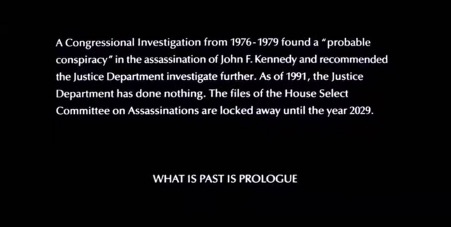
For more than sixty years, the administration of records concerning the assassination of President John F. Kennedy has been characterized by institutional resistance and a persistent divergence from the objective of total transparency. Despite a 1979 Congressional finding of a "probable conspiracy," the federal government’s response has been marked by a continuum of suppression, extending from the initial sealing of investigative files until 2029 to the modern utilization of media "propaganda assets" to manage public perception. This systemic informational management has allowed a high-stakes, contemporary crisis of accountability to persist into 2026, effectively subverting the 1992 JFK Records Collection Act through a decades-long operational shell game of non-compliance and administrative delay.
Internal CIA documentation confirms that the agency likely initiated a preemptive strategy to circumvent the JFK Records Act months before its enactment. Two Secret CIA memoranda, both dated February 10, 1992, reveal that agency leadership sought to "get ahead" of an independent statutory review process by proposing a controlled transfer of the House Select Committee on Assassinations (HSCA) "Sequestered Collection" and other agency equities to the National Archives (NARA). By attempting to place these sensitive records under agency-specific classification guidelines rather than the JFK Records Act’s statutory standards, the CIA aimed to maintain control over its files and activities and insulate critical evidence from the Assassination Records Review Board (ARRB).
The collapse of the Act’s enforcement mechanism is further evidenced by the systemic disappearance of more than 27,000 ARRB Final Determinations—the binding legal orders intended to ensure the timely release of postponed records. While the ARRB was legally mandated to provide document-specific justifications for postponements and firm dates for the periodic review or release of records, a proposed 1997 policy shift toward "simplified" Final Determination Notifications may have resulted in boilerplate forms that current researchers describe as functionally equivalent to "blank pieces of paper". NARA’s current inability to locate or identify these 27,000 instruments of judicial review constitutes a significant gap in compliance with the JFK Records Act, leaving the JFK Records Collection in a state of administrative disarray that precludes effective public or judicial oversight.
To rectify these structural failures, Congress must move beyond the era of "voluntary" transparency (one that continues to depend on action by recalcitrant agencies) and enforce a strict "statutory" mandate. Although Presidential Executive Orders may initiate certain disclosures, only the rigorous application of the JFK Records Act—specifically through the recovery of missing Final Determinations and the publication of a comprehensive Subject Guidebook and Index — can ensure the permanent availability of and accessibility to these records.
True closure of the government enabled the JFK records fiasco requires Congress to move beyond the excitement of random and periodic document "dumps" and confront the structural non-compliance that has allowed these secrets to remain withheld. Ultimately, Congress must stop requesting agency cooperation and start demanding the full, indexed, and certified collection that the law has required for over thirty-three years. The public also needs to focus not on the hoopla surrounding the random release of sporadic records, but on demanding clear answers about why the JFK Records Act has not been complied with; why is there is no complete index and directory of records; why records were not released in accordance with the ARRB Final Determinations; and what is the status of the complete JFK Assassination Records Collection.
More than six decades have passed since the guns rang out in Dallas. While many in the corridors of power wish that the assassination of President Kennedy would fade into the pages of history books that all trumpet the same false Warren Commission narrative, the fact that elements of the security state continue to fight so hard against a fully accountable release of all records and compliance with the law, shows that the JFK assassination remains a current crisis and an inescapable problem that mortally challenges the public’s faith in government–all of which demand a legitimate investigation and resolution.
PART I
The Opening Salvo Against Oliver Stone’s Film “JFK”
Section Summary
This section examines the coordinated mainstream media attacks on Oliver Stone’s 1991 film “JFK” and on the director himself that aimed to publicly discredit and discourage citizens from taking a thoughtful and diligent approach to examining the available evidence of a conspiracy. The strategies employed against Stone and JFK mirrored the efforts 25 years prior to destroy the credibility of the early critics of the Warren Commission and represents a continuum of suppression, obstruction and character assassination to weaken not only the public’s demand for a legitimate investigation, but to also repress the public from even entertaining thoughts about the evidence in the case beyond what the government deemed suitable for public consumption.
-------------------------------------
If anyone was still under the illusion that there has been a shift towards transparency and objectivity in the mainstream media’s coverage of the JFK assassination, ABC’s 2-hour primetime special broadcast on November 24, 2025, deceivingly titled “Truth and Lies: Who Killed JFK?”, made no attempt to dispel the sense that the mainstream media continues to act as the strongly biased water carriers for the Warren Commission Report. While ABC feigned objectivity by misleading Oliver Stone and Jim DiEugenio into appearing in less than three minutes of highly edited screen time, the large majority of this “primetime special” was dominated by committed Warren Commission apologists Dale Myers, Philip Shenon, Tim Naftali and Barbara Perry.
For people with knowledge of the painfully extracted evidence that has emerged over sixty-two years since the November 22, 1963 assassination of President John F. Kennedy in Dallas, what the ABC special made clear is that there has been a continuing mainstream media propaganda war on Oliver Stone, his 1991 film JFK and ongoing compliance issues surrounding the 1992 JFK Records Collection Act that was enacted to force the release of millions of pages of assassination records that have been kept tightly secret by government agencies for decades.
The CIA probably never had to dust off its January 1967 SECRET DISPATCH, titled “Countering Criticism of the Warren Report”, when the mainstream media initiated a pre-emptive attack on Oliver Stone’s film JFK. The infamous CIA memo provided a step-by-step action plan “To employ propaganda assets to answer and refute the attacks of the critics. Book reviews and feature articles are particularly appropriate for this purpose.” It further advised its assets to discredit the critics' motivations and to attack them as being politically or financially motivated, pushing pre-conceived theories, or being hasty and inaccurate in their research.” Most famously, the memo pushes the concept that “conspiracy theorists” were deliberately or unwittingly promoting Soviet propaganda to undermine the legitimacy of the U.S. government.
Whether or not the mainstream media in 1991 “got the memo”, they were obviously running aggressively from the same playbook. In May of 1991, seven months before Oliver Stone’s JFK hit movie theaters, the first salvo against the film was issued by the Chicago Tribune’s Jon Margolis. In a May 14, 1991, article titled, “JFK Movie and Book Attempt to Rewrite History“, Margolis attacked both Stone and the film, accusing the director of attempting to promote a “counter-myth” to the official history of the assassination.
On May 19, 1991, The Washington Post published columnist George Lardner’s opinion piece titled, “On the Set: Dallas in Wonderland; How Oliver Stone's Version of the Kennedy Assassination Exploits the Edge of Paranoia”. Lardner’s piece was largely based on a dubiously obtained copy of the first draft of Stone’s screenplay for JFK. Lardner’s op-ed is widely recognized as being the most hostile attempt to shape and destroy the public’s view of the film.
Washington Post Columnist George Will published his December 25, 1991, column titled “JFK: Paranoid History” a few days after the launch of the film. In his opinion piece, he sneered at the movie and Oliver Stone with insults, such as, “Strange that a society so sick allowed such a saint to be president at all, but this is cartoon history by Stone, who is 45 going on 8…” Further, Will adds “in his three-hour lie, Stone falsifies so much that he may be an intellectual sociopath, indifferent to truth…”, Will continued, “JFK is an act of execrable history and contemptible citizenship by a man of technical skill, scant education and negligible conscience.”
During the run-up to the 1992 Academy Awards, for which JFK was nominated eight times, Jack Valenti, who in 1992 was the President of the Motion Picture Association of America (MPAA), took out a two-page paid advertisement in both Variety and the Hollywood Reporter. In 1963, Valenti had been a close personal friend of Lyndon Johnson since the 1950s and was part of the “Texas Mafia”, a group of powerful Texas businessmen and politicos who supported Johnson. During the Dallas motorcade, Valenti was riding six cars back from the President’s limousine and was at the time Liaison to the Media for the Dallas trip. Valenti played a significant role in planning the Texas Trip. After the assassination, Valenti traveled with Johnson on Air Force One from Dallas back to Washington, D.C. and was appointed by Johnson as Special Assistant to the President, becoming one of Johnson’s closest and most loyal advisors. It should be of no surprise that as one of the “Mad Men” of Texas’ leading advertising agencies and a committed Johnson loyalist that Valenti would use his position and influence as President of the MPAA to attack Oliver Stone and JFK with the kind of shrill statements made in the excerpt from his paid advertisement below.
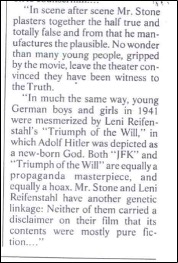
The mainstream media’s attempts to malign, discredit and destroy Oliver Stone’s JFK were largely based on thin, emotionally-driven accusations regarding minor dramatic elements rather than substantive rebuttals of the film’s core storyline. When weighed against the Warren Commission’s fabrications and gross omissions, the American public saw the media attacks for exactly what they were… a continuing propaganda effort.
The Senate Select Committee to Study Governmental Operations with Respect to Intelligence Activities (the “Church Committee”) and the corresponding House committee, led by Otis Pike, conducted investigations and hearings from 1975 to 1976. Both, especially the latter, exposed certain elements of what has come to be known as Operation Mockingbird and the CIA’s long-running program of domestic operations maintaining relationships with U.S. publishers, editors, journalists, authors, and other media personnel for the purposes of propaganda dissemination and intelligence gathering. In February 1976, then Director of the CIA George H.W. Bush issued a directive to the agency to cease contractual relationships with accredited U.S. journalists. This directive apparently did not apply to freelance journalists, and it is unclear whether the directive applied to unaccredited journalists, authors and media executives. Searches suggest that Bush’s directive has not been publicly disclosed.
A full list of those CIA media assets involved with the so-called Operation Mockingbird has never been disclosed. The closest the public has come to seeing beneath the veil of this CIA/media partnership is Carl Bernstein’s October 20, 1977, Rolling Stone article titled “The CIA and the Media”.
Throughout this article, references will be made to the truly explosive under oath testimony provided to Congress on May 20, 2025, by Judge John Tunheim, former Chair of the ARRB; Doug Horne, Chief Military Analyst for the ARRB; and Attorney Dan Hardway, former investigator for the HSCA. Among other revelations, Judge Tunheim testified that many of the records requested by the ARRB were never turned over by the CIA and that records now being released were never reviewed by the ARRB. Doug Horne testified about known missing records and evidence (e.g., tissue and blood slides; memos on autopsy photography; a signed "original" autopsy report; and JFK's brain) from the President’s military-controlled autopsy at the Bethesda National Naval Medical Center, and serious evidentiary problems with the autopsy that destroyed the credibility and legitimacy of the final autopsy report. Dan Hardway testified to the now-proven obstruction of the HSCA investigation and the CIA’s operational use of “Oswald” in Mexico City.
The May 20th hearing was the first time that any of this information had been discussed on a national stage, yet there was no mainstream media (i.e. televised) coverage of the hearing that would have allowed the American public to hear and watch the witnesses’ shocking testimony (This is in stark contrast to the April 1, 2025 Congressional hearing that was televised live.) Not even with the elevated national interest in the Kennedy assassination did CSPAN (whose job it is to provide television coverage of congressional hearings) broadcast any part of the hearing on May 20, 2025. For keen researchers, the media blackout was obvious…. no ABC, NBC, CBS, Fox, CNN, or PBS…. not even CSPAN. Thankfully, Forbes live-streamed the entire hearing on its YouTube channel, where it can still be viewed.
The above examples demonstrate that the highly skewed mainstream media reporting on the JFK assassination is still running on high octane today and that the time is ripe for full disclosure of the CIA’s current and historical contacts in the U.S. domestic media and how these assets have been deployed to steer, misdirect and gate-keep information about the assassination, and also to control the public’s perception of the assassination through propaganda and message control. It is certainly time for Congressional oversight committees to obtain and disclose the CIA’s records regarding the JFK film and its strategies against Stone. To fully understand which publications, broadcasters, journalists, publishing houses, authors, and media personalities have been utilized (wittingly and unwittingly) by the CIA over the last 63 years (and perhaps currently) would likely be an eye-opening and highly informative exercise.
The apparent information operation discussed above serves as the essential context for understanding the obstruction of the JFK Records Collection Act. The media’s role in marginalizing critics and ignoring evidentiary breakthroughs provided the necessary cover for agencies to "wait out" the ARRB and resist the full release of documents. The following sections move beyond the cultural sphere to provide a clinical analysis of the legal mechanisms used to subvert the 1992 Act. We will examine the ARRB’s meticulous processes and also its internal struggles, the National Archives’ (NARA) failure to release the ARRB’s legal orders and maintain an accountable index of assassination records, and the current legislative hurdles preventing the final, unredacted release of the JFK assassination records.