Angleton’s Slip: Did the National Security State
Assassinate Jack Dunlap?
Part 1: The Unfolding Public Story
By James Nicita
On June 19, 1975, James Angleton, recently relieved of his twenty-year tenure as chief of the Central Intelligence Agency’s Counterintelligence Division, gave sworn testimony in an executive session interview with several representatives of the Senate Select Committee to Study Governmental Operations With Respect to Intelligence Activities, known as the Church Committee, after its chair, Senator Frank Church of Idaho.[1]
Both Angleton’s ouster and the establishment of the Church Committee itself owed much to New York Times reporter Seymour Hersh’s December 22, 1974 article revealing that Angleton had directed CIA activities in direct violation of the agency’s charter, including “a massive, illegal domestic intelligence operation...against the antiwar movement and other dissident groups in the United States,” as well as “dozens of other illegal activities…including break-ins, wiretapping and the surreptitious inspection of mail.”[2]
Now summoned before the Committee, Angleton rambled through various accounts of Cold War espionage. Midway through his testimony, Angleton described the internal damage report the Soviets had likely undertaken after the 1961 defection of the KGB officer Anatoliy Golitsyn to the United States.[3] By way of example, he referenced the damage report American authorities had undertaken regarding Army Sergeant Jack E. Dunlap, who, while assigned to the National Security Agency complex in Fort Meade, Maryland, had sold extremely sensitive secrets to the Soviets, and who reportedly had taken his own life in July 1963 while under investigation.
While discussing the damage report in the Dunlap case, Angleton made a slip:
Mr. Angleton: …. Now, when we did a similar operation on the Sergeant Dunlop [sic] who was working in the National Security Agency and committed suicide, if I am not mistaken we came to approximately 400,000 documents that he could have had access to, although he may not have. And it is interesting to note that after his assassination, in a search of the quarters, the Bureau, or whoever did the search, found six of my letters to NSA relating to information from Golitzen [sic].[4]
The panel was startled.
Senator Baker. Did you speak of the assassination?
Mr. Angleton. What did you say?
Mr. Miller. Did you say Mr. Dunlop?
Mr. Angleton. After his suicide. I am sorry.
Mr. Miller. You used the term assassination.
Mr. Angleton. I meant suicide.
Mr. Miller. The word is interesting, because it is charged, as you know, that he was assassinated.
Mr. Angleton. Maybe I was thinking out loud or something.[5]
Angleton’s slip, on its own, does provoke suspicion that Dunlap’s “suicide” was in fact an assassination. Beyond the slip, however, William Miller, the staff director of the committee charged by the Senate to investigate the activities of intelligence agencies, was himself already aware of allegations that Dunlap had died by assassination, and called out Angleton on his own knowledge of such allegations. It would be interesting to know from whom Miller was getting his information. And, there are a handful of other anecdotes suggesting assassination rather than suicide.
II
In October 1963, Dunlap’s mother, Eloise Childs, told a reporter that upon learning that her son’s body had been found in his car in Ferndale, Maryland, she had flown up from Louisiana. Dunlap had allegedly stuck a hose to the car’s exhaust pipe and inserted it through the car’s window.
She said she viewed her son’s body and found it badly bruised and beaten about the torso and legs.
“He was murdered, and put in the car,” she asserted.
Mrs. Childs said she asked a doctor at the Army’s Walter Reed Hospital if her son appeared to have been a victim of carbon monoxide poisoning and quoted the doctor as replying he was “not allowed to go into the case.”
She said she asked the Army to perform an autopsy on her son but officials refused. She also said the undertaker handling funeral arrangements said that Dunlap’s body “was in terrible shape,” and was unable to answer her when asked if he had died of carbon monoxide poisoning.[6]
Local police countered that there was nothing to suggest anything but suicide. Dunlap was known to have had a skin infection on his legs, and the ointment he used to treat it was found in the car. Although his legs were discolored, there was no indication that he had been beaten.[7]
Decades later, in 2006, Michael Patterson shared claims similar to those made by Eloise Childs. Patterson maintained a website consisting of biographies he compiled of veterans buried in Arlington National Cemetery. He also used his website to advocate on behalf of veterans, for example, assembling a roster of alleged abuses of waivers that allowed influential people who were not veterans to be buried in the prestigious cemetery.[8] In his bio of Jack Dunlap, in a section he opened with the qualification, “Some of it is hearsay, some heresy from unnamed sources,” Patterson wrote: “At least one person swears that the autopsy of Jack Dunlap would show that he was ‘beaten to a pulp’ and that a “snake in the woodpile’ was responsible for placing the hose in his car which caused his death.”
Returning to 1963, in December the syndicated columnist Drew Pearson described how agents of both the FBI and the Army’s Criminal Investigation Division (CID) “were shadowing Dunlap, but both let him commit suicide though they were within 500 feet of him when he stopped on the road, hooked a hose to his exhaust, and brought it into the car where he sat with the windows closed.” These FBI and CID agents were “virtually looking on” when Dunlap took his own life. “It’s reported that in this case both the FBI and CID were under orders not to interfere with any suicide attempt, in order to avoid a sensational trial which would upset Senate ratification of the test ban treaty,” Pearson wrote. “This report, however, has not been confirmed.”[9]
Years later, Angleton himself discussed Dunlap with the sympathetic journalist Edward Jay Epstein. In his book Deception, Epstein relates his conversation with Angleton regarding the Carroll Report, the NSA’s internal report on the Dunlap matter, during which Epstein remarked to Angleton that a number of other Soviet agents had apparently killed themselves before they could be interrogated. Angleton, with an “enigmatic shrug,” replied, “Making murder look like suicide is no trick.”[10] Outside of the Dunlap context, Angleton told Epstein in another interview, “A common thug can kill someone, but it takes the talents of an intelligence service to make a murder appear to be a suicide or accidental death.”[11] In a later book, How America Lost Its Secrets, Epstein says, “Angleton suspected Dunlap was murdered by the KGB in what he termed a surreptitiously assisted death, to prevent Dunlap from talking to investigators.”[12] Angleton had expressed no such suspicion of the Soviets in his sworn testimony to the Church Committee, even when specifically pressed on the question of assassination.
III
Angleton was no stranger to assassination. In his landmark book JFK and the Unspeakable, author James Douglass writes that in the 1950s, Angleton supervised a small assassination unit headed by Army colonel Boris Pash, the targets of which were suspected double agents abroad. Angleton also controlled access to the CIA’s hyper-secret Staff D, later Division D. Staff D’s roles included liaison with the NSA – the very agency to which the Army had assigned Dunlap. Staff D’s so-called “second-story men” executed break-ins to steal encryption codes from foreign governments for use in NSA surveillance, received communications intercepts from the NSA, and had authority to conduct wiretaps abroad. Angleton’s close colleague Bill Harvey ran Staff D from 1959 to 1963, and during this time consulted with Angleton on the development, within Staff D, of the infamous ZR/RIFLE, or “executive action,” assassination program. In an often-repeated story, Angleton and Harvey openly discussed assassination in a restaurant with MI-5 officer Peter Wright.[13]
This article is the first in a three-part series on the Dunlap espionage case. The series provides a general case history, and explores arguments favoring and disfavoring the possibility that the U.S. national security state assassinated Dunlap to prevent the publicity of extremely sensitive intelligence.
Part 1 traces the unfolding of the Dunlap case in the American press in the several months from his alleged suicide on July 23, 1963, to March 1964. The Dunlap matter threatened to scuttle negotiations over, and Senate ratification of, one of President Kennedy’s signature achievements: the Limited Test Ban Treaty. There are contradictions in contemporaneous news accounts as to a) whether or not government officials knew prior to Dunlap’s death that he was spying for the Soviets, or only learned afterward; and b) whether the FBI was investigating Dunlap before his death, or only entered the case afterward.
Part 2 examines available agency records of the CIA, the FBI, the NSA, and the President’s Foreign Intelligence Advisory Board, made available over decades through both the Freedom of Information Act and the 1992 JFK Assassination Records Act. Ironically, the PFIAB was meeting at the White House on November 22, 1963, and was on lunch break from its discussion of the Dunlap case when it learned of President Kennedy’s assassination. Agency records also reveal some intriguing intersections between the Dunlap case and the Oswald case.
Part 3 discusses later revelations of congressional investigative committees and of scholars and researchers. Angleton’s confidante Edward Jay Epstein, based on credible authority, learned that Dunlap had reached the doorstep of Angleton’s own Counterintelligence Staff, and, as noted above, then probed Angleton himself about Dunlap. In addition, there is some suggestion from another source – although not based on actual documentary evidence – that Dunlap may also have penetrated Harvey’s Staff D. Dunlap’s period of espionage aligns almost precisely with Harvey’s Staff D tenure. Outside of Dunlap’s own NSA, it is hard to think of repositories of secrets that were more sensitive than those of the CIA’s CI Staff and Staff D. These two staffs were also associated with assassination.
The Unfolding Public Story: The Dunlap Case Threatens the Test Ban Treaty
The top headline on the front page of the July 24, 1963, edition of the Annapolis, Maryland Evening Capital read, in large font: “OFFICIALS HOPEFUL ON TEST BAN.”[14] Negotiations over what would become known as the Limited Test Ban Treaty opened on July 15 and concluded on July 25. President Kennedy announced the agreement on July 26, in one of the most significant televised addresses of his presidency. The parties – the United States, the Soviet Union, and the United Kingdom – signed it on August 5. The Senate ratified the treaty on September 24, and Kennedy signed it on October 7.[15]
The Evening Capital article continued on page 3. Immediately adjacent to the continued article a brief, and seemingly unrelated, article was headlined “Glen Burnie Man Found Dead In Car.” The county medical examiner reported that 35-year-old Jack Edward Dunlap was found in his car the day prior, on the east side of Markey Creek. One William Deardorff of Baltimore discovered the body and noticed a hose leading from the car’s exhaust pipe into the vehicle. The motor was running, and Deardorff disconnected the hose and turned off the engine. After alerting two fishermen and asking them to call the police, Deardorff himself went to a local service station and called them. The county medical examiner pronounced Dunlap dead by carbon monoxide poisoning.[16] At least as reported in the article, the medical examiner did not declare whether or not Dunlap’s death was by suicide.
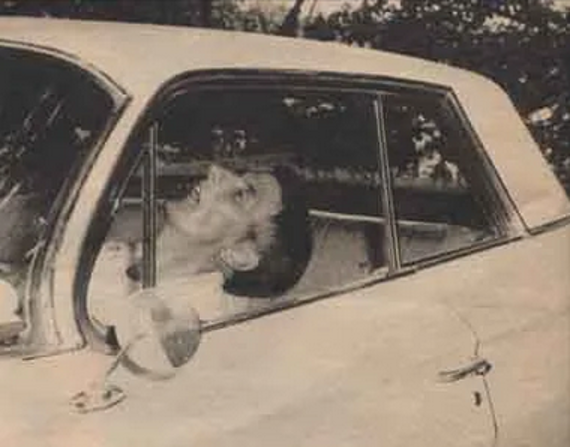 Police photograph of the dead body of Jack Dunlap.
The next day, the Baltimore Sun carried a brief death notice for “Sgt.” Dunlap, mentioning as survivors his wife Diane, his five children, his parents, and his sister. Aside from his military rank, the death notice gave no indication of his employer, except that funeral services would take place at the Main Post Chapel at Fort Meade. Fort Meade is the location of the NSA. The notice closed by stating Dunlap would be interred at Arlington National Cemetery.[17]
The summer passed with no further mention of Dunlap. Then, on October 10, the Dunlap scandal erupted into international news, via a story leaked to reporter Earl Voss of Washington, D.C.’s Evening Star. For a little more than two years – i.e., since 1961 – the Soviets had paid Dunlap, an employee of the NSA, approximately $60,000 for “some of the Nation’s most sensitive communications codes and official secrets.” Voss did not specify Dunlap’s position within the NSA. Dunlap had allegedly hidden some of the secret papers and photographs under his shirt when he carried them to his Soviet contact. Anonymous sources described the compromise as much broader than that resulting from the 1960 defection of two NSA mathematicians, Bernon Mitchell and William Martin, who had fled to the Soviet Union via Cuba.[18]
Voss wrote that Dunlap was born in 1927 in Bogalusa, Louisiana, and joined the Army in 1952. Anne Arundel County, Maryland, police affirmatively stated that Dunlap committed suicide. “Patrolman George Bozek…reported that there was a partly filled whiskey bottle in the front seat.”[19] (See photo.)
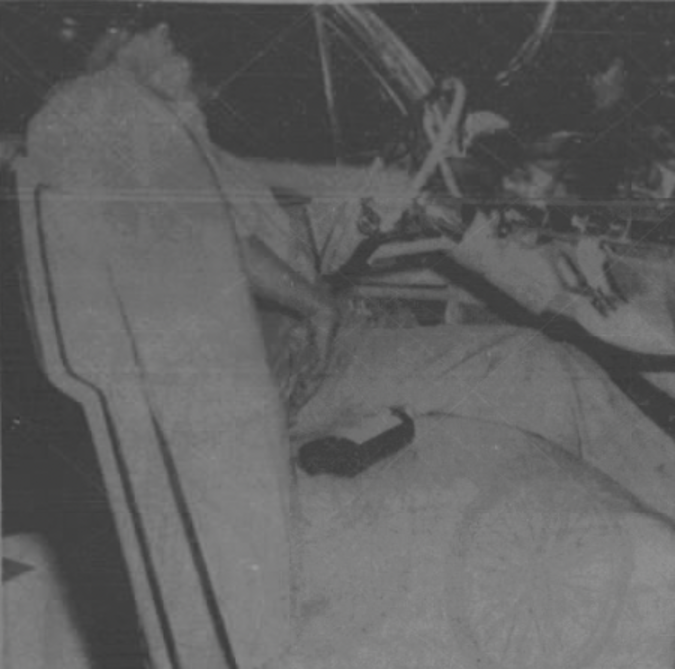 This police photo of the body of Jack Dunlap, whisky bottle at his side, appeared in the October 11, 1963, issue of the Orlando Evening Star.
In the months prior to his death, Dunlap was planning to leave the Army and continue his intelligence work as a civilian. But NSA rules required him to take a lie detector test before transferring. He reportedly was worried about the test and killed himself in the belief that U.S. intelligence organizations were closing in on him. In fact, the Army had relieved him of his NSA duties several weeks before his alleged suicide and assigned him to an Army unit at Fort Meade.[20]
Dunlap had several girlfriends, played the horses, and owned several Cadillacs, including the 1962 Coupe de Ville in which his body was found. “His high living was believed to have been one of the tipoffs for United States investigative agencies.”[21]
IV
Voss reported that Kennedy Administration officials had hushed up the Dunlap case since July, presumably so that they could check out all of the leads to Dunlap’s Soviet contact.[22] However, the suppression of the story until precisely October 10 might be attributable to another factor. Immediately adjacent to the Evening Star’s Dunlap article was a small, unassuming story announcing that the Limited Test Ban Treaty had gone into effect.[23] Two conservative columnists, Senator Barry Goldwater and Edith Kermit Roosevelt, would allege that the Administration had suppressed the Dunlap story so that it would not interfere with Senate deliberations on ratification of the treaty. Roosevelt claimed, “This hush-hush required close consultation between [Secretary of State Dean] Rusk and Secretary of Defense [Robert] McNamara.”[24]
On October 11, Voss gave additional details on Dunlap’s background. He was a decorated veteran, awarded a Bronze Star, a Purple Heart, and a Commendation Ribbon for his service in Korea. After service in Turkey (discussed in detail in Part 2) – Dunlap was assigned to NSA’s Fort Meade headquarters as a driver after undergoing an Army security investigation – which, as will be seen, apparently did not include a lie detector test. Then he became a clerk-messenger with, allegedly, limited access to classified information.[25]
Dunlap’s request to transfer to civilian status as an NSA employee, however, did trigger the requirement of a new security investigation that included two lie detector tests, which “disclosed prior actions on his part involving petty thievery and immoral conduct which were considered to render him unsuitable for employment at NSA.” A Pentagon official confirmed that he was under investigation for espionage activities at the time of his suicide. In addition, the article reported that Dunlap had made an initial failed suicide attempt on June 16 by swallowing pills in a hotel room.[26]
On October 12, another Evening Star reporter, Gerry Herndon, wrote that Dunlap had called his wife Diane on the evening of July 22 and informed her he was going to commit suicide. “Mrs. Dunlap apparently doubted he really intended to take his life, officers said.” Police had located a gas station near Dunlap’s home where he had purchased $5 worth of gasoline on the night of July 22. Authorities had also traced the hose attached to the exhaust pipe to a motor pool supply room at Fort Meade, where Dunlap was still stationed at the time of his death. The report reaffirmed that the county medical examiner found only that Dunlap died by carbon monoxide poisoning; it was the police who made the suicide determination.[27]
Voss’ final Evening Star article on October 13 provided an initial inventory of secrets that Dunlap had disclosed to the Russians. Notably, they included not just those from the NSA but also from the CIA. Among the stolen documents were most of the CIA’s estimates of Soviet and NATO military strengths; the progress of Soviet nuclear submarine development; difficulties that the United States encountered with its own nuclear submarine program, including poor workmanship; American intelligence on the disposition and capabilities of Soviet missile forces, and on Soviet troop deployments in Eastern Europe; and CIA probings of Soviet technological advances.[28]
After Dunlap’s June 16 suicide attempt, he reportedly told his commanding officer that he planned to try again. Similar to Drew Pearson’s later December column, mentioned above, regarding the FBI and CID agents tailing Dunlap but allowing him to kill himself, Voss wrote (although not mentioning the FBI or the CID) that Dunlap was surveilled briefly, but then allowed to “go his own way…By that time it was already known in the intelligence community that he had been spying for the Soviet Union.”[29]
Dunlap’s wife Diane told investigators that her husband brought a great deal of work home every evening, and she even led them to some documents Dunlap had left in the attic. According to Voss, many of these were communications from CIA agents abroad. The FBI was said to be dismayed that it was called into the case too late to make effective moves against Soviet operators involved. Sources suggested that “Dunlap may have been the most damaging espionage agent for a foreign power in the history of the nation.”[30]
The Dunlap scandal thereafter became grist for newspaper editorial boards and syndicated columnists. In October, Drew Pearson’s column bemoaned that an alleged spy and traitor like Dunlap could be buried with full honors in Arlington National Cemetery. Since Dunlap had not been charged with any crime prior to his death, and he had a stellar service record, military regulations entitled him to such a burial. After his first suicide attempt in June, Dunlap “was under constant surveillance, the FBI delaying arrest in the hope that he would arrange another contact with Russian agents,” Pearson wrote. “This he did not do.”[31]
Also in October, Robert S. Allen and Paul Scott of the syndicated “Allen-Scott Report” added to the inventory of secrets Dunlap had provided to the Soviets: extensive details on U.S. capability to detect nuclear tests and missile launchings, and exhaustive data on Russian nuclear blasts and space shots. “The reports gave the Soviets a full picture of the degree to which the U.S. can detect nuclear and missile operations in the atmosphere and outer space.”[32]
They reported that the House Un-American Activities Committee was looking into the Dunlap case and asking whether there was any relation between Dunlap’s disclosures and the Russians’ agreeing to the test ban treaty. According to one anonymous official, the Soviets definitely knew “which tests and launchings we detected and those we didn’t,” and “as a result of this infamous espionage, they will be able to cheat on the test ban agreement with impunity. They will know our blind spots.”[33]
If true, the information revealed in Allen and Scott’s column, had it been known to senators, almost certainly would have complicated ratification of the test ban treaty. The column bolsters claims that the Kennedy Administration suppressed the Dunlap story until the test ban treaty entered into effect. Certainly, the administration was convinced of the accuracy of Allen and Scott’s regular column and its sourcing: just months before, they had been targeted with an illegal domestic wiretap operation in order to identify their sources. This was likely part of Project Mockingbird, which later became part of the infamous CIA “Family Jewels” disclosures in the 1970s.[34]
Don Oberdorfer of The Saturday Evening Post closed out the major contemporaneous coverage of the Dunlap scandal with his March 7, 1964, article, “The Playboy Sergeant Who Spied For Russia.” Oberdorfer expanded the period during which Dunlap had been selling secret documents to the Russians: from two to nearly three years, or beginning in mid-1960, while qualifying, “Not even the Pentagon can be certain how or when Dunlap began selling secrets.”[35]
Without mentioning Dunlap’s tour of duty in Turkey, Oberdorfer wrote that upon his initial assignment to the NSA in April 1958, as part of the Army’s regular quota of support personnel, Dunlap had first served as the chauffeur for the NSA’s assistant director and chief of staff, Major General Garrison B. Coverdale. Later, he graduated to duties the Pentagon described only as “clerk-messenger.” But this position gave him access to highly classified documents. “Higher-ups in secret agencies are limited in their access to such papers by a strict requirement of ‘need to know,’ but it is difficult to circumscribe the faceless clerks and messengers who plod the treadmill of the bureaucracy,” Oberdorfer wrote. “Paradoxically, they often handle documents which some of their bosses are not authorized to see.”[36]
V
Later, in his book The Puzzle Palace, author James Bamford would refine this explanation as it pertained to Dunlap:
At the NSA, just as at the CIA or any other highly sensitive government agency, those employees with the greatest access to secret information are not the department heads or project chiefs, who, under the uniform “need to know” policy, are knowledgeable only about their particular operations. Instead, the system works in such a way that, oftentimes, the lower a person is on the ladder of responsibility, the greater is his or her access to sensitive information. Before the director can send an “eyes only” message to the President, for example, it first has to be typed by a secretary, who then most likely hands it to someone to deliver to the message room, where a teletype operator punches it into a crypto machine, handed to another messenger, who probably turns it over to someone else for eventual delivery to the President. By the time it reaches his hands, the message destined for his eyes only has come under the possible scrutiny of at least six other pairs of eyes. With most messages and documents, that number is increased many times.
Dunlap, who acted as a courier for highly classified documents between various parts of the [NSA], was now in a position to be of that number.[37]
According to Oberdorfer, Dunlap hid documents under his shirt, and used his top-secret security pass to “blithely” walk past heavily armed Marine guards and a triple-strand fence. He passed documents on to Soviet contacts in the parking lot of a shopping center several miles from NSA: “NSA’s slumbering watchdogs never roused.” Consistent with Voss’ report, Oberdorfer wrote that Dunlap’s exposure originated with his desire to transfer to civilian status and failing the NSA polygraph exam. At this point, investigators discovered he was living beyond his means, and the Army relieved him of his NSA duties.[38]
After his June 16 suicide attempt, investigators found two suicide notes, one to his wife and the other to his mistress. At that point, the NSA, the Army Counterintelligence Corps, and the Army Military Police (not the FBI) all began to collaborate on Dunlap’s case and to undertake a “halfhearted surveillance.” After his recovery, he told his commanding officer he would try suicide again. But still it seemed that “no official steps were taken to stop him.” Friends and colleagues did try, however: on July 20, an unidentified friend allegedly wrested a revolver from Dunlap just before the latter intended to use it on himself.[39]
In Oberdorfer’s account, the realization that Dunlap was a Soviet spy did not occur until after Dunlap killed himself:
On August 20, nearly a month after his suicide, the leisurely investigators were jolted to discover that Diane Dunlap had discovered a sheaf of highly classified official papers among her husband’s belongings. At long last the NSA flashed word of the case to the FBI; and an army of investigators immediately set to work…Some agents concentrated on the difficult task of identifying Dunlap’s outside contacts, reportedly including Soviet diplomatic personnel.”[40]
Oberdorfer’s story became the standard account of the Dunlap case. Former CIA director Allen Dulles included the piece in his anthology, Great True Spy Stories.[41]
Summary
Even conceding that Jack Dunlap’s death, if murder, could be staged to appear as suicide, the proposition that Dunlap was assassinated faces a steep hurdle amid the extensive evidence presented in various media accounts of Dunlap’s intent to commit suicide. There was the initial June 16 attempt, his subsequent communication to his commanding officer that he planned to try again and his suicide notes to his wife and his mistress, his foiled July 20 attempt with a revolver, and his July 22 communication to his wife of his intent to kill himself, as well as his procurement on that date of gasoline and a length of hose.
And yet, the CIA’s director of counterintelligence, James Angleton, who knew the Dunlap case intimately, appears to have implicitly rejected all of this reported evidence in expressing his suspicion, according to Edward Epstein, that the Soviets assassinated Dunlap to silence him.
If instead the U.S. national security state assassinated Dunlap, then not only were “the talents of an intelligence service [used] to make a murder appear to be a suicide…” – per Angleton’s spook wisdom imparted to Epstein – these talents by extension could also have been used to plant a record of Dunlap’s intent to commit suicide. The long period between Dunlap’s July 22/23 death and the spy scandal that broke on October 10 would have provided ample time to develop an official story of both suicidal intent and actual suicide, including suborning local officials in the name of national security. It is notable that none of the supposed private individual witnesses of Dunlap’s suicidal intent were quoted by name on the record. Even Dunlap’s wife Diane was not directly quoted: her statements regarding his suicidal intent were reported second-hand.
Voss, Oberdorfer, and Pearson each described an apparently intentional slow-walking of the Dunlap investigation, but then offered conflicting reasons for it. Voss wrote that after Dunlap’s first suicide attempt, he was surveilled briefly, but then allowed to “go his own way,” as it was known by then he was a Soviet spy; the implication seems to be that authorities hoped an espionage problem would solve itself. Oberdorfer described a “halfhearted surveillance” and said “no official steps were taken” to stop Dunlap from committing suicide, but did not provide a reason why. Pearson suggested in one article that the FBI refrained from an arrest in hopes that Dunlap would make contact with his Soviet handlers. In a subsequent article, he suggested that the FBI and CID looked on as Dunlap killed himself because authorities wanted to avoid a sensational trial that would upset negotiations over the test ban treaty. If the latter, could such a desire serve equally as a motive for the outright assassination of Dunlap?
There is another conflict in the reporting: as to whether the FBI was investigating Dunlap before his death, or only entered the case afterward. Pearson said it was before. Voss implied that it was afterward, and Oberdorfer said so explicitly.
A third conflict concerns whether government officials knew prior to Dunlap’s death that he was spying for the Soviets, or only learned afterward. Voss and Pearson wrote that it was before; Oberdorfer asserted it was afterward. Prior knowledge might certainly bolster the case that Dunlap was assassinated.
Part 2 will examine whether available agency records resolve the conflicts in the press accounts. It will also lay the groundwork for additional theories to be offered in Part 3 as to why the national security state might have had a motive to assassinate Jack Dunlap.
__________________
-
James Angleton testimony, Senate Select Committee to Study Governmental Operations with Respect to Intelligence Activities (“Church Committee”), June 19, 1975, JFK Assassination System, U.S. National Archives, Record No. 157-10014-10005, pp. 1-2. Present for this session were Senator John Tower of Texas, Senator Howard Baker of Tennessee, Senator Charles Mathias of Maryland, William Miller, Staff Director, Frederick A. O. Schwarz, Jr., Chief Counsel, and Charles Kirbow and David Aaron, Professional Staff Members.
-
Hersh, Seymour M., “Huge C.I.A. Operation Reported in U.S. Against Antiwar Forces, Other Dissidents in Nixon Years,” New York Times, December 22, 1974, p. 1.
-
Angleton June 19, 1975 Church Committee testimony, pp. 62-63.
-
Angleton June 19, 1975 Church Committee testimony, p. 64. In the original, a reviewer has underlined the word “assassination.” The same reviewer has notated the letter “a” over the letter “o” in the transcript’s first misspelling of Dunlap’s name as “Dunlop.” The misspelling “Dunlop” occurs with some frequency in the various original records.
-
Id.
-
“Wealth Inheritance, Dunlap Account to His Neighbors,” The Times-Picayune (New Orleans, LA), October 12, 1963, p. 1.
-
Herndon, Gerry, “Dunlap Phoned Wife, Told Her Suicide Plan,” The Evening Star (Washington, DC), October 12, 1963, p. 3.
-
Levy, Marc, “Iraq Dead Ahead,” Counterpunch, June 2, 2007.
-
Pearson, Drew, “Army Intelligence and FBI Scramble Over Security Job,” The Miami Herald (Miami, FL), December 16, 1963, p. 7.
-
Epstein, Edward Jay, Deception: The Invisible War Between the KGB and the CIA (New York, NY: Simon & Schuster, 1989), p. 175.
-
Simpich, Bill, The Twelve Who Built the Oswald Legend – Epilogue, Mary Ferrell Foundation, October 1, 2020.
-
Epstein, Edward Jay, How America Lost Its Secrets: Edward Snowden, the Man and the Theft (New York, NY, Alfred A. Knopf, 2017), p. 224.
-
Douglass, James, JFK and the Unspeakable: Why He Died and Why It Matters (New York, NY, Simon & Schuster, 2010), p. 143; Stockton, Bayard, Flawed Patriot: The Rise and Fall of CIA Legend Bill Harvey (Washington, D.C., Potomac Books, Inc., 2006), pp. 111-112, 143-165; Wright, Peter with Greengrass, Paul, Spycatcher: The Candid Autobiography of a Senior Intelligence Officer (New York, NY, Viking Penguin, Inc., 1987), pp. 159-162.
-
Evening Capital, July 24, 1963, p. 1.
-
Arms Control Association, “Nuclear Testing and Comprehensive Test Ban Treaty (CTBT) Timeline,” April, 2026.
-
Evening Capital, July 24, 1963, p. 3.
-
“Deaths,” Baltimore Sun, July 25, 1963, p. 37.
-
Voss, Earl H. “U. S. Secrets Sold to Russians by Security Agency Sergeant,” The Evening Star (Washington, DC), October 10, 1963, p. 1. Raymond, Jack, “G.I. Suicide Sold Secrets To Russia,” New York Times, October 11, 1963, p. 1 (Dunlap story “leaked” to Evening Star).
-
Id.
-
Id.
-
Id.
-
Id.
-
“Test Ban Pact Goes Into Effect; Kennedy Pledges ‘Good Faith,’” The Evening Star, October 10, 1963, p. 1.
-
Roosevelt, Edith Kermit, “Between The Lines: Rusk Is Charged With Evasiveness,” The Arizona Republic (Phoenix, AZ), October 19, 1963, p. 6. Roosevelt was a granddaughter of President Theodore Roosevelt and First Lady Edith Kermit Carow Roosevelt through their son Archibald. Her first cousin Kermit Roosevelt, Jr. was a key operative in the CIA’s overthrow of Iranian prime minister Mohammed Mossadegh in 1953. See, Kinzer, Stephen, All the Shah’s Men: An American Coup and the Roots of Middle East Terror (Hoboken, NJ: J. Wiley & Sons, 2003).
Voss himself had opposed the idea of a test ban treaty in a book he published in early 1963, Nuclear Ambush: The Test-Ban Trap (Chicago, IL, Henry Regnery Company, 1963). Among the individuals Voss thanked in the book’s Foreword for “help and support” was CIA director John McCone.
-
Voss, Earl H., “Spy Disclosure Likely to Spur Security Probe,” The Evening Star, October 11, 1963, p. 1.
-
Id.
-
Herndon, Gerry, “Dunlap Phoned Wife, Told Her Suicide Plan,” The Evening Star, October 12, 1963, p. 3.
-
Voss, Earl H., “Sergt. Dunlap Called Super-Spy for Reds,” The Evening Star, October 11, 1963, p. 1.
-
Id.
-
Id.
-
Pearson Drew, “Accused Spy Buried at Arlington,” Los Angeles Times, October 24, 1963, Part II, p. 6.
-
Allen, Robert S. and Scott, Paul, “Data Given Reds On US Nuclear Detection Blind Spots?” Tallahassee Democrat (Tallahassee, FL), October 17, 1963, p. 3.
-
Id.
-
Rotman, Gabe, “CIA director personally intervenes in a long-forgotten press wiretapping matter (in a good way),” Reporter’s Committee for Freedom of the Press, May 8, 2023. Part 3 of this series will revisit “Project Mockingbird.”
-
Oberdorfer, Don, “The Playboy Sergeant Who Spied For Russia,” The Saturday Evening Post, March 7, 1964.
-
Id.
-
Bamford, James, The Puzzle Palace: A Report on America’s Most Secret Agency (Boston, MA, Houghton Mifflin, 1982), p. 150.
-
Oberdorfer, Don, “The Playboy Sergeant Who Spied For Russia,” The Saturday Evening Post, March 7, 1964.
-
Id.
-
Id.
-
Dulles, Allen, Great True Spy Stories (New York, NY, Harper & Row Publishers, 1968), pp. 65-72.
In his October 20, 1977 Rolling Stone article, “The CIA and the Media,” Carl Bernstein made mention of The Saturday Evening Post as one of the media outlets used by the CIA, for agent cover abroad, interview of returning correspondents, and its connection with columnist Stewart Alsop. Bernstein does not mention Oberdorfer. Notwithstanding its service to the CIA, The Saturday Evening Post also published in January of 1964, two months prior to Oberdorfer’s Dunlap profile, the prophetic article by Senator Eugene McCarthy, “The CIA is Getting Out of Hand,” which called for a congressional oversight committee for the CIA long before the Church Committee did.
Bernstein mentions reporter Jerry O’Leary of the Evening Star as having provided the CIA extensive assistance regarding Latin American matters in the 1960s. Bernstein does not, however, mention Voss.
