Reconsidering Oswald's Eccentric "Babysitter" – Part 3
Endgame
By Dan Carbone
"The Port Aransas Incident"
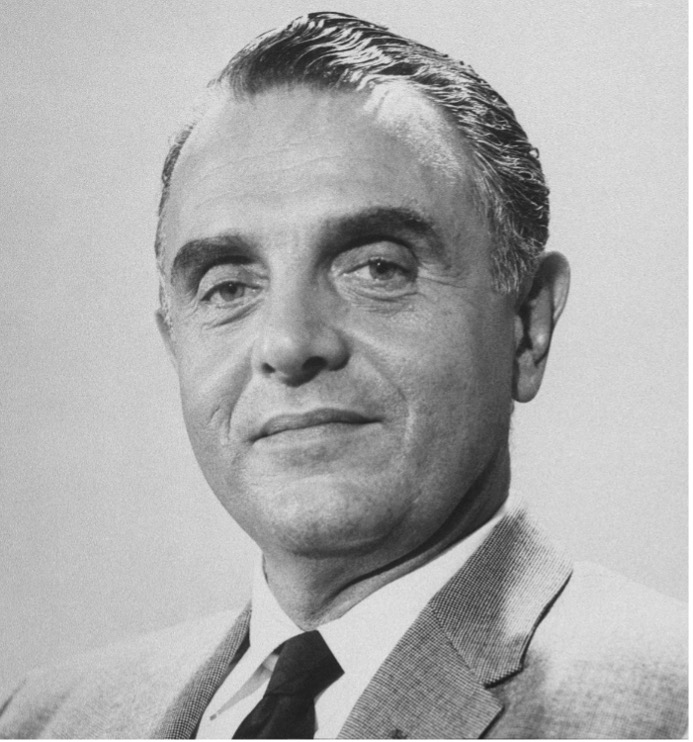
According to Edward J. Epstein, near the start of WWII, "British mail intercepts in Bermuda indicated George was closely associated with Intelligence agents working against the allies." An odd incident occurred in 1941 when he was briefly detained by the FBI for sketching a naval installation in Port Aransas, Texas. On his person, there were two sets of papers. One said he was a Greek Catholic born in 1914, and another said he was Swedish, born in 1911. If that wasn't suspicious enough, he claimed to have several different professions, yet the FBI determined he wasn't making a living off any of them. He seemed to have money. A lot of money. Yet it was never really clear how he generated it and whom he was working for. This would be a pattern throughout his life. Ultimately, the FBI let him go, but continued to watch him closely, on and off, for the rest of his life.[1]
Since his arrival back in the USA after his defection to Russia, the continually hounded Oswald also had an antipathy for the FBI. Indeed, this was one of the mutual issues George and Oswald bonded over.
"The Jewish Mafia"
Part of George's paranoia in his final years revolved around the threat of a so-called "Jewish Mafia" out to get him. Perhaps the result of his own conscience catching up with him - the "double game" he years later admitted to his wife Jeanne he had been playing back in the '40s.[2]
The FBI really tried to pin something on him over the years. A CIA "Memorandum For The Record" was compiled the week after George's death, noting extensive Intelligence investigations in 1941, 1942, 1945, 1947,1957, and 1964 detailing allegations that he was a Nazi spy, was sympathetic towards the Communists, and had "been known to associate with persons of questionable loyalty, reputation, and moral character." Yet the memo concluded that virtually all the investigations "failed to produce any legal competent evidence or witnesses to substantiate the reports that [the] Subject had been pro-Communist or pro-Nazi."[3]
Perhaps the answer to George's immunity lies in his blueblood ties as well as his business associations. Key to this is an early occurrence that involved George that appears not in any of the intelligence cables, nor in the many summarized bios of George's adventures examined by the Warren Commission and HSCA, most likely because of one of the other major participants. Which leads us to…
The Scheherazade Incident & Allen Dulles
George arrived in the USA in 1938. After meandering through several other professions, since oil was in his family's blood, George decided to try his hand in the industry, becoming employed by Humble Oil (a subsidiary of Standard Oil). Following along his usual pattern, George soon became embroiled in another scandal when, in 1941, the British Navy intercepted the Scheherazade, a French oil tanker on the way to Casablanca (i.e., the Nazis). This was not all that unusual, as France was occupied by Germany at the time. The unusual part was where the shipment originated: Baytown, Texas. As is documented in Greg Poulgrain's excellent book, The Incubus of Intervention (spoiler alert: Allen Dulles is behind Greg's 'incubus'), the USA was only months away from entering WW2 and here was Humble, supplying oil to the Nazis against the Allies. In essence, it could be said George was not working for the Nazis. He was working for the good ol' apple pie USA, aka Big Oil, where war boundaries do not exist.
The Scheherazade oil shipment was arranged by Standard's Director Walter Teagle, French Intelligence agent Pierre Freyss, George de Mohrenschildt and Standard's lawyer, none other than Allen Dulles.[4]
De Mohrenschildt and Dulles would meet again in 1964 under other tense circumstances we will soon get into.
A Secret Discovery in New Guinea
George disappeared for several months to avoid becoming a witness to the litigation surrounding the Standard debacle and became a driller for Humble in the far-flung Netherlands possession, New Guinea, where he achieved "instant fame among his geologist peers" uncovering the largest single well ever discovered in Southeast Asia. A discovery that was to remain secret because of the war in the Pacific, and remain so (even from Indonesian President Sukarno) due to Dulles' long-term master plan for regime change in Indonesia.[5]
Thus, George returned to the USA having endeared himself to the upper echelons of Big Oil for many years to come, a newly endowed "Teflon status" and apparently $10,000 richer from an oddly timed "inheritance."[6]
He earned a Master's Degree from the University of Texas in Petroleum Engineering in 1945. Was it that Texas-oriented business, and his association with Moore, that led to his demise?
"I felt it was none of my business."
A 1977 CIA Memo[7] by Russell B. Holmes quotes a June 3, 1964 CIA report sent by Richard Helms[8] to Warren Commission Counsel J. Lee Rankin describing Dallas CIA Chief J. Walton Moore's actions directly following the JFK Assassination. It states that after receiving an alarming call from an acquaintance of Moore who told of having actually met Oswald, "Our Representative immediately arranged for the FBI to contact the executive."
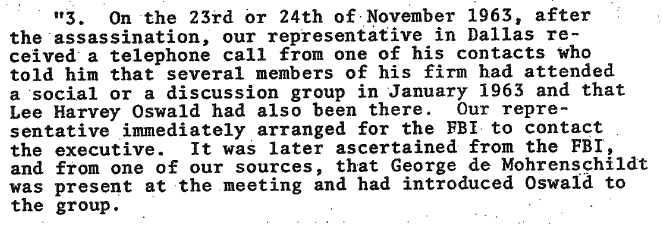
The Helms Report forwarded to Rankin embellishes Moore's inexplicable response to the alarming call as described by Moore himself in an April 20, 1964 Headquarters Memo. Presumably, the basis for the Helms report, and Moore's actions, are decidedly more bizarre.
Here is an excerpt, filled with later handwritten notations and redactions by other agents, followed by the memo's transcription:
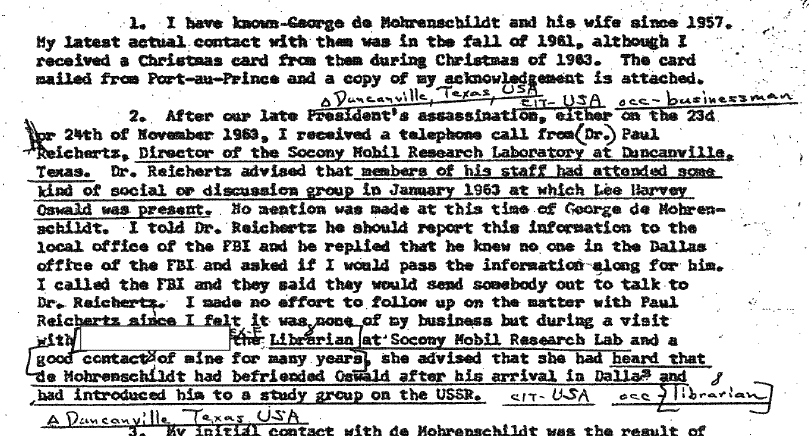
Here is the above memo excerpt transcribed:
1. I have known George de Mohrenschildt and his wife since 1957. My latest actual contact with them was in the fall of 1961, although I received a Christmas card from them during Christmas of 1963. The card mailed from Port-au-Prince and a copy of my acknowledgement is attached.
2. After our late President's assassination, either on the 23rd or 24th of November 1963, I received a call from (Dr.) Paul Reichertz of the Socony Mobil Research Laboratory in Duncanville, Texas. Dr. Reichertz advised that members of his staff had attended some kind of social or discussion group in January 1963 at which Lee Harvey Oswald was present. No mention was made at this time of George de Mohrenschildt. I told Dr. Reichertz that he should report this information to the local office of the FBI and he replied that he no knew one in the Dallas office of the FBI and asked if I could pass the information on for him. I called the FBI and they said they would send somebody out to talk to Dr. Reichertz. I made no effort to follow up with Dr. Reichertz since I felt it was none of my business but during a visit with [redacted] the Librarian at Socony Research Lab, and a good contact of mine for many years, she advised that she had heard that de Mohrenschildt had befriended Oswald after his arrival in Dallas and had introduced him to a study group on the USSR." [emphasis added][9]
I don't presume to understand CIA protocol, but here you have the CIA Chief in Dallas, receiving a phone call 1 or 2 days after the JFK assassination from an acquaintance (Dr. Paul Reichertz) stating he had met the President's alleged assassin, and the first thing Moore does is tell Reichertz to contact the FBI, and wash his hands of it? Only after the friend protests that he knows no one at the FBI does the CIA Chief finally call the FBI on his behalf, like it's some sort of chore, so much so that he feels the need to actually stress the fact that "I made no effort to follow up with Dr. Reichertz since I felt it was none of my Business." It's kind of like he is telling his bosses, "I know I'm not supposed to do this, but I was forced. So don't blame me." It is also illustrative of the well-documented historical animosity between the CIA and FBI.
Though he tried his best, Moore could no longer look the other way after another friend of his, an oil company librarian (later ID'd as Maryann Duggan), informed him that his buddy, George de Mohrenschildt, had introduced the alleged assassin at a "study group on the USSR" (later ID'd as the party where Oswald met Volkmar Schmidt on February 22, 1963).[10] Moore now had no choice but to request a new background check on de Mohrenschildt (conveniently forgetting the identical one provided him in 1958), the results of which were unsurprisingly negative. At which point Moore cut off all contact with de Mohrenschildt, as further documented in the aforementioned Russell B. Holmes CIA Memo:[11]

We must ask why the Dallas CIA Chief would go out of his way to turn his head in the opposite direction while all Intelligence agencies were supposedly scrambling for any shred of information?
Unless, of course, Moore felt he already knew all there was to know about George de Mohrenschildt. Including the fact that he was the one who instructed the Baron to introduce himself to the alleged assassin.
Bill O'Reilly vs Ed Epstein
The Battle of the "Reality Deficient"
The Warren Commission never formally interviewed J. Walton Moore, and the HSCA would not interview him until March 1978. Yet nearly one year earlier, a lone reporter was hot on the trail.
In 2015, George de Mohrenschildt briefly reentered the national news spotlight. But the focus was not on the larger story of all the Baron's intelligence connections, nor his revelation tying his friend Lee Harvey Oswald to the CIA. The news media wasn't interested in that. The main focus was on Bill O'Reilly's swiftly debunked sensational claim in his book Killing Kennedy that O'Reilly was on the porch of de Mohrenschildt's residence about to ring the doorbell when he heard the suicidal shotgun blast that killed him. And who was the primary debunker? Edward J. Epstein! An outraged Epstein wrote a Newsweek article dated 3-9-15 titled O'Reilly's JFK Reporting Was Impossible. I Know Because I Was There.
Epstein writes:
In his 2012 best-selling book Killing Kennedy: The End of Camelot, [O'Reilly] wrote himself—as a 29-year-old reporter—into the de Mohrenschildt death scene, stating on page 300: "As the reporter knocked on the door of de Mohrenschildt's daughter's home, he heard the shotgun blast that marked the suicide of the Russian, assuring that his relationship with Lee Harvey Oswald would never be fully understood. By the way, that reporter's name is Bill O'Reilly."
But O'Reilly's insertion suffers from a reality deficiency disorder. How do I know? I was the actual—and only—reporter interviewing de Mohrenschildt on the last day of his life in 1977. I was meeting him at the Breakers Hotel in Palm Beach, Florida, because I was writing a biography of Oswald…
Epstein, somehow neglecting his own "reality deficiency disorder" regarding his final conversation with de Mohrenschildt, goes on to cite the multiple witnesses in the mansion where de Mohrenschildt shot himself, none of whom recounted a reporter on the doorstep. And also the absurdity that if O'Reilly truly was on the doorstop, why wouldn't he have reported the sensational story at the time?
The sole focus of the flurry of media articles in 2015 was on debunking O'Reilly's fabrication. Yet if any one of those reporters had bothered to dig a little further, they would have found that many years before, on April 11, 1977, a little over a week after de Mohrenschildt's death, that same Bill O'Reilly (then an investigative reporter for WFAA-TV in Dallas) rang another doorbell accompanied by a full camera crew; only this door wasn't imaginary. It belonged to the office of J. Walton Moore. Not only that, but O'Reilly had also interviewed de Mohrenschildt's wife, Jeanne, regarding Moore as part of that same report! An episode inexplicably left out of O'Reilly's Killing Kennedy, which might have been lost entirely (the video most likely long since wiped), if not for a detailed transcript meticulously transcribed by J. Walton Moore himself in a CIA Memo.[12]
Here are some excerpts beginning with his interview with Jeanne:
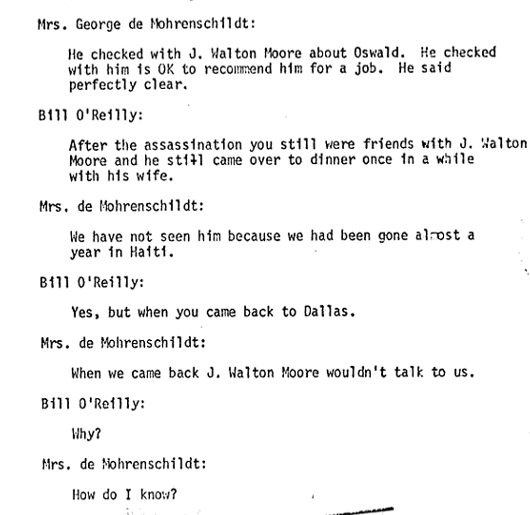
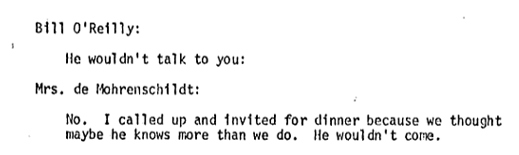
O'Reilly then followed his hot lead to its conclusion outside Moore's office, where Moore bravely refused to open up to the intruder, opting instead to speak to O'Reilly through a telephone in the outer foyer.
Let's rejoin Moore's exciting transcript:
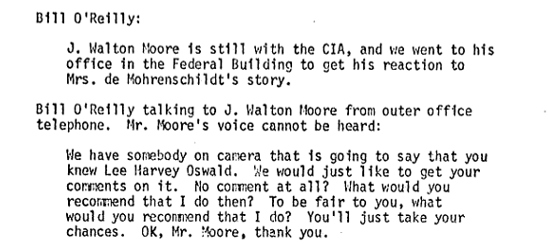
But it didn't end there! The next day, Moore's office received a rather goofy, mysterious phone call. The fact that Moore appended the transcript of the O'Reilly report documenting the call implies a suspected connection to the previous day's visit.

"Morris" Bishop undoubtedly referred to "Maurice" Bishop, reportedly the alias of CIA spymaster David Atlee Phillips, alleged associate of Oswald (and perhaps knew Jeanne de Mohrenschildt). Did the caller really expect "Bishop" to answer?
As we have seen, both Moore and the Bouviers, perhaps with the advice of Allen Dulles, slammed the door in George DeMohrenschildt's face after the assassination. When all he did was follow instructions.
(Next part coming soon.)
_____________
[1] Edward J. Epstein, Legend: The Secret World of Lee Harvey Oswald (Reader's Digest Press/ McGraw Hill, 1979) p 178
[2] Edward J. Epstein, Legend: The Secret World of Lee Harvey Oswald (Reader's Digest Press/ McGraw Hill, 1979) p 179
[3] Russell B. Holmes, Memorandum For The Record (April 7, 1977, NARA Record #104-10103-10149)
[4] Greg Poulgrain, The Incubus of Intervention: Conflicting Indonesia Strategies of John F. Kennedy and Allen Dulles (Strategic Information and Research Development Centre, 2015) p 114
[5] Greg Poulgrain, The Incubus of Intervention: Conflicting Indonesia Strategies of John F. Kennedy and Allen Dulles (Strategic Information and Research Development Centre, 2015) pp 117-120
[6] Greg Poulgrain, The Incubus of Intervention: Conflicting Indonesia Strategies of John F. Kennedy and Allen Dulles (Strategic Information and Research Development Centre, 2015) p 116
[7] Russell B. Holmes, Comments on George de Mohrenschildt "Reputed Former CIA Agent" April 7, 1977 (CIA Record #104-10103-10149) p 2
[8] Richard Helms, Memo for Mr. J. Lee Rankin Subject: George and Jeanne de Mohrenschildt, June 3, 1964 (reproduced in Holmes doc CIA Record #104-10103-10149) Tab B, pp 7-9
[9] J. Walton Moore, Headquarters Memo 20 Apr.64 p 1
[10] Weiford, p 440-441
[11] Russell B. Holmes, Comments on George de Mohrenschildt "Reputed Former CIA Agent, April 7, 1977 (CIA Record #104-10103-10149) p 4
[12] J. Walton Moore, CIA Memo to Chief Collection Division, 4-13-77/ NARA Record Number: 104-10428-10196
