
George de Mohrenschildt’s Final Interview: Part 4
Scattered Puzzle Pieces are Fitted Together
The End of George
Day Two: March 29, 1977 (Continued)
A Visit From The House Investigator
by Dan Carbone
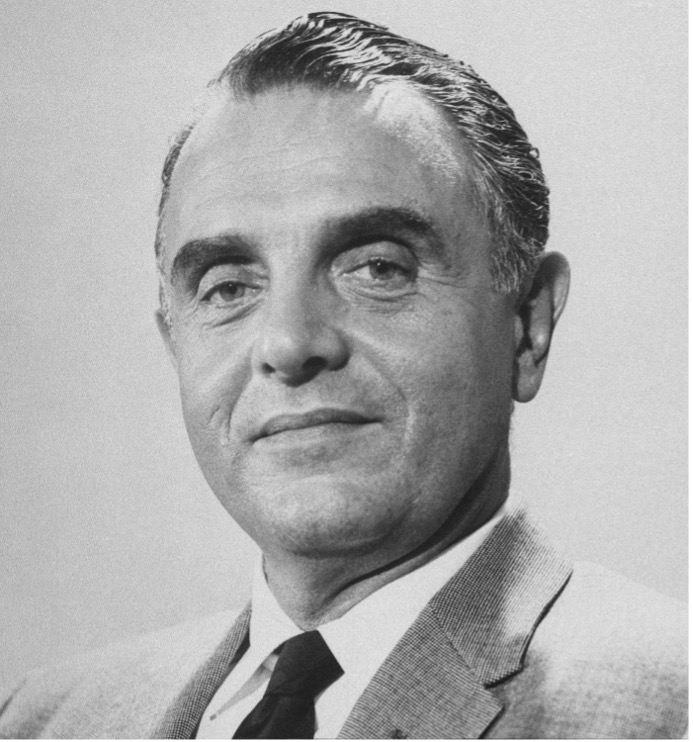
While George was being interviewed in Palm Beach, the HSCA had sent its investigator, Gaeton Fonzi, in search of him. He left his calling card with George’s daughter where George had been staying in Manalapan. The HSCA was able to track George because, in his haste to fly with Dutch journalist Willem Oltmans on an ill-fated tour of Holland the previous month, George left his car in Dallas in care of Oltmans’ friend David Russell. An entire article could be devoted to the disastrous Holland trip, but for now we will keep the focus on George’s final day.
George’s close friend Jim Savage (another oil company executive) later told the FBI that on March 24th 1977, three days before his interview with Epstein, George called from Manalapan:
“[…] extremely upset and depressed,” mostly over his separation from Jeanne and his health, which had “gone to pot. He asked Savage if he could pick up his car in Dallas from Russell, whom he said he didn’t know, and stated he’d been on a trip with Oltmans, working on a story, but that he didn’t trust “these guys.” Savage agreed to pick up the car, and invited George to come back to Houston where he’d help him get a job “in the oil patch.”[1]
The next day George called Russell and told him Savage would pick up the car.[2]
Russell then called Oltmans, and Oltmans called Robert Tanenbaum of the HSCA, who had been searching for George, and alerted him to George’s whereabouts. Tanenbaum, in turn, immediately dispatched Fonzi.[3]
George returned to the mansion of Nancy Tilton (his daughter Alexandra’s wealthy aunt) in Manalapan for the lunch break. We follow what happened next in an FBI memo:
“Daughter Alex, advised [George] approximately 1:30 pm, March 29, 1977 that [Gaeton] J. Fonzi of the House Committee investigating the assassination, had been at the residence earlier looking for [George] and according to his daughter [George] was quite upset by the news and wanted to flee from the area.”[4]
One can just imagine the thoughts racing through George’s head. He probably wondered how on earth the HSCA had found him. He already had a deathly fear that investigators were out to arrest him because of the Dallas News article. Did he also, like Epstein, surmise the hotel room was bugged? After all, he’d just opened up about his CIA contact, the Oswald Backyard Photo, and what he said went down the night of the Walker shooting. Might he have also wondered if Epstein himself had alerted the authorities?
George also had concerns about his Oswald manuscript, the pages of which attacked:
- Ex-CIA Director Allen Dulles
- The Warren Commission
- A menacing FBI Agent named Wood sent by Director J. Edgar Hoover to threaten George in Haiti
- Members of the Kennedy family itself for their complete incuriosity about the assassination investigation
Plus further details about:
- CIA Chief J. Walton Moore confirming that Oswald was “OK.”
- A Bay of Pigs Invasion observation that wouldn’t become public till decades later
Like an Agatha Christie Novel
The rest of the afternoon unfolded like an Agatha Christie novel. Details were derived from the Sheriff’s Office Death Investigation Report and journalist Nancy Wertz Weiford. [5]
Before leaving for a bridge game, Nancy Tilton asked her maid to audio-record her favorite soap opera, The Doctors, in her bedroom.
Nancy’s cook served George lunch, after which she went to the post office, came back and donned a bathing suit and went into the backyard to sun herself.
A gardener was outside watering the grounds and performing general maintenance work.
Above the Tilton garage, a couple of neighbors were busy renovating an apartment.
George asked Alexandra to pick up a few toiletry items for him as she was going shopping. She recalled, “I said okay and went off with my friend to do just that. I did not know he was just trying to get me out of the house for the time.”[6]
George then went upstairs to his bedroom and lay on his bed reading a book. A hardback copy of The Sensuous Woman was later found on his bed. The maid saw him from time to time in the midst of her chores, and he asked if his daughter had returned. She had not. The maid was in Tilton’s bedroom doing housework when George came out of the room complaining of hearing cat noises, like a cat scratching, that were bothering him. She assured him that there was no cat in the residence, but he paced up and down the long hallway calling for a cat. The maid later told the FBI she thought him “slightly mad.”
Around this time, the maid turned on the tape recorder in Tilton’s room to record her soap opera. After that, she went downstairs to the kitchen where she had a conversation with the cook.
A total of five people were in and around the residence, yet no one heard the shotgun blast from the second floor as George sat in a chair in the hallway and blew his brains out with a shotgun and shells he’d grabbed from Nancy’s bedroom. The sound of the shot was captured on Tilton’s tape recorder a few seconds after a Betty Crocker frosting mix commercial, as well as his daughter’s horrified screams upon discovering his body when she’d return to give him his toiletries about 10 minutes later.
Investigators speculated that no one heard the shot because it was absorbed by George’s body, the carpet and various furnishings.[7]
Tilton told the FBI she had kept the rifle in her room by her bedside. I could find no reason why she had heard noises in the house in recent days.[8]
Detectives found the Dallas Morning News article about his mental breakdown and hospitalization in his left pants pocket.
The coroner concluded George died from a single, “gunshot wound to the brain, which was indicative of suicide.”[9]
What Did Ed Know? And When Did He Stop Knowing It?
Edward J. Epstein initially burst out of the momentous de Mohrenschildt interview wanting to tell the world about what he’d learned. Only a few days later, he would gab about George’s revelation concerning J. Walton Moore to the Dallas Morning News:
[de Mohrenschildt] said he’d have never seen Oswald without Moore’s encouragement. And Epstein speculated it was just a matter of time before Moore was called before the HSCA.[10]
Moore was never called before the HSCA. And when Epstein’s Reader’s Digest, April 1978 article came out a month later, Moore’s name was nowhere to be found. Digest readers were instead informed that George met Oswald under “circumstances he would never fully disclose.”[11]
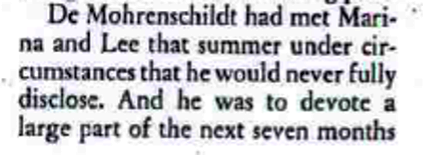
In other words, a complete and utter lie.
The article even includes a special highlighted section written by “The Editors” titled “The Death of George De Mohrenschildt” which ends with the following sentence:
[…] De Mohrenschildt was found shot to death in what appeared to be a suicide, leaving a gap in Oswald’s secret world that will never be completely filled in.[12]
Yes, especially when you are doing all you can to pave everything over with a thick layer of concrete.
A Book Jacket Promise Unfulfilled
The book jacket for Legend: The Secret Life of Lee Harvey Oswald, published in 1978, promised a tantalizing interview:
George De Mohrenschildt, the mysterious figure who arranged significant portions of Oswald’s life, granted the author a four-day interview in 1977 to tell his story. Although the interview was never completed – De Mohrenschildt was found shot to death, an apparent suicide, on the second day – this book reveals for the first time the content of his final interview.
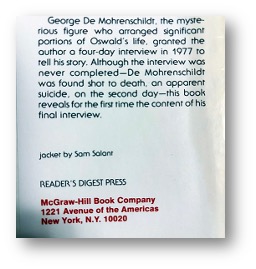
Yet within the book’s pages, the details of the interview are all jumbled. George’s direct comments are replaced by a garbled story that makes no sense. George is now made to meet Oswald entirely of his own volition through vaguely remembered friends of his in the Dallas Russian community. He later becomes suspicious that the CIA might be monitoring him because of his association with Oswald after George’s apartment is broken into and his manuscripts are rifled through. So he confronts Dallas CIA Chief J. Walton Moore, who flatly denies everything and assures George that Oswald is “merely a ‘harmless lunatic’ of no use to the agency.” [13]
None of this makes any sense because although it implies some sort of CIA foreknowledge of Oswald, it leaves out the most important part – that Moore directed George to Oswald, the “harmless lunatic,” in the first place.
Almost as an afterthought, other parts of George’s interview are buried in small print in an appendix entitled “Final Questions for Intelligence Agencies” at the very end of the book, a part that many readers are likely to gloss over. The contents of this appendix are not even included in the book’s main index!
Epstein’s very first question to the CIA states:
George Sergius De Mohrenschildt told me in an interview a few hours before he committed suicide that he had been encouraged to maintain his contacts with Lee Harvey Oswald by J. Walton Moore, an employee of the CIA’s Domestic Contact Service in Dallas, in 1962. Did de Mohrenschildt, in fact, discuss Oswald with Moore? If so was it for the purpose of gaining information for the CIA? Did the CIA’s inspector general or other investigative element conduct an investigation into the Dallas office of the Domestic Contact Service to ascertain whether there were any direct or indirect contacts with Oswald?[14] [emphasis added]
The question is twisted. In this revised history, George is now being “encouraged to maintain his contacts” by Moore. A distortion of George’s statement that Moore directed George to initiate contact with Oswald.
At any rate, the CIA could care less about any of this, and responded to Epstein’s request thusly:
[… ] we have reviewed your questions carefully and have determined that they do not constitute a request for reasonably described records as prescribed in the Freedom of Information Act.[15]
Mark Lane’s Savage Review
Mark Lane, never one to mince words, wrote a savage review of Epstein’s resulting book:
[Oswald] the forgotten, inept and hated loner of the early 1960’s returns to us in the late 1970s as a cool, KGB-trained killing machine, courtesy of FBI Director J. Edgar Hoover’s favorite dissemination belt of false information, the Reader’s Digest, and the questionable theories of an author who put his legitimizing credential as ‘Critic of the Warren Commission Report’ on the line for a budget of $2 million. No one dare call Edward Jay Epstein, author of the Reader’s Digest book, Legend: The Secret World of Lee Harvey Oswald, a cheap whore.[16]
As James DiEugenio recently pointed out, the book’s 2 million budget (worth 10.9 million today) was a staggering sum for such a project at the time, as was Epstein’s $500,000 advance (over 2.5 million today).[17]
As Lane suggests, could it have been that Epstein learned more than he was being paid a substantial amount of money to learn? After all, what George would reveal flew in the face of Epstein’s book’s central thesis (i.e., Oswald as a probable KGB agent) and pointed instead squarely toward another far more homegrown, three-letter agency.
The Man Who Really Knew Too Much
In his Epilogue to The Assassination Chronicles, titled “The Man Who Really Knew Too Much,” published in 1992, as a compilation and summation of his three previous books on the subject, Epstein muses that George might have been attempting to pull the poor, innocent CIA down with him as some sort of last vengeful red herring. Epstein then provides his own red herring: that de Mohrenschildt dragged the CIA into it “to divert from his own guilt in not reporting the Walker shooting – or from some more sinister connection he had. I therefore could not accept de Mohrenschildt’s story without serious confirmation, which was not to be forthcoming.” [18] Being the dutiful journalist, he merely wished to verify George’s words with the CIA first, neglecting to see the irony that Epstein himself was having his own troubles reporting the truth of what occurred during those final two days. Epstein then relates how he was stonewalled by the CIA in 1978.
The CIA fully recognized most of the public wasn’t buying the government’s lone-nut theory, so they simply devised another. You want a conspiracy? We’ll give you a conspiracy: “Oswald as a KGB asset.” And it just so happened that this had also been Epstein’s book’s central thesis, exactly as the CIA wished. George had just leveled all that. Did Epstein really expect the most corrupt agency on the planet to rock the boat by admitting they were the ones that steered George toward Oswald?
Epstein then reports that the HSCA subsequently gained access to Oswald’s CIA file. In the previously classified file, Moore acknowledged that though he did not remember discussing Oswald with George, he may have been in contact with George well into the Oswald period of their relationship in 1962. And though the new documents didn’t detail George’s contacts with Moore, they did relate George’s meetings with Intelligence contacts in Washington both before and after the Walker shooting. According to the documents, these meetings mostly dealt with debriefings about George’s simultaneous wheeling and dealing in Haiti with Papa Doc Duvalier (again worthy of an entire article) as he hopped back and forth between Dallas and Haiti while juggling his duties with Oswald. Yet as Russ Baker, among others, has suggested, it’s hard not to imagine the subject of Oswald didn’t come up at these meetings as well.
Then comes the kicker. Epstein states this is his personal “smoking gun.”
[…] a well-respected CIA analyst […] in the summer of 1962 […] clearly remembered data coming from a CIA field office on the operations of [a] Minsk electronics factory in the form of ‘contact reports.’ He recalled that these reports had been based on the experiences of a U.S. ex-Marine who had worked at the Minsk plant after his defection to the Soviet Union. Since there was only one ex-Marine who had worked in this particular Minsk factory, the source of this information had to be Lee Harvey Oswald. Since Oswald himself had not been openly debriefed by the CIA, as the committee established, the technical details in the ‘contact reports’ that the local field office were relaying to the analyst in the CIA’s Foreign Document Division had to be coming from an intermediary. Presumably this ‘contact’ had begun eliciting data from Oswald in the summer of 1962.[19]
This was the exact time period George had access to Oswald’s Minsk diary. Epstein then wonders what happened to all the contact reports and routing slips that went between Dallas and Washington? The HSCA found no trace of them. There was, however, evidence of an expiated check on de Mohrenschildt in April 25, 1962, completed on April 29th from the CIA’s Office of Security, the CIA’s “internal police force.” According to Epstein’s research, for persons who were not CIA agents, the Office of Security routinely forwarded such requests to the FBI to handle. But in this case it did not, “even though the CIA was prohibited by law from operating in the United States. But there was one exception, if “the CIA had a ‘proprietary relationship whose cover would be endangered by a non-CIA inquiry.”[20]
Epstein concludes:
Whatever de Mohrenschildt might have said that April about Oswald, Walker, Haiti, or other matters, the contact reports that cover that period do not exist in his CIA files. If they ever existed, they were purged after the assassination. De Mohrenschildt was evidently the man who knew too much.[21]
Ed’s Final Curveball
When Epstein wrote Legend: The Secret Word of Lee Harvey Oswald back in 1978, he appeared to ascribe to the “lone gunman” theory, but was willing to concede that Oswald may have been a KGB asset. Yet over the decades, his opinion appeared to have evolved.
Asked “who was responsible for the assassination,” during a 2012 interview on the “Education Forum” website, Epstein was unequivocal in his response:
“The CIA.”
The interviewer pressed, “Who at the CIA?”
Epstein stated he had no idea.
The interviewer’s impression was that Epstein’s “work investigating the assassination was quite early, and Ed seemed to have moved on from paying attention to the assassination […] He knew a lot from firsthand experience, but he seemed not to have paid much attention to the work of other researchers.”[22]
>Ed apparently paid enough attention to come to his conclusion. And a bitter pill it was to have finally reached the same conclusion as his lifelong nemesis, Mark Lane, decades earlier. Or maybe, like George de Mohrenschildt, he finally said to hell with it and let his true feelings be known.
The Backstory
This series concentrated on the last two days of de Mohrenschildt’s life. A second series entitled “The Backstory” will detail the years leading up to his final two days, including forgotten incidents regarding his friendship with Oswald, the Backyard Photo, J. Walton Moore, his drugging by a doctor who disappeared, Haiti, the origins of George’s “Jewish Mafia” complex, his brother Dimitri and his wife’s Intelligence Connections and more journalistic shenanigans and cover-ups.
Click here to read part 1.
_________
-
FBI Interview with Jim Savage, Investigation Conducted at Houston, Texas to Locate George de Mohrenschildts’ Automobile, 4-4-77.(File# HO 62-115) p 51
-
Willem L. Oltmans, Reporting on the Kennedy Assassination (University Press of Kansas, 2017) p 116
-
Willem L. Oltmans, Reporting on the Kennedy Assassination (University Press of Kansas, 2017) p 116
-
FBI Memo MM 89-35 EFTO dated March 30, 1977 p 6. Note: The original document misspells Gaeton J. Fonzi's first name as "Gastan."
-
Det. Thomas Neighbors, Sheriff’s Office Palm Beach County, Death Investigation (Report Case #77-11753, 3-30-77) pp 1-18 / Weiford pp 663-679
-
Nancy Wertz Weiford, The Faux Baron: George de Mohrenschildt (Lumiere, 2013) p 664
-
Weiford pp 666-667
-
Russ Baker, Family of Secrets (Bloomsbury Press, 2009) p 277
-
Weiford p 672
-
Earl Golz, Dallasite debriefed Oswald after return, author says (Dallas Morning News, March 30, 1978) p 26A
-
Edward J. Epstein, Book Selection: Legend The Secret World of Lee Harvey Oswald, Part II (Reader’s Digest, April 1978) p.176
-
Edward J. Epstein, Book Selection: Legend The Secret World of Lee Harvey Oswald, Part II (Reader’s Digest, April 1978) p.197
-
Edward J. Epstein, Legend: The Secret World of Lee Harvey Oswald (Reader’s Digest Press/ McGraw Hill, 1979) p 186
-
Edward J. Epstein, Legend: The Secret World of Lee Harvey Oswald (Reader’s Digest Press/ McGraw Hill, 1979) p 362
-
Edward J. Epstein, Legend: The Secret World of Lee Harvey Oswald (Reader’s Digest Press/ McGraw Hill, 1979) p 363
-
Mark Lane, The Assassination Of President John F. Kennedy: How The CIA Set Up Oswald (Hustler, Oct 1978) p37
-
James DiEugenio, Edward Epstein: The Critic Who Flipped (kennedysandking.com 1-28-24)
-
Edward J. Epstein, The Assassination Chronicles, (Carroll & Graf Publishers, 1992) p 561
-
Edward J. Epstein, The Assassination Chronicles, (Carroll & Graf Publishers, 1992) p 565
-
Edward J. Epstein, The Assassination Chronicles, (Carroll & Graf Publishers, 1992) p 566
-
Edward J. Epstein, The Assassination Chronicles, (Carroll & Graf Publishers, 1992) p 569
-
Mark Gorton, Ed Epstein's tale of George De Mohrenschildt's last day,(The Education Forum, 7-8-12)


