
George de Mohrenschildt: Reconsidering Oswald’s “Babysitter”
Series 2, Part 1: The Backstory
by Dan Carbone
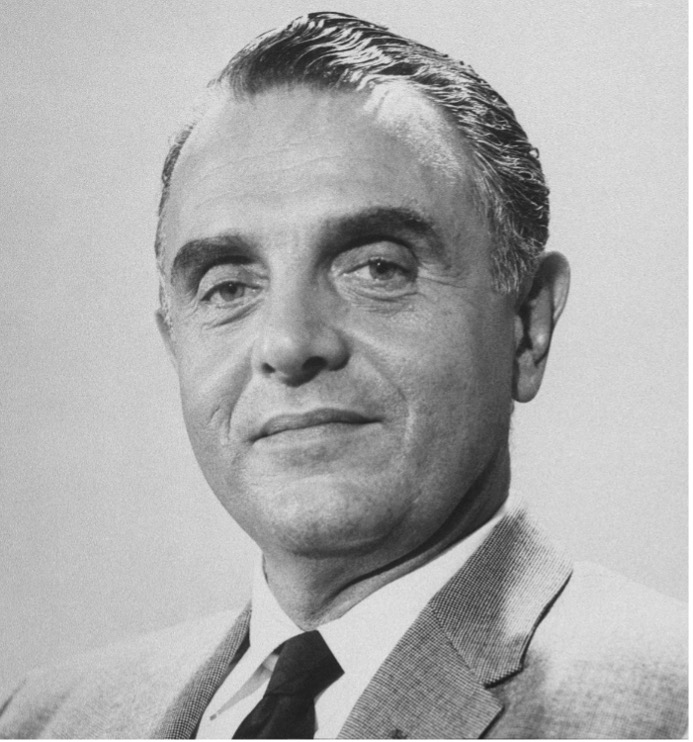
“George de Mohrenschildt was a wonderful undisciplined creature of nature… although the economic realities of life have given him much trouble he is a man who owes allegiance to mankind and not to any particular country.” – Sam Ballen, Texas oil executive.
Editor’s note: The four parts of the first series (“George de Mohrenschildt’s Final Interview”) may be found here: part 1, part 2, part 3, part 4.
George’s Myriad of Intelligence Connections
"A whole new subterranean level to the story”
Oilman Jim Savage told the FBI that on March 29, 1977, he was listening to the radio when he heard of his buddy, George de Mohrenschildt’s death. He phoned a man named David Russell, who had been watching George’s car while George was in Holland on a disastrous trip with Dutch journalist Willem Oltmans. Russell was a friend of Oltmans.
According to an interview that Russell gave to the FBI, as detailed in depth in Russ Baker’s Family of Secrets:
Savage had behaved strangely; among other things, he had seemed intent on avoiding a face-to-face meeting. Oltmans’ friend was instructed to leave the car in a parking lot and slip the keys under an apartment door.[1]
The reason Savage acted strangely is that, according to Savage’s FBI interview, George had called him a few days before and stated he did not know Russell and though he had been working with Oltmans, he didn’t trust “these guys.”[2] But what of Savage himself? Had the FBI bothered to pursue his background, they would have discovered Savage’s own connections, and what Baker deemed “a whole new subterranean level of the story” that would lead to recently departed CIA Director and soon-to-be President George H.W. Bush.[3]
Oil Industry Roots & Allen Dulles
George was born in 1911 in Belarus to a long line of aristocratic nobility.
As Russ Baker points out in Family of Secrets:
The de Mohrenschildts were major players in the global oil business since the beginning of the twentieth century… [George’s] uncle and father ran the Swedish Noble Brothers Oil Companies operations in Baku, in Russian Azerbaijan […] this was no small matter. In the early days of the 20th century, the region held roughly half of the world’s known oil supply. By the start of WWI every major oil interest in the world including Rockefellers’ Standard Oil was scrambling for a piece of Baku’s treasure or intriguing to suppress its competitive potential.[4]
Eventual CIA Director Allen Dulles was a lawyer for Standard and negotiated on its behalf with George’s father. George and Dulles would later meet under tense circumstances when George testified before the Warren Commission. George stated in his memoir “I Am A Patsy” that though the ex-CIA Director did not interfere, his silent presence was an obvious implied “distant threat.”[5]
Brother Dimitri & Uncle Ferdinand
George’s diplomat uncle, Ferdinand von Mohrenschildt (George changed the “von” to a “de”), was dispatched to America by the Russian government in 1915 to plead for intervention by the American army against the Germans crushing the Czarist forces. According to Baker, Uncle Ferdinand was an “instant hit on the Newport, Rhode Island, millionaires’ circuit.”[6] Thus, the beginning of George’s connections to American bluebloods.
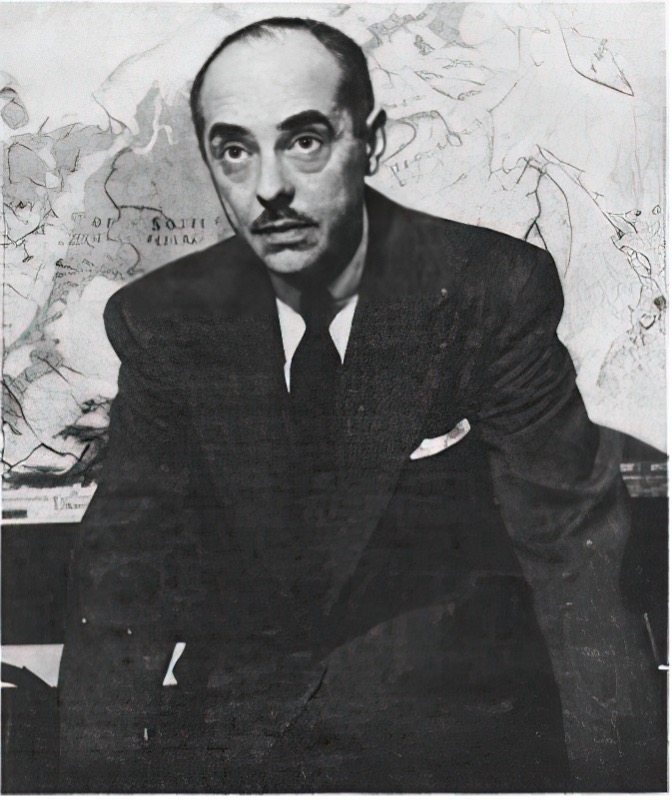
Professor Dimitri von Mohrenschildt
George’s older brother, Dimitri von Mohrenschildt, arrived shortly after Ferdinand in 1920 and married Betty Hooker, ex-wife of Roland Hooker, Mayor of Hartford, and close friend to Jacqueline Kennedy’s family, the Bouviers[7]. Betty’s first cousin married John D. Rockefeller. Dimitri graduated from Yale, served in the Office of Strategic Services (OSS), a forerunner of the CIA, was a co-founder of Radio Free Europe, and a co-editor of Radio Liberty, and the CIA subsidized “Russian Review,” where his father’s old acquaintance Allen Dulles was a fellow contributor. Dimitri kept in touch with Dulles over the ensuing years, as documented by researcher Bruce Adamson.[8] Dimitri’s final position was as a professor at Dartmouth.
Curiously, George mentions his distinguished brother not at all in his autobiography.[9] George’s biographer Nancy Wertz Weiford asserts that when George arrived in the USA in 1938 into the very highest levels of society, he carried with him “a deep resentment” toward Dimitri for escaping from Russia, leaving George and his parents in “severe strife” under the Bolsheviks. Having fled to Poland, all three caught typhoid, and his mother died. [10]
>It is difficult to conceive how conversations between the brothers during the ‘60s must have gone considering the enormous embarrassment caused by George’s intimate involvement with the alleged assassin of the President. Yet despite their differences, one must wonder if Dimitri’s lofty Intelligence connections kept his brother George alive for some of his nine lives.
Phyllis Washington
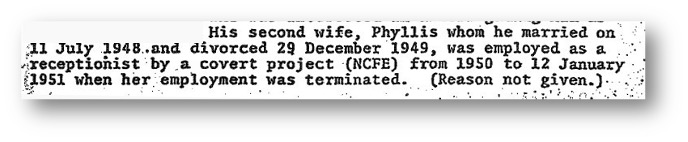
George was married 4 times, and two of his wives had Intelligence connections. George’s second wife, Phyllis Washington, was employed as a receptionist for the NCFE (National Committee for a Free Europe) from 1950-1951, referred to in a declassified CIA memo as a “covert project.”[11]
Jeanne le Gon
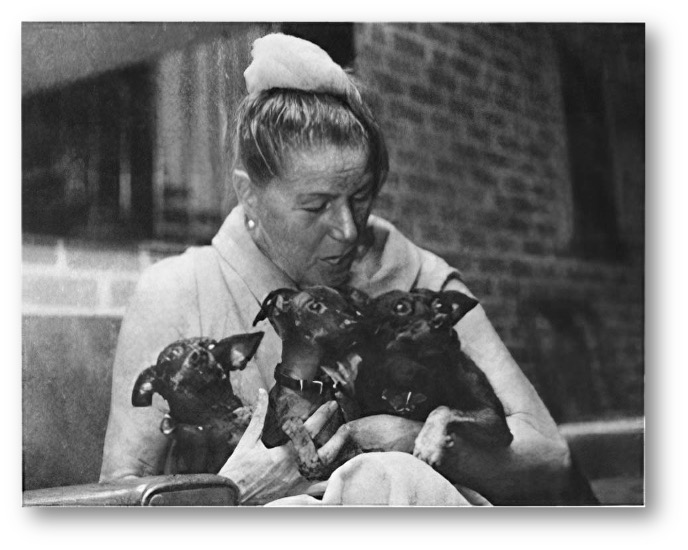
Jeanne de Mohrenschildt with Nero, Poppaea & Cinderella. “[Oswald] was a wonderful human being that my dog loved. The dog knows who is bad and who is good. And Oswald was good, because they stood up, the father and mother, and came close to him and set directly next to him without any barking, and believe me when they see a stranger of anybody who have anything malice in his mind, they will bark. This is the baby, he does not know anything yet. But these two knew Oswald and they never barked to him.” – Jeanne de Mohrenschildt [12]
In 1957 George would meet his fourth wife, clothing designer, Jeanne Le Gon. Jeanne was the daughter of the Director of the Chinese Far East Railway. During interviews with CIA operatives, journalist Michael Kurtz discovered almost by accident that Jeanne had a “long history” of working in Intelligence and was acquainted with Richard Helms, Hunter Leake, and David Atlee Phillips.[13] Kurtz claimed that Phillips and James McCord called him because they appreciated his conclusion that the CIA was not involved in the JFK assassination and that their past association with Jeanne came up incidentally in those conversations.[14]
In addition, Jeanne’s brother Sergei Fomenko was a nuclear physicist who worked on the Manhattan Project with Robert Oppenheimer.[15]
While Jeanne claimed to have met George by chance lounging around a pool in a Dallas Apartment complex they both inhabited, it is questionable considering their intelligence connections.[16]
To make matters more confusing, sometimes Phyllis Washington and Jeanne Le Gon are confused for each other in various Intelligence reports.
Admirals and Colonels and Oilmen All!
Colonel Orlov
Soon after George met him, Oswald, the broke, ex-marine defector - alleged traitor to his country – was soon hanging out with a bewildering array of oilmen, colonels and admirals… all prominent people.
George told the Warren Commission his memory was hazy about who first gave him Oswald’s contact information. He pointed to various members of the Dallas Russian Community, though all disputed his account. And he later admitted on the last day of his life to journalist Edward J. Epstein that he first met Oswald in the summer of 1962 under instruction from his contact, Dallas CIA Chief J. Walton Moore.
When the Baron went to visit Oswald in a Fort Worth slum where the sullen “loner” was living with his wife and daughter, he was accompanied by George’s “good friend” Col. Lawrence Orlov, another oilman and “handball” partner of Moore. What neither George nor Col. Orlov knew at the time was that both were secretly reporting to the Dallas CIA Chief about each other.[17] In the world of espionage, no one is above suspicion, least of all one’s good friends.
Moore and de Mohrenschildt were described by Moore himself in a 1964 CIA Memo:[18]
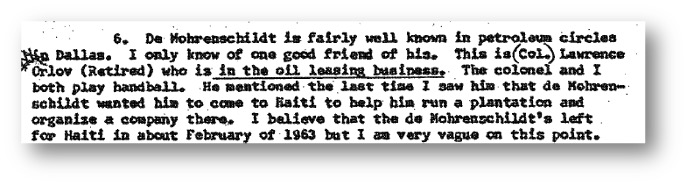
Despite George’s contention that this was his first meeting with Oswald, Orlov (later interviewed by Epstein in 1976) stated it was obvious that the two had met before.
The Other Colonel Orlov (Jeanne’s gaffe)
In my research, I became confused when I encountered a later FBI interview with Jeanne de Mohrenschildt in 1977 after George’s passing. When she was asked if George “knew a Colonel Orlov,” her description of Orlov was rather strange:
She advised that as far as she can recall Orlov called himself a Colonel because he had been in the Russian army after World War I or in that time frame.[19]
Yet Colonel Lawrence Orlov was American-born, of Russian descent. Could there have been another Colonel Orlov? Turns out there was. Alexander Orlov was a Soviet defector and a Colonel in the Soviet Secret Police who published the CIA-funded “Handbook of Intelligence and Guerrilla Warfare,”[20] as well as a bestseller about Stalin.[21]’m not sure what this slip-up points to, but it is weird. One would think the FBI investigators who broached the subject of Col. Lawrence Orlov with Jeanne would have been puzzled by this discrepancy and followed up on it. They certainly knew something about him; otherwise, why would they bother to bring him up in the first place?
Oddly enough, Dutch journalist Willem Oltmans also identified Orlov as being a “Russian Colonel” in his HSCA (House Select Committee on Assassinations) testimony, mispronouncing his name as “Orlof,” referring to a 1969 audio interview he conducted with George.[22] Although a review of the recording by this writer reveals that George correctly refers to Orlov as a “Retired United States Colonel.” One can attribute Oltmans’ mix-up to sloppy or sensationalistic journalism, but Jeanne’s misremembering is really odd, unless Jeanne had somehow encountered the other Orlov in some past time through her own connections.
George & Lee
Just how much de Mohrenschildt and Oswald actually knew or suspected about each other is unknown. Given the previously mentioned high level of paranoia at the time, it is logical the two had to have been somewhat wary of each other. Despite this, they seemed to form a genuine friendship. George’s commanding, fatherly, larger-than-life presence, a man who seemingly knew everyone, impressed Oswald. From all accounts, Oswald never had a bad word to say about George. For his part, when they first met, George was intrigued that Oswald lived in and photographed Minsk, the lost land of his youth. The two men bonded over Minsk and their mutual hatred for the FBI. Both were CIA-connected. Hoover’s FBI, always left out in the cold by the CIA, had hounded Lee for information since his return, and George’s life had been torn apart by the FBI’s incessant whisper campaign against him since his WWII arrival.
When they met, both men were broke and exhausted, having recently returned from their respective Latin American and Russian adventures, making George’s assistance to Oswald even more extraordinary. But perhaps that was another bonding point. Both had written diaries of their adventures. George had potential publishers for his. He recognized Lee as a hot commodity in that Lee was perhaps the only American (certainly the only Marine) who lived and worked in Russia during the Cold War and returned to tell the tale. Lee was bursting to tell people what he’d learned - that essentially the Russian people were exactly like the American people, with the same wants and desires. And that both populations were being kept down by their rotting governmental systems.
At the time, this was considered a dangerously radical position, and Lee appeared to have come to it on his own after experiencing both governments first-hand. And here was George encouraging Lee to tell his story, whereas the local Dallas Russian expatriate community treated Lee as a pariah for defecting. They shut him down, yet they lavished gifts and dresses on Marina, which annoyed him and caused more splintering in his troubled marriage. It seemed the couple had gone from one extreme to another. From the poverty of the communist system to the empty, alienating, bovine consumerism of the capitalist culture. George and Jeanne became full-time referees in the center of the young Oswalds’ marital battles. Could Lee have gravitated toward George out of loneliness? Here was a worldly, cultivated man listening to and encouraging him. At least in the beginning, Oswald respected and followed George’s guidance; until there would come a time when Oswald would spin outside of George’s control, and George would suspect he himself was being set up for some larger escapade.
Assuming the two were somehow made aware of each other as trusted Intelligence operatives, what was their mission? What was the ultimate goal?
George’s clandestine mission was more obvious. Help Lee get set up in the community, pump him for information, get him a job, get him to Dallas where he could be more easily observed, obtain Oswald’s diaries, and report everything back to Dallas CIA Chief J. Walton Moore in return for Moore’s help. George wished to obtain an oil exploration contract with Haitian President Duvalier. As he told journalist Edward J. Epstein in 1977, "I would never have contacted Oswald in a million years, if Moore had not sanctioned it. Too much was at stake."[23]
But what was Oswald’s mission during several months the two were together from the summer of ‘62 to April of ’63? I don’t believe Oswald had a mission, at least during the that early phase of their friendship. I think he was just trying to quietly survive until he got the call from whomever was controlling him. Then he would come alive.
On the subject of who was controlling Oswald, I am reminded of Oswald’s telling statement to his brother Robert after Oswald was interviewed by the FBI a couple of months before the JFK assassination regarding his supposed “defection” to Russia. According to Robert’s Warren Commission testimony, when the agents asked Oswald if he had ever been an agent of the U.S. Government, he didn’t exactly answer that he wasn’t. Lee told his brother that he laughed at the agents and responded, “Well, don’t you know?”[24] This apparently stuck in Commission lawyer Albert Jenner’s craw. When Robert came back for follow-up testimony a couple of days later, Jenner asked again for the exact phrase that his brother used, and Robert repeated that Lee said, “Well don’t you know, sir?”[25]
>When the Commission later interviewed John W. Fain,[26] the FBI agent who interrogated Oswald, one would think the commissioners would have followed up if Fain actually asked Lee the question Jenner was so intrigued by. And if so, did Fain blithely accept such a mysterious answer without further grilling the subject? But the Commissioners never followed up. The subject was dropped completely.
The Admiral Bruton Incident
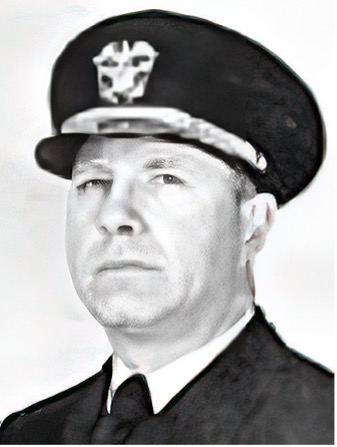
Admiral Henry Chester Bruton
From the start, George and Lee were an odd fit. All George’s contacts were very high level, hence the line of puzzled oilmen, businessmen and military brass Oswald was paraded before in hopes of landing a job. One of which was retired Admiral Henry Chester Bruton, former Naval Director of Communications in charge of the navy’s secret global military communication systems. Bruton now worked for Texas-based Collins Radio which built communication and avionics equipment for the U.S. Air Force presidential fleet. George devoted an entire chapter[27] to his “good friend” Bruton in his memoir. He mentions a poolside introduction in the summer of ‘62 with Bruton and Oswald at Bruton’s estate, and his attempt to get Oswald a job with Collins, which might have gone well under normal circumstances. Consider Oswald’s former credentials as a Marine radar operator with the highest security clearance, and his employment in a radio factory for about a couple of years.
According to George, Lee professed his disgust with the military brass and the Marines in general (maybe due to a nasty dishonorable discharge he’d been saddled with. This didn’t sit well with the Admiral. Yet Bruton hardly recalled meeting Oswald when interviewed years later by Edward Epstein. And far from being a ‘good friend” of the Admiral, the Brutons told Epstein they didn’t even know George and his wife Jeanne until they’d suddenly turned up on their doorstep earlier that summer. George said they just happened to be driving by, and seeing the Bruton’s estate reminded him of fond memories of partying with the estate’s former owner, George’s old friend Colonel Schruger, a Naval Intelligence engineer. George added that he had helped design the pool landscape (though Schruger later stated that was untrue). Franny Bruton was so entranced by the grand duke standing on her doorstep that she actually invited he and his wife inside to show them how she had renovated the place. Admiral Bruton was a little less taken with the couple but went along with the enchanted Franny when she invited the charming couple to come back to use the pool whenever they liked. And so they did - nearly every day that fine summer.
According to Epstein:
At one point, Admiral Bruton was taken aback when de Mohrenschildt showed a knowledge of the Navy crosses that Bruton had won as a submarine commander in the Pacific in World War II. Jeanne de Mohrenschildt later told [Epstein] she had come across these crosses while searching through bureau drawers in the Bruton home and later told her husband about them. (She never explained what she had been looking for in the Brutons’ drawers).[28]
By October, the de Mohrenschildts were getting fed up arbitrating the Oswald’s marital battles and recommended a trial separation. Toward that end, the de Mohrenschildts showed up one day at the Brutons’ while the Admiral was away on business in Europe. This time, the de Mohrenschildts were accompanied by Marina and her baby. While watching the others frolicking in the pool, George told a concocted story to Franny (along with a friend of Franny’s son, Army Captain Philip Weinert) about Oswald cruelly abandoning his family, leaving them out on the street to fend for themselves. And how poor Marina couldn’t even speak English. George and Jeanne had put her and her baby up for a few days at their place but they didn’t have enough space. Could Franny possibly put them up until they got some government assistance? It was an emergency situation and Franny felt so sorry that she was seriously considering it, when there was a knock on the front gate.
Epstein continues:
The Judge Duvall Incident
As further proof that George didn’t always know where Lee was or that he completely controlled what he was doing, in February ’63 he tried to get Judge J.C. Duvall, a new acquaintance of his, to assist Oswald in getting his Marine dishonorable discharge reversed. Oswald had bitterly complained about this to de Mohrenschildt and in a letter to then Secretary of the Navy John B. Connally, petitioning for reversal in Jan 1962 stating:
I have and always had the full sanction of the U.S. Embassy, Moscow, USSR. and hence the U.S. government. In as much as I am returning to the U.S.A. in this year with the aid of the U.S. Embassy, bringing with me my family (since I married in the USSR.) I shall employ all means to right this gross mistake or injustice to a bona-fide U.S. citizen and ex-serviceman. The U.S. government has no charges or complaints against me. I ask you to look into this case and take the necessary steps to repair the damage done to me and my family.[30]
Connally refused Oswald’s request. Here was Oswald’s big chance to undo the “gross mistake” staining his reputation and preventing him from higher job opportunities. Yet he had disappeared. According to a later FBI interview, Judge Duvall stated that George attempted to contact Oswald but was unsuccessful and “the matter was dropped and received no further attention.”[31] Although George mentioned Lee’s bitterness at the dishonorable discharge in his memoir, he never mentioned the Judge Duvall escapade and Lee’s odd disappearance to anyone. If not for Duvall, the incident would have been lost completely.
The Curious Man from Magnolia
George introduced Oswald to Volkmar Schmidt--one of George’s co-workers at Magnolia Laboratories, a subsidiary of Mobil Oil--at a party in late 1962. Schmidt engaged Oswald in a conversation in which Oswald expressed his impassioned opposition to the JFK Administration’s aggressive policies toward Cuba, resulting in the Bay of Pigs and Cuban Missile Crisis and argued that the continuing American-sponsored acts of hostility and sabotage were setting the stage for nuclear annihilation. A perfectly reasonable stance for any liberal at that time, (the public had no idea of JFK’s fury at his betrayal by the CIA with the Bay of Pigs fiasco).
According to Epstein:
[de Mohrenschildt] recalled that he had heard Oswald single out Walker as a "fascist" that should be dealt with, and, when [Schmidt] egged him by talking of an assassination plot against Hitler, Oswald answered that Hitler should have been shot before he ever achieved power.[32]
Yet Schmidt’s own recollection was far more nuanced than de Mohrenschildt’s and puts a different spin on the conversation. Schmidt told Epstein that though he thoroughly disagreed with Oswald’s stance, Schmidt didn’t let it show. He used on Oswald a psychological technique he had learned in Heidelberg during WWII from his friend, a certain Dr. Kuetemeyer, “conducting experiments on psychotics.”[33] Schmidt stated he used this technique to gain Oswald’s trust by “appearing to be in sympathy with Oswald’s political views and making even more extreme statements.” Thus, Schmidt shifted the focus of the conversation as described in Epstein’s book:
In an intentionally melodramatic way Schmidt brought up the subject of General Edwin A. Walker, who had been forced to resign from the Army because of his open support for the John Birch Society and other right wing extremist causes. He suggested that Walker’s hate-mongering activities at the University of Mississippi, which the federal government was then trying to desegregate, were directly responsible for the riots and bloodshed – including the deaths of two reporters – on that campus. He compared Walker with Hitler and said that both should be treated as murderers at large.
Oswald instantly seized on the analogy between Hitler and Walker to argue that America was moving toward fascism. As he spoke, he seemed to grow more and more excited about the subject.” [34]
Despite what he told Epstein in 1977, de Mohrenschildt recalled witnessing the very same conversation in his memoir in much the same way as Schmidt, but with quite a different slant on Oswald’s response:
[Schmidt] described General Walker as the most dangerous man in the United States, a potential neo-fascist leader. I noticed that Lee kept on asking why. [Schmidt] explained clearly his reasons.[35]
Schmidt further recalled that through his apparently brilliant powers of deduction, he was able to somehow extrapolate this singular conversation into a “psychological profile” of his subject, assessing Oswald as a “totally alienated individual, obsessed with political ideology and bent on self-destruction… a Dostoevskian character impelled by his own reasoning towards a logical suicide.”[36]
Did Schmidt flee from this frightening, suicidal lunatic hell bent on self-destruction as any rational person would do? No. Schmidt threw a party for him, inviting him to his house in order to “get him out of his shell” and “bring him back to sanity.” A party Schmidt admittedly paid the expenses for, out of the kindness of his heart (even though he wouldn’t be there, as he was on a lengthy business trip). A party which would introduce Oswald to quite the hornet’s nest of Intelligence-connected denizens from the far left to far right of the political spectrum. In addition to Schmidt’s fellow Magnolia co-workers, (whom George took pains to point out were deeply conservative) Oswald would also meet in particular, Bell Helicopter employee, Michael Paine, son of radical leftist George Lyman Paine, one of the founders of the USA Trotskyite movement. Oswald would not have known this, but Michael Paine’s mother, Ruth Forbes, was one of the Boston Forbes family, one of the wealthiest in the United States.
Oswald would also meet Michael’s estranged wife (another “Ruth”) known as Ruth Hyde Paine, whose father worked for USAID, an organization frequently cited by researchers as a cover for CIA operations during the Cold War. Ruth’s sister, Sylvia worked as a psychologist for the CIA.
Also present was Magnolia geologist Norman Fredrickson, son of the director of Radio Free Europe.[37]
George had an interesting observation about Schmidt’s “follow-up” party in his memoirs:
…They asked Lee some pointed questions and he answered them aggressively and sharply without hiding, and even exaggerating, his feelings. Lee wanted to show these well dressed, prosperous youngsters that he was different radically from them. I wanted to stop him but he went on nevertheless talking of his sympathies of revolutionary movements all over the world, of his respect for Fidel Castro and for Che Guevara. This made him hardly popular with this group, composed mainly of big oil companies' employees, dreaming not of revolutions but of advancement of their respective careers… And there is nobody more conservative and even race conscious than an oil company employee or executive. Lee knew that. "I bet you" he said sharply, "that your companies do not employ any Blacks or Mexicans in any positions, not executive but average positions."
Nobody answered Lee's challenge. [emphasis added][38]
Yet did any of this group flee from Oswald after the party? From all indications some the party guests on the left and right of the political spectrum clung to him. Marina almost moved in with Ruth Paine, while Oswald looked for an apartment in Dallas and hung around with Ruth’s husband Michael. Oswald also kept in touch with Magnolia co-worker, Everett Glover.
According to George and Schmidt’s own recollections, here was Oswald, “exaggerating his feelings” and here was Schmidt provoking Oswald in “an intentionally melodramatic way.” I wonder, was everyone acting? Was anyone at these soirees actually who they appeared to be? George was known to whisper jokingly at such gatherings, “There’s a spy in the room.”[39] A double-joke, and George knew it. After all, with so many creepy people clustered wall to wall it would be hard to identify anyone who was not.
CIA Chief J. Walton Moore
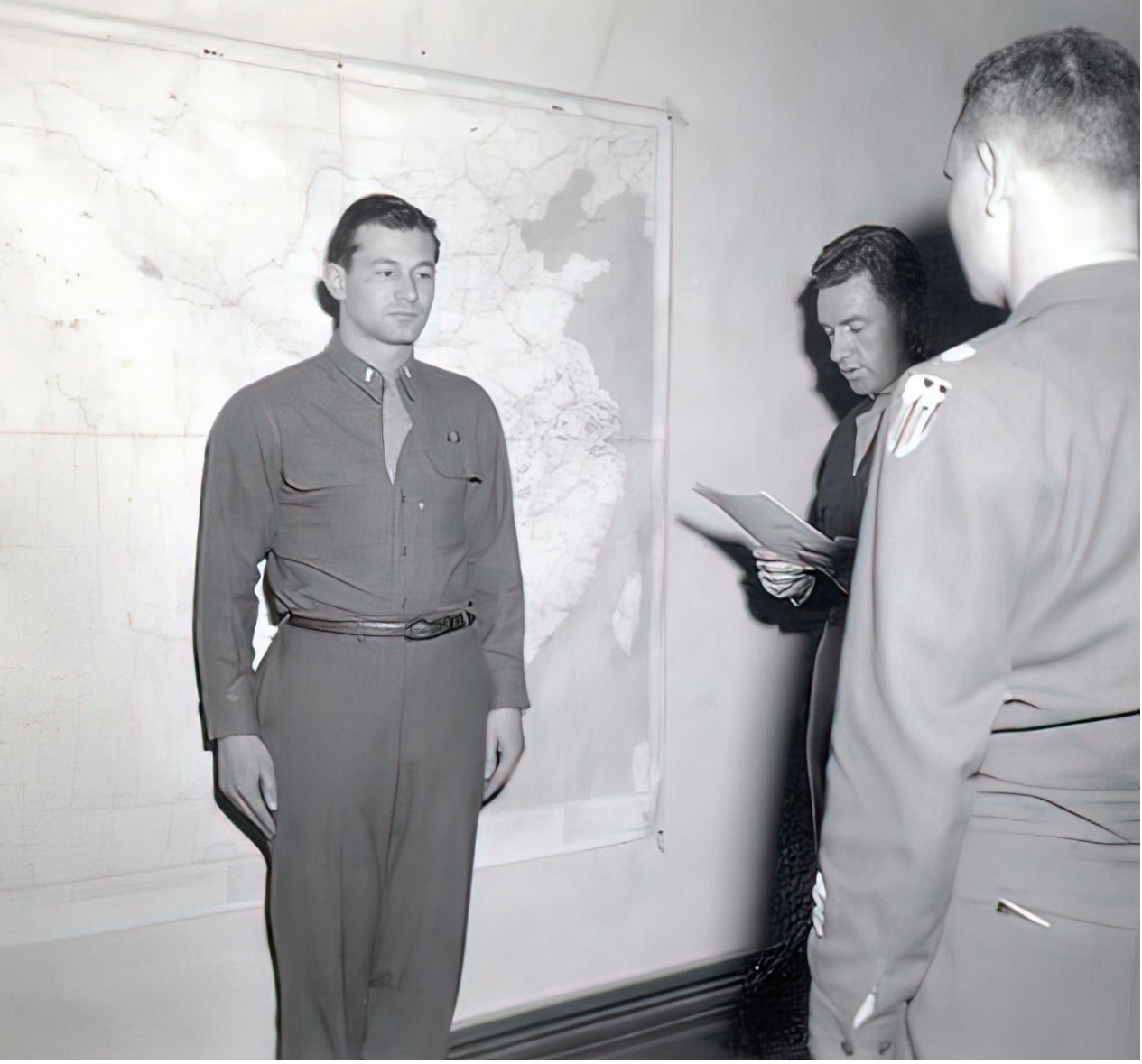
J. Walton Moore, Dallas CIA Head of Domestic Contact Service. “He got along fabulously well with Jeanne. I used to see Mr. Moore occasionally for lunch. A cosmopolitan character, most attractive.”[40] - GDM
In 1958, George was quite busy being dispatched to Haiti, Mexico, Ghana,[41] Togoland and Dahomey,[42] by the likes of oil Clint Murchison, and Brown & Root, among others, after spending several months in Yugoslavia as a US Government consulting geologist, where he was shot at a couple of times while making sketches of General Marshal Tito’s private island. [43]
Jeanne accompanied George when he arrived back in Dallas, presumably with his unfinished drawings. There he was debriefed by J. Walton Moore of the CIA’s Dallas Domestic Contact Service, and the geological information George provided “became the basis for at least ten reports what were circulated within government agencies.”[44]
Before that first debriefing, Moore had received advanced information about George’s past, as documented in a 1977 memo:
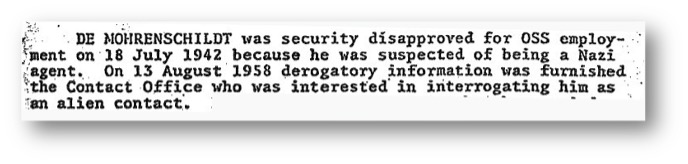
As the above excerpt states: “[…] derogatory information was furnished the Contact Office who was interested in interrogating [de Mohrenschildt] as an alien contact.”[45] The Contact Office was J. Walton Moore’s Office, around the time he debriefed de Mohrenschildt on Yugoslavia. Thereby proving Moore knew of George’s past yet chose to befriend him anyway. Moore would later imply he knew little about George’s history until after the JFK assassination, at which point he cut off all communication with him.
Not only did Moore befriend George, the two men and their wives hit it off business-wise and socially as Jeanne grew up in China and Moore had spent a lot of time there as a young man doing missionary work. In fact, he began working for the CIA in China in 1946 when he was appointed U.S. Vice Counsel.[46]
As documented by Nancy Wertz Weiford:
Over the next four years, Moore and de Mohrenschildt met often enough to share political, social and economic data of interest. The Moores and the de Mohrenschildts dined at one another’s homes, played tennis and enjoyed cocktails together. [47]
In later years, the 1978 HSCA determined that Moore was less than forthcoming when he told a House investigator that he’d previously only met George on two occasions in 1958 and 1961:
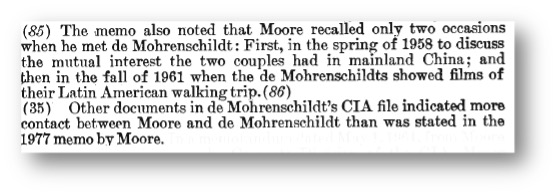
Figure 1: HSCA Vol XII pp 54-55
This led to accusations by journalists like Joan Mellen, that Moore was being evasive.[48]
Yet an inspection of the original memo reveals that this is a misreading. In Moore’s transcript, Moore (speaking in the third person) addresses Jeanne’s allegation that George consulted with Moore about Oswald and “Moore recalls only two occasions on which he and his wife met Mrs. de Mohrenschildt”[49] [emphasis added]
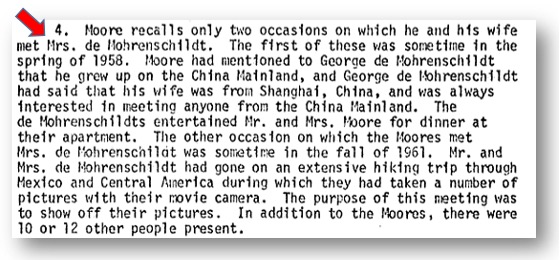
When author Anthony Summers interviewed Jeanne, she became annoyed that Moore stated he had only met with her a couple of times. She replied that Moore and his wife, and the de Mohrenschildts were so close they met for dinner every couple of weeks during that period, and reiterated that Moore was well familiar with Oswald.[50]
The HSCA finally followed up with Moore in a 1978 staff interview and Moore would finally acknowledge “periodic contact” with de Mohrenschildt since he met him in 1957, but none of course, related to Oswald.[51]
(Part 2 of the series is coming soon)
________________
Russ Baker, Family of Secrets (Bloomsbury Press, 2009) p 275
Jim Savage & David Russell, Investigation Conducted at Huston, Texas to locate George de Mohrenschildt’s automobile, by 2 FBI Agents with redacted names, (File# HO 62-2115/ April 1, 1977) pp 46-52
Russ Baker, Family of Secrets (Bloomsbury Press, 2009) p 275
Russ Baker, Family of Secrets (Bloomsbury Press, 2009) pp 69-70
HSCA Vol XII p 215
Baker, Family of Secrets, p 71
Baker, Family of Secrets, p 72
Bruce Cambell Adamson, Oswald’s Closest Friend: The George de Mohrenschildt Story Vol. 1-6 (Self Published, 1995-?)
George de Mohrenschildt, Lee Harvey Oswald as I Knew Him aka “I’m Am a Patsy!,” Edited by Michael A. Rinella (University Press of Kansas, 2014)
Nancy Wertz Weiford, The Faux Baron, (Lumiere, 2013) p 35
Russell B Holmes, “Comments on George de Mohrenschildt,” (April 4, 1977, p. 6, CIA, NARA, Record No. 104-10414-10144) p 16
Transcript of a lost Willem Oltmans NTS TV interview with George & Jeanne titled “Regarding the investigation into the murder of Pres. Kennedy” found in Harold Weisberg’s work files. A receipt signed by George for $250.00 indicates is was filmed in Dallas on Oct 15, 1967.
Michael Kurtz, The JFK Assassination Debates: Lone Gunman vs. Conspiracy (University Press of Kansas, 2006) pp 149-150
Baker, Family of Secrets, p 495. Note #41.
Baker, Family of Secrets, p 78
Weiford p. 187
Weiford p. 310
J. Walton Moore, Headquarters Memo 20 Apr.64 p 2
FBI interview Jeanne de Mohrenschildt 4-19-77 in Dallas by Udo H. Spect & LLoyd D Harrell Jr
Alexander Orlov, Handbook of Intelligence and Guerrilla Warfare. (Ann Arbor: University of Michigan Press, 1973)
Alexander Orlov, The Secret History of Stalin’s Crimes (Random House, 1953)
U.S. Congress, House, Testimony of Willem Oltmans, House Select Committee on Assassinations, April 1, 1977, HSCA Record Number 180-10105-10250, p.12
Edward J. Epstein, The Assassination Chronicles, (Carroll & Graf Publishers, 1992) pp 558-559
Robert Edward Lee Oswald, Warren Commission Interview 2-20-64. Vol 1 Pg 315
Robert Edward Lee Oswald, Warren Commission Interview 2-22-64. Vol 1 Pg 430
John W. Fain, Warren Commission Interview 5-5-64 Vol IV Pg 403
HSCA Vol XII pp 188-193
Edward J. Epstein, Legend: The Secret World of Lee Harvey Oswald (Reader’s Digest Press/ McGraw Hill, 1979) p 315
Edward J. Epstein, Legend: The Secret World of Lee Harvey Oswald (Reader’s Digest Press/ McGraw Hill, 1979) p 183-185
Oswald to Connally, Jan. 30, 1961, Warren Commission Hearings, Volume 19, Page 248 (author date error).
Richard T. Rabideau, FBI Special Agent, field interview with Duvall (FBI File# DL 105-632 & DL 105-1766, Feb. 25, 1964)
This quotation was downloaded from Epstein’s now defunct website. Although there is a version of it in his Assassination Chronicles on p 560 it frustratingly eliminates the sentence about George protecting his CIA contacts.
Edward J. Epstein, Legend: The Secret World of Lee Harvey Oswald (Reader’s Digest Press/ McGraw Hill, 1979) P318 Note#2
Edward J. Epstein, Legend: The Secret World of Lee Harvey Oswald (Reader’s Digest Press/ McGraw Hill, 1979) pp 204-205
HSCA Vol XII pp 201-202
Edward J. Epstein, Legend: The Secret World of Lee Harvey Oswald (Reader’s Digest Press/ McGraw Hill, 1979) p 205
Edward J. Epstein, Legend: The Secret World of Lee Harvey Oswald (Reader’s Digest Press/ McGraw Hill, 1979) p 206
HSCA Vol XII pp 177-178
Nancy Wertz Weiford, The Faux Baron, (Lumiere, 2013) p 630
HSCA Vol XII pp 208-209
Baker, Family of Secrets, p 84
Edward J. Epstein, Legend: The Secret World of Lee Harvey Oswald (Reader’s Digest Press/ McGraw Hill, 1979) p 182
Edward J. Epstein, Legend: The Secret World of Lee Harvey Oswald (Reader’s Digest Press/ McGraw Hill, 1979) p 182
Edward J. Epstein, Legend: The Secret World of Lee Harvey Oswald (Reader’s Digest Press/ McGraw Hill, 1979) p 182
Russell B Holmes, “Comments on George de Mohrenschildt,” (April 4, 1977, p. 6, CIA, NARA, Record No. 104-10414-10144) p 16
Nancy Wertz Weiford, The Faux Baron, (Lumiere, 2013) p 209
Nancy Wertz Weiford, The Faux Baron, (Lumiere, 2013) p 214
Joan Mellen, Our Man in Haiti: George de Mohrenschildt and the CIA in the Nightmare Republic (Trine Day, 2012) p54
J. Walton Moore, CIA Memo, Charge Made on WFAA-TV Dallas that Lee Harvey Oswald was Employed by the CIA in 1962 and J. Walton Moore Knew Oswald (Record # 104-10428-10196, 4-13-77)
Anthony Summers, Conspiracy (Athena, 1989) pp 197-198
HSCA Vol XII pp 54-55, references a 3-14-78 staff interview with Moore, pg. 66, footnote #90 refers to as JFK Document 014893, but try as I might, I am unable to locate the actual transcript, only references to the transcript.


