PART II
Pre-emptive Strikes Against the JFK Records Act
Section Summary
This section will reveal how the CIA swiftly devised a preemptive strategy to safeguard its most sensitive assassination records following the release of Oliver Stone's 1991 film "JFK," which accused U.S. intelligence agencies, particularly the CIA, of involvement in President Kennedy's assassination and highlighted the sealing of House Select Committee on Assassinations (HSCA) files until 2029. After understanding this pre-emptive strategy, which may have created a separate “protected” collection of sensitive assassination records before the JFK Records Act even became law, you will recognize its profound impact on the state of JFK records disclosures to this day.
~~~~~~~~~~~~~~~~~~~~~~~~~
The CIA immediately understood that Stone’s JFK would unleash a very significant problem that compromised their (up to that point) success in keeping the public in the dark regarding the vaults of secret agency records related to the assassination. The film galvanized the public despite the efforts of the mainstream media to reject the idea of a conspiracy. Public anger quickly turned into momentum to demand that Congress pass legislation to release all of the JFK assassination records. With the effort to discredit the film already being employed through its media assets, the CIA turned to its next task of developing a strategy to contend with any legislative action that might arise regarding the secret JFK files.
One of the main themes of the JFK film was that U.S. intelligence agencies were culpable in the assassination of President Kennedy, and the CIA knew its activities would be front and center in the public’s attention. As shown at the top of this article, the film closed with a succinct and powerful statement regarding the locked-up investigative files of the HSCA.
Oliver Stone’s caption at the end of the film stated: “The files of the House Select Committee on Assassinations are locked away until the year 2029.” Records clearly show that the unpublished records of the HSCA, a temporary congressional committee that concluded in 1979, were in fact sealed for 50 years under standard House rules for protecting sensitive materials from public disclosure, including disclosure under the Freedom of Information Act (FOIA).
To further ensure the continuing secrecy around these records, the HSCA and CIA entered into an agreement that created the “CIA-HSCA Sequestered Collection”, which allowed the CIA to retain possession after 1979, making certain that the materials remained protected under CIA classification rules. The records remained classified under executive branch rules, not congressional ones, and agencies like the CIA could (and did) begin partial declassifications in the early 1990s, even before the JFK Act became law, though with redactions under their rules.
Part of the CIA’s preemptive plan against certain action by Congress is revealed in the first of two February 10, 1992, CIA memos. The first memo was authored by Kenneth McDonald, the Chief of the CIA History Staff, to the Director of Central Intelligence (DCI). This is mandatory reading to fully understand how deeply concerned the CIA was about its HSCA Sequestered Collection after the public pressure applied from the JFK film. A copy of the February 10, 1992 Memo RIF# 104-10331-10001 (the “First Memo”) can be found here, The First Memo provides a precise list of the materials in the Sequestered Collection, which not only contains 64 separate boxes of sensitive materials, but also Oswald’s 201 file (16 additional boxes), and Mexico City Station files (8 bulky files).
The First Memo also reveals that, in January 1992, the CIA essentially made a beeline to Congress for an emergency review of the HSCA Sequestered Collection. Since Congress was then poised to open all U.S. government records on the Kennedy assassination--including the HSCA files highlighted at the end of Stone’s film.
In the period immediately following its emergency review of its HSCA files, CIA leadership considered two (2) options. The first option was to keep the Sequestered Collection completely closed, remaining entirely in the CIA’s hands, and sequestered by Congress until 2029 or earlier (depending on a shift by Congress). The second option was to completely open the HSCA files in order to “dramatically demonstrate the CIA’s new policy of ‘openness’, and rapidly reveal that these records contain nothing pointing to a CIA role in the Kennedy Assassination.” The CIA did not choose either option.
Ultimately, J. Kenneth McDonald recommended a transfer of the entire CIA-HSCA Sequestered Collection to NARA at its existing classification. However, the transfer to NARA would involve a continuing declassification review by Archives staff in accordance with CIA guidelines, to be carried out under the auspices of the CIA’s Historical Review Program and with CIA-paid staff at NARA conducting the review.
McDonald concluded that this strategy of a controlled transfer to NARA offered “some significant advantages”. According to McDonald, the perceived advantages were: a) getting the collection out of the CIA’s hands and into secure vaults at NARA with other congressional investigative records; b) protection of existing CIA classification under statutory guidelines requiring NARA to protect investigatory sources and national security information (sources and methods); and c) CIA funding of review positions at NARA to ensure declassification review under CIA rules.
In the “Notes on Transfer to the National Archives and Declassification of CIA Records” (pages 22-23), the CIA planned a transfer of the collection to NARA in fully classified status, to be stored in secure NARA vaults and accessible only to archivists with appropriate security clearances. Codeword documents would go into a special compartmented vault, to be processed only by viewers with approval to access highly classified materials. As far as the actual declassification guidelines to be used and funding for the same, that would be a “matter for negotiation between the CIA and NARA”. The Archivist of the United States is the Custodian of the JFK Assassination Records Collection. The JFK Records Act mandates extremely limited discretion to the Archivist. The authority to “negotiate” classification guidelines with respect to JFK assassination records is not within the Archivist’s duties or authorities under the Act. With regard to the JFK records, the Archivist has the mandatory, non-discretionary, ministerial duties to implement the ARRB’s Final Determinations and to protect the Records Collection.
The final Recommendation in the First Memo states: “If Congress should eventually undertake to open this entire Collection without regard to classification, the National Archives will be in a stronger position to protect its national security and privacy information than the CIA, whose motives would appear self-serving, if not sinister.” To be clear, the CIA contemplated that NARA would not only serve its archival purpose, but would also be in a position to assist the CIA with protecting these sensitive records.
The key takeaway from the First Memo was that the CIA knew it would face significant pressure to eventually relinquish control of its HSCA records to an independent agency. The CIA’s responsive proposed strategy was to devise a way to maintain maximum control at NARA and to do so 8 months before the JFK Records Act and the Assassination Records and Review Board (ARRB) came into existence.
A second Secret CIA Memo, apparently emanating from the Directorate of Operations (DO), also dated February 10, 1992, quickly followed in response to Kenneth MacDonald’s suggestions to transfer the entire CIA/HSCA Sequestered Collection to NARA. This memo, RIF# 104-10428-10103 (the “Second Memo”), can be found here. Note that the author is unknown and that there are missing pages. The Second Memo reflects the CIA’s Directorate of Operations immediate reaction to Kenneth McDonald’s contemporaneous plans that would impact operational files in the Sequestered Collection, which were deemed “disturbing and, if approved, could have far-reaching negative consequences for the Agency’s ability to collect vital foreign intelligence.”
CIA operational files were of major concern in this Second Memo. The unknown CIA author states that “DO (Directorate of Operations) documents from project files should remain under the DO’s control and should be reviewed only in the context of the operation and not singularly”, and that “once the DO loses jurisdiction over its documents, age notwithstanding, it loses its ability to protect the sources and methods contained in them.”
The Second Memo further states: “A more logical approval would be for the DO (not an independent entity) to review the entire project 30 years after its inception or perhaps 10 years after the project file has been retired. We should never relinquish control of DO (Operational) documents simply because of their age.”
In short, there was no way that CIA officers in charge of operations and protecting sources and methods in operational project files were ever going to let an independent entity (i.e., the ARRB) even have access to operational files. Again, you can see that the CIA was somehow aware, 8 months before the passage of the JFK Act, that an independent agency like the ARRB might soon have legal access to the operational files in the Sequestered Collection.
The missing pages from the Second Memo may reveal more. However, we suggest that what happened next is that the CIA probably went with a Plan “B” and did not fully adopt Kenneth McDonald’s proposed plan of transferring the entire Sequestered Collection to NARA under its “existing classification”. Rather, it was likely determined that the best path forward was to test the resolve and power of the JFK Records Act and the ARRB, and how newly sworn-in President Bill Clinton (not George H.W. Bush, the former CIA Director) was going to handle postponement appeals from the Agency.
What we can see occurring throughout the days, weeks, months, years and decades since the November 22, 1963, assassination of President Kennedy is that the CIA particularly had a continuing and evolving strategy to deal with the evidence and records related to the assassination and its many investigations. As the investigations took place in the 1960s and 1970s, and later, when Oliver Stone’s film JFK was released, and the JFK Records Act was passed, the agency had to adapt to new situations that threatened its reliance on bulletproof national security claims over all of its records and operations. As the JFK Records Act was quickly moving through the legislative processes of the House and Senate in the spring and summer of 1992, the CIA was likely confident that George H.W. Bush (former Director of Central Intelligence) was going to easily defeat Bill Clinton in the November 1992 election and that President Bush would be an ultimate backstop for CIA appeals of ARRB decisions to release assassination records. Once Clinton was in the White House and the ARRB was appointed, both the ARRB review process and the Presidential “appeal” process created a fluid situation for the agencies, and they planned accordingly. By the summer of 1995, it was clear that President Clinton was not going to override any of the ARRB’s Final Determinations.
A Plan “C” was seemingly then developed, which was to wait out the ARRB’s term through September of 1998. This is supported by both the metadata contained in many of the 2025 NARA releases and in Judge Tunheim’s sworn testimony to Representative Luna’s task force on May 20, 2025. Judge Tunheim testified: “Many of these (2025) releases were not seen by the ARRB and were apparently transferred to NARA at a later time…It didn’t take a rocket scientist to know they [the CIA] were waiting us out.” Judge Tunheim’s full May 20, 2025, testimony before the House Task Force on the Declassification of Federal Secrets can be viewed here.
Why is all of this a serious problem? These two CIA memos from February 10, 1992, suggest that the CIA was firmly against “inviting a panel of historians into CIA to examine and report on this (sequestered) collection.” Notably, that is exactly what would happen when the JFK Records Act was enacted on October 26, 1992. Under the JFK Act, the newly-created ARRB would have the power to access and declassify the entire HSCA Sequestered Collection unless the CIA made a compelling case under the ARRB’s standards on a record-by-record basis.
The plan outlined by the first February 10, 1992 memo, perhaps modified following the second memo, allowed the CIA to “get ahead” of any independent review that Congress may require in new legislation.
Notably, under section 5(d)(3) of the JFK Act, any assassination records transferred to NARA before the JFK Act was passed were not required to have record identification forms (RIFs) for tracking purposes. They were not subject to independent review by the ARRB as required by the JFK Act. Section 5(d)(3) did, however, require full public disclosure (unredacted) status for any records transferred to NARA before the JFK Act. This makes sense from an administrative perspective - why expend NARA or ARRB resources for records already at NARA and already fully available to the public? However, a pre-planned and expedited transfer of sensitive CIA records to NARA before the passage of the JFK Act and under CIA classification guidelines did provide an opportunity to subvert the ARRB’s independent review process under the strict standards of the JFK Act. Records show that indeed the HSCA/CIA Sequestered Collection and the records of the Senate Select Committee on Intelligence (also held under unique Senate Rules) were some of the most contentious and highly contested files sought by the ARRB from 1994 to 1998.
Sequestered and Protection Collections - Questions Raised
Because NARA still does not appear to maintain a full and accountable directory and index of every legislative investigation record transferred to NARA for ARRB review under the JFK Act, researchers are not able to track the status of all of these records with precision. The ARRB Final Report deals with this specific problem. The ARRB's Final Report (issued in 1998) explicitly references the HSCA's 2029 sealing as a problem the JFK Act was designed to address, noting that it overrode prior restrictions by mandating a "presumption of immediate disclosure" unless agencies provided "clear and convincing evidence" of current harm (e.g., to intelligence sources or foreign relations).
Page 163 of the ARRB’s Final Report addresses the opening of the HSCA records and confirms that after issuance of the HSCA’s report in 1979, the “voluminous files of the HSCA were placed in storage and were to be kept under seal until 2029 (i.e., fifty years from 1979). Because these were Congressional records, they were not subject to disclosure under the FOIA.” The ARRB also noted that NARA “opened the JFK assassination portion of the HSCA records after consulting with the agencies that had equities in the records.”
What was the final result after NARA “consulted with agencies?” The two CIA memoranda from February 1992 strongly suggest that the Sequestered Collection was and has been handled under separate CIA guidelines at NARA. As discussed later in this article, the extent to which this was done can only be answered by the release of the aforementioned index and all of the records of the ARRB.
The Archivist and NARA staff members who controlled these records in the 1990s need to be questioned about exactly how the Archivist exercised his discretion pursuant to section 5(d)(3) of the JFK Records Act, which allowed pre-JFK Act records transmissions to NARA to possibly avoid the ARRB review and tracking process for declassification.
The Archivist and NARA staff also must be questioned on (a) the extent of the CIA’s HSCA records that did not receive RIF numbers and were not disclosed to the ARRB for review and final release decisions; and (b) why there is still no complete subject guidebook and index of the CIA’s HSCA and Church Committee Collection at NARA that allows for public disclosure of release or withholding information. Without this key information (e.g., what was going into NARA and going out to the public), there is no way to make complete sense of what has been released with respect to these Collections in their entirety, and what is still withheld or “sequestered” at NARA or in other legislative archives.
Seasoned archives researcher Malcolm Blunt has discussed this in detail. At minute 7:30 in his October 23, 2023, talk with Bart Kamp, Malcolm discusses the lack of a publicly available index to legislative investigation records and the problems this creates for researchers. All of this information is required to be maintained by NARA under sections 4(a)(1) and (2) of the JFK Records Act.
PART III
The Battles Against the ARRB Review Process
Section Summary
In the 63 years since the assassination of President Kennedy took place, the JFK research community has had very few meaningful wins. While the diligent work of the research community has piece-by-piece exposed much of the truth regarding the assassination, its plotters and those who covered it up, virtually none of this collective work has been officially acknowledged or officially accepted by the government. Regardless of the government’s refusal to admit that the Warren Commission was a fabrication aimed at swiftly closing the book on the JFK case and any real investigation of Oswald’s extensive intelligence touchpoints, a very large majority of Americans have consistently rejected the myth created by Allen Dulles and his Warren Commission fellows.
The single most important development of the last six decades is the passage of the JFK Records Act in 1992. This federal statute established the Assassination Records Review Board (“ARRB”), an independent agency of citizens, which had broad authority to identify, review, and declassify assassination records, including issuing legally binding and enforceable legal orders (called ARRB Final Determinations) for the final release of postponements. This section will examine how the creation of the ARRB was easily the most meaningful win for researchers seeking honest answers, while at the same time, in many respects, it has been a missed opportunity.
~~~~~~~~~~~~~~~~~~~~~~~~~
In the prior section, we addressed the CIA’s preemptive plan regarding the JFK Records Act and the independent declassification review they would be facing. With the appointment of the ARRB Board Members in April 1994, the agencies then had to contend with the ARRB itself. For the first time, the legal burden to continue classification and withholding assassination records shifted to the agencies. Absent clear and convincing evidence of the need for continued postponement, then 30 years after the assassination, the ARRB was mandated to release assassination records to the public and was determined to do so.
Records show that the ARRB faced significant challenges in fulfilling its mandate. First, due to delays in presidential appointment of Board members, appropriations and the time needed to organize a strong staff with detailed processes, the ARRB only initially had two (2) years to review and declassify millions of records. This was a virtually impossible task to complete, even with the strong and talented staff of analysts and attorneys who joined the ARRB. A complete declassification review of all assassination records, as defined by the ARRB, would have taken many more years, and that assumes full cooperation and transparency from all government offices and agencies. The agencies seeking long-term secrecy knew this and took full advantage.
By 1995, however, the ARRB had done two significant things that showed the strength of their resolve in enforcing the powerful declassification standards of the JFK Act. First, the ARRB broadened the definition of an assassination record in the JFK Records Collection Act. Under the JFK Act, as written in 1992, an “assassination record” was defined simply as any record related to the assassination of President Kennedy. In June 1995, the ARRB exercised its legal authority to broaden the definition to include “all records, public and private, regardless of how labeled or identified, that document, describe, report on, analyze or interpret activities, persons, or events reasonably related to the assassination of President John F. Kennedy and investigations of or inquiries into the assassination.”
By expanding this definition of “assassination record”, the ARRB sought to collect and review all records collected by or sequestered by all Federal, state and local government agencies in conjunction with any investigation or analysis of or inquiry into the assassination (i.e., prior congressional investigations such as the Church Committee and HSCA). This put agencies on notice that the ARRB would definitely seek to collect all records made available to and sequestered by congressional committees in the late 1970’s, which were thought to be largely locked away until at least 2029.
Second, the ARRB consistently and vigorously contested initial agency appeals to the president. Early on, when agencies realized that the ARRB was serious about its intentions to immediately declassify assassination records absent legitimate and compelling reasons from the agencies under the JFK Act, they brought their appeals to President Clinton. For instance, the FBI appealed over 500 ARRB decisions to President Clinton. In response, the ARRB prepared legal briefs and fought each appeal based on its exacting standards. In the end, the president did not side with an agency on a single appeal. These appeals stole precious time and resources away from ARRB staff and the Board. Ultimately, President Clinton advised the agencies and the ARRB that he would not be entertaining this volume of appeals, and he instructed the agencies and the ARRB to work out amongst themselves the declassification of the records. This had the real effect of giving the ARRB a potential upper hand in pushing for greater disclosure.
Approaching 1997, the agencies were left with few alternatives with regard to the highly sensitive segregated or “sequestered” collections - mainly “waiting out” the ARRB. As discussed in the next section dealing with congressional records, the ARRB struggled mightily in 1997 and 1998 to finish its declassification review of the agencies’ most sensitive assassination records, and in particular, completing the record on Oswald’s alleged visit to Mexico City and ensuring the complete declassification of the 291-page HSCA “Lopez-Hardway” Report on that topic. An example of this struggle was ARRB chairman Judge John Tunheim’s priority requests to the CIA for records related to Oswald’s activities in Mexico City that may have been held by the Mexican government. In this internal CIA memo RIF# 104-10331-10187 declassified in 2023, the CIA discussed how to best deal with the ARRB’s priority requests to obtain copies of tapes from joint tel-tap operations, including coverage of Oswald’s alleged telephone calls to the Soviet Embassy. According to this CIA memo, locating these records was “the highest priority of the Board (ARRB).”
In an October 28, 1997, letter from ARRB Legal Counsel to David W. Carey, Executive Director of the CIA, Gunn warned the CIA that unless the agency sped up its review process, the ARRB would be forced to vote to release-in-full all relevant CIA records and transfer them to NARA.
It is our firm intention to complete our task within the congressionally mandated time limit. If CIA is unable to pre-review and process its records consistent with completion of this task, the Review Board will vote to release-in-full all relevant CIA records and mandate that custody be transferred to the National Archives in a timely way. We sincerely hope that it will not be necessary for the Board to make wholesale decisions on unreviewed records and we will be pleased to work with the Agency to see that such a step is unnecessary. But we are prepared to make such decisions to the extent they are required to fulfill our own responsibilities. Although it is our perception that CIA may wish to devote additional human resources to this project, we of course leave such decisions to the sound judgment of knowledgeable CIA officials.
In his May 20, 2025, testimony to Congress, former Chair of the ARRB Judge John Tunheim spoke about the ARRB’s threat to simply release all the contentious files.
Finally, on pages 145 through 147 of its Final Report, the ARRB provides details that help better understand the CIA’s (non)compliance with the JFK Act, and shares the ARRB’s struggles with ensuring complete access to assassination records. In 1997, the ARRB was still receiving CIA briefings with respect to their files, record-keeping systems and their searches for assassination-related records. By 1998, the ARRB had expressed serious concern to the CIA regarding the thoroughness of the CIA’s initial 1992-1993 records searches pertaining to Oswald. The Review Board “was disturbed by the belated discovery of these records, particularly given its mandate to assure the public that all relevant materials on the Kennedy assassination were being released by the U.S. government.”
The ARRB closed its operations for good on September 30, 1998. As Judge Tunheim testified on May 20, 2025, before Representative Luna’s congressional task force, while NARA was quite helpful to the ARRB during its 4-year term, he did not hear from NARA’s JFK archivists afterward with respect to critical work that the ARRB could not complete.
—---------------------------------
PART IV
The Special Operation On Congressional Investigative Records
Section Summary
From 1994 to 1998, the ARRB faced the daunting task of declassifying millions of assassination records in two (2) primary areas. The first area dealt with “sequestered” collections of records that agencies turned over to Congressional investigators in the 1970’s. This specifically includes records of the Pike Committee, Rockefeller Commission, the Church Committee (including Schweiker-Hart subcommittee) and the House Select Committee on Assassinations (HSCA). The second area dealt with everything else– specifically, records of private citizens and records ultimately deemed related to the Kennedy assassination under the ARRB’s expanded definition of “assassination record.”
This section discusses the special problem of Congressional investigation records and why they remain a significant barrier for researchers today. The complete collection of records from the Church Committee, Schweiker-Hart subcommittee, and the HSCA is still a source of relative secrecy. Despite a clear mandate in 1992 from Congress for the full release of Congressional assassination records by 2017 at the latest, many of these sensitive materials appear to still be subject to special treatment and protections.
—-----------------------------
First, it is important to remember that there is no exception or special declassification rule for Congressional records in the JFK Act. They were all required to be archived in the JFK Records Collection in custody at NARA and to be included in the Archivist’s subject guidebook and index of the Collection. And unless they were transferred to NARA before the JFK Act and fully available to the public in unredacted form by October 26, 1992, congressional records required RIF numbers and identification aids for review and declassification by the ARRB. Second, these congressional records are not executive branch records. Yes, executive agencies like the CIA and FBI claimed (and still claim) equities in sequestered collections of the Church Committee and the HSCA. However, the President retained no discretion or authority over congressional records. In its 1992 Report that attended the passage of the JFK Records Act (Senate Report 102-328 page 25), the United States Senate ensured that Congress would maintain control over its own records, not the President. This was codified in section 9(d)(1) of the JFK Records Act.
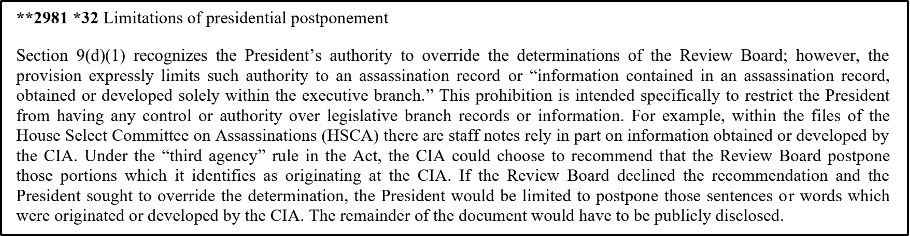
In short, all congressional records were to be reviewed for declassification by the ARRB and fully released to the public by 2017 at the very latest. That is the law mandated in the JFK Records Act, and there is no exception whatsoever for congressional records. The JFK Records Act, as expressly declared by Congress itself in 1992, supersedes any special legislative “sealing” rules that existed before the Act or today.
However, the actual mechanics for the declassification of congressional records have taken many turns that do not seem to be consistent with the JFK Act. The agencies generally made their assassination-related files available for review and copying by the congressional investigators in the 1970’s. At the conclusion of the HSCA’s investigation, however, Congress entered into agreements with agencies, including the FBI and CIA, not to destroy their assassination-related records and to keep them separate or “segregated” from the agencies’ other files. As such, as of October 1996, the ARRB started to wrangle with segregated or “sequestered” collections of records held by federal agencies that were originally requested by Congressional investigative bodies in the course of prior investigations into the JFK case, and were largely stored separately from other agency files. For a greater understanding of this, please read RIF#104-10332-10010, “Memorandum from T. Jeremy Gunn to ARRB dated October 15, 1996 re: ARRB Staff Recommendations for Processing Records in the Segregated Collections and Records that Contain Information Having “No Apparent Relevance” to the Assassination of President Kennedy."
The ARRB staff concluded that the Sequestered Collections contained many records clearly related to the assassination. ARRB Legal Counsel Jeremy Gunn concluded: “Postponements in records that clearly are related to the assassination should continue to be reviewed carefully.” However, the ARRB staff also found that the Sequestered Collections contained a great deal of information that had no apparent relevance to the assassination.
The dilemma for the ARRB was to decide how to process and review the records in the Sequestered Collections in less than two (2) years’ time. One of the challenges was the review of “hybrid records” - those that contained information directly relevant to the assassination, but also contained sensitive information with no apparent relevance to the assassination of President Kennedy.
Surprisingly, the ARRB Final Report does not go into great detail about the results of its exhaustive review of the CIA’s (HSCA) Sequestered Collection, and its ability in its short life span to review all assassination records therein with the required scrutiny. On page 45 of the ARRB Final Report, the Review Board makes mention of the 63 boxes of paper records made available (by the CIA) to the HSCA staff, and the 64th box of the CIA’s sequestered collection containing 72 reels of microfilm containing the entire set of files in the collection. Again, the ARRB confirms the contents of the materials in the CIA-HSCA Sequestered Collection, but the Review Board does not discuss the extent to which that collection was fully reviewed for release or postponement.
We know that the ARRB adopted guidelines in 1997 in an attempt to streamline review of postponements in the sequestered collections, but the Review Board also knew that its operations would only be extended through 1998 at the very latest, and it could not “hope to complete review of postponements in Segregated (Sequestered) Collections under the current method of review.” The Review Board sought to be vigorous in applying the law, but, in order to complete its work, found it necessary to employ a “rule of reason” (see page 48, ARRB Final Report).
As discussed in the last section, we also know that in 1997 (and going into 1998), the Review Board was still in extensive communications with the CIA and FBI regarding the thoroughness of its initial 1992-1993 records searches (see Pages 147-148, ARRB Final Report).
In the end, the ARRB’s Final Report (page 203, Appendix F) states that the ARRB voted on postponements for 1,421 HSCA records and 267 records of other Congressional committees. Also, according to the ARRB Final Report (page 3), the HSCA generated approximately 414,000 pages of records related to the JFK case.
Until all of the ARRB’s Final Determination Notifications and the ARRB’s other records (e.g., complete Lotus Notes database) are released, tied to an associated index and catalog of the Sequestered Collection(s) in its entirety, we will not know with certainty if NARA has actually released the associated assassination records from the Sequestered Collections. This information would give researchers the “whole nine yards” with respect to ARRB activities, and NARA is required by law to archive all records of the ARRB in the publicly facing JFK Collection under the JFK Act.
Researchers familiar with the voluminous holdings of records from these Congressional investigations are left to question whether the ARRB had the opportunity to review all assassination-related records from Congressional record holdings. ARRB staff memos and Judge Tunheim’s recent testimony indicate that this is still an open question.
For instance, one of the most significant achievements of the ARRB was the declassification of the HSCA “Lopez-Hardway Report” on Oswald, the CIA and Mexico City. The aforementioned sealing of HSCA records had kept this report entirely out of the actual final report of the HSCA. That is how sensitive it was to the CIA. It was so sensitive that the CIA tied up the HSCA investigators and later the ARRB for hours to get through a declassification review of even a single page of this 291-page report.
Even the ARRB had to agree to 301 postponements in the Lopez-Hardway Report when it partially declassified the Report in 1996. ( See a copy of the first of a number of ARRB Final Determinations for RIF# 1080-10110-10484 “The Lopez-Hardway Report”.) While most of the Hardway-Lopez Report was declassified by the end of the ARRB’s term in 1998, there remain questions about materials from this specific HSCA investigative report that are still classified or missing.
Related to this area are HSCA transcripts of executive session testimony of David Phillips, who had been promoted to CIA Chief of Cuban Operations in Mexico City at the time of Oswald’s alleged visit. In addition to staff notes and summaries of HSCA investigators who questioned Phillips regarding pulse cameras aimed at the Cuban consulate during the time that Oswald allegedly visited Mexico City, back-channel communication methods between the CIA’s Mexico City station and its JMWAVE station in Miami, and sources of stories and propaganda linking Oswald to Castro and the Fair Play for Cuba Committee (FPCC) that appeared immediately after the assassination. This is important because at a 2014 conference in Washington, Hardway revealed that he and Lopez prepared a bill of indictment for Phillips and Anne Goodpasture, who handled his operations when he was away.
In light of Dan Hardway’s powerful testimony on May 20, 2025 before Representative Luna’s committee, it is abundantly clear that Congressional oversight committees need to pick up on the hard work of the ARRB and complete the record of Oswald, the CIA, Mexico City and post-assassination CIA propaganda that linked the accused assassin Oswald to Castro and Cuba.
Files from the Church Committee also remain an open question. This Senate committee of 1975-76 investigated a wide array of intelligence agency abuses. The Church Committee records are discussed in detail on page 164 of the ARRB’s Final Report. After the passage of the JFK Act, the Senate Select Committee on Intelligence (SSCI) inventoried 450 boxes of original records of the Church Committee and transmitted 40 boxes to NARA. However, the ARRB found that some testimony directly relevant to the JFK case, and cited in the Church Committee’s report, was not included in the materials. For two years, the SSCI did not explain or rectify this crucial gap.
Finally, in 1997 and 1998, the SSCI produced microfilmed copies of transcripts of testimony of FBI and CIA officials who worked on the JFK investigation, as well as officials who testified regarding assassination plots against Castro. However, when the ARRB finally gained access to the 450 boxes of original Church Committee files, the Board could not locate original hardcopy transcripts and any accompanying materials. The ARRB specifically asked the SSCI to explain the absence of the hard copy files, and the SSCI never accounted to the ARRB for these original transcripts and accompanying materials relating to the JFK case. It should be noted that former Warren Commission attorney Arlen Specter was the Chair of the SSCI from 1995 to 1997, which coincided with the ARRB’s most intensive efforts to retrieve and declassify records and working files from the Church Committee and Schweiker-Hart subcommittee.
The Schweiker-Hart files are also a major concern for researchers. Senators Gary Hart and Richard Schweiker led a subcommittee of the Church Committee tasked with investigating the performance of the intelligence agencies (the FBI and CIA) during the original investigation (Warren Commission) into the assassination of President John F. Kennedy. For archival purposes, the Schweiker-Hart files should be part of the overall Church Committee holdings in the legislative archives. Knowing that the SSCI’s liaison roadblocked the ARRB from obtaining the Schweiker-Hart files, legendary archives researcher Malcolm Blunt has looked inside and out of the boxes of Church Committee records that are available through NARA and has also found little to no trace of the Schweiker-Hart working files. Blunt asked NARA for another search as recently as 2018, and for years, on visits to NARA, he specifically asked the NARA archivists for a search of the Church Committee legislative archive in downtown Washington, DC. NARA’s response was: “We won’t be looking at that any time soon.”
The SSCI Charter and Senate Resolution 400, passed in 1976, are likely the reason for this response from NARA. This resolution established the SSCI as a permanent committee and set the “procedural charter” for how it handles sensitive intelligence information. Unlike the HSCA’s rigid 50-year sunset by 2029, the Senate’s rules generally refer to the Standing Rules of the Senate and the internal protocols of the committee regarding the “closure” of records.
Since the Church Committee concluded its primary work in 1976, the 50-year mark for its most sensitive materials - including the Schweiker-Hart subcommittee’s specific investigation into the JFK assassination - is occurring now in 2026.
The question becomes whether the JFK Records Act overrides any special Senate rule or resolution for SSCI (Church Committee) records. Section 11(a) of the JFK Records Act answers this question. It states, “PRECEDENCE OVER OTHER LAW.—When this Act requires transmission of a record to the Archivist or public disclosure, it shall take precedence over any other law (except section 6103 of the Internal Revenue Code), judicial decision construing such law, or common law doctrine that would otherwise prohibit such transmission or disclosure, with the exception of deeds governing access to or transfer or release of gifts and donations of records to the United States Government.”
No other section of the Act exempted the SSCI from the disclosure and transfer of assassination records or from the review processes of the ARRB, and there appear to be no special provisions directing SSCI assassination records to be stored anywhere other than in the JFK Assassination Records Collection at the National Archives.
As a result, if a document was specifically identified as an “assassination record” by the ARRB in the 1990s, it should have been moved to the JFK Collection for ARRB review between 1994 and 1998 and released to the public by 2017 at the very latest. However, many Church Committee files involved broader intelligence abuses and may not have been classified as JFK “assassination records” at the time. There is a subset of Schweiker-Hart subcommittee records--which again focused exclusively on the JFK assassination--specifically transcripts of executive session testimony and “raw” investigative files that the SSCI has historically protected as containing sensitive “sources and methods”. Whether these kinds of “residual” records are directly central to the assassination is still an open question.
Regardless, the current Senate oversight committee(s) retain jurisdiction over the declassification of these files under the JFK Act. If the ARRB did not (due to time restrictions and information available at the time) classify certain SSCI records as “assassination records” in the 1990s, oversight committees still have the authority and duty to conduct oversight under the JFK Act. Again, the Act does not authorize or defer to separate declassification procedures for Congressional files that are arguably “assassination records” in any way, shape or form. The entire point of the JFK Records Act was to declassify and make public these exact records.
The first step for Congressional Oversight would be to obtain an accurate unified index of HSCA and Church Committee (including Schweiker-Hart) records at NARA and in the legislative archives - i.e., what was coming in and going out. Without this index, there is no way to know the full extent of what has been declassified and what is still withheld in a “sequestered” collection at NARA or in the Center for Legislative Archives in Washington, D.C.
For the hundreds of boxes of Congressional records related to the assassination that were processed by NARA’s Center for Legislative Archives, most importantly, the HSCA and Church Committee records, oversight is needed to determine whether those records are fully archived in the JFK Collection at NARA with a catalog and index as required by the JFK Records Act. Again, the JFK Records Act takes precedence over any other law regarding assassination records, and thus certainly would take precedence over 50-year-old resolutions or internal Congressional rules for withholding.
All of this goes back to the declassification standards of the JFK Act as initially administered by the ARRB in the 1990’s. If Congressional oversight committees at that time (or now) did not agree with an ARRB final order on a congressional record, they had a chance to adopt a resolution governing disposition, conduct periodic review, and release the record no later than October 26, 2017, as required by the Act. We will not know the extent to which this was done until the Oversight Committee(s) require the Archivist and NARA to publish a full catalog and index of all congressional investigative records and release all records of the ARRB.
For protected or “sequestered” congressional records that never made their way to the ARRB for a decision, that is a different matter entirely. These protected records require serious oversight today under the disclosure standards of the JFK Act and under no other law or special rule. Congress does not have legal authority to seal its protected or sequestered collections indefinitely, consulting only with agencies outside of the standards of the JFK Act. NARA certainly does not have that authority. Any attempt to make conclusory statements about the status of the HSCA/CIA and SSCI without a complete and comprehensive directory and index of records is speculation and leaves a gaping black hole in the accountability and reliability of the Collection.
A new independent ARRB should be a strong consideration for completing the job that Congress intended in the JFK Act with respect to its own legislative records.