

PART V
The Thirty Years War on the ARRB Final Determinations
Section Summary
This final section will examine the root problems at the National Archives and Records Administration (NARA) that have prevented timely release and the ability to track the status of all assassination records following dissolution of the Assassination Records Review Board (ARRB) in September 1998. Central to the problem is the systematic disappearance of over 27,000 critical legal orders issued by the ARRB during its term of operations between 1994 and 1998.
NARA’s inability to account for over 27,000 legal orders governing the release of JFK records represents a significant departure from the transparency mandated by the JFK Records Act. Until these records are addressed, claims of 'full disclosure' remain difficult to substantiate, leaving a critical void in the official record which perpetuates the mistrust and lack of confidence the American public has in its government regarding the assassination and the full disclosure of the Kennedy assassination records.
Further, without access to the ARRB Final Determinations, the research community and the public have been denied their lawful ability to seek enforcement of the ARRB’s postponement decisions through judicial review.
~~~~~~~~~~~~~~~~~~~~~~~~~
The JFK Records Act - The Framework of the "Enforceable" Final Determinations
In May and June 2025, Kennedys and King.com website published a two-part article (Part I & Part II) by author Andrew Iler, who undertook a deep investigation into both the JFK Records Act and the fastidious processes of the ARRB to collect, review and release the JFK assassination records. As a result of this investigation and prior work dating back to 2019, it was determined that the ARRB was mandated by the Act to issue final legal orders for each and every record that the Review Board processed for postponed release. In total, as confirmed by the ARRB Final Report and by the Chair of the ARRB, Judge John Tunheim, the ARRB issued over 27,000 final legal orders (“Final Determination Notifications”) governing the release or postponement of all assassination records it processed.
The two articles linked to above go into granular detail regarding the statutory framework of the JFK Records Act and in particular the decision-making authority of the ARRB and the structure and notice requirements of the ARRB Final Determinations. Without retreading heavily on this information, it is important for readers to fully appreciate the legal significance of the ARRB’s binding and enforceable final agency actions.
In no uncertain terms, Congress mandated that the ARRB’s Final Determinations be enforceable in a court of law. In Senate Report 102-328 that attended the passage of the JFK Records Act, the Senate of the United States categorically stated that,
S.J. Res. 282, as amended, creates a process to publicly disclose all records related to the assassination of President John F. Kennedy. The underlying principles guiding the legislation are independence, public confidence, efficiency and cost effectiveness, speed of records disclosure, and enforceability. In order to achieve these objectives, the Act creates a presumption of disclosure upon the government, and it establishes an expeditious process for the review and disclosure of the records. The Act creates numerous requirements to ensure that the public will be enabled to make its own *18 observations, judgments, and determinations with regard to the history of the assassination and related matters. In order to provide for the most comprehensive disclosure of records related to the assassination of President Kennedy, the Act empowers an independent review board with the authority to request any additional information or records from relevant government agencies and congressional committees. Finally, the determinations of the review board are reviewable and enforceable in a court of law.
The language of sections 2 and 11 of the JFK Records Act clearly establishes that ARRB final agency actions are enforceable and specifically mandate that nothing can prevent judicial review of the ARRB’s final agency actions.
Section 2(a)(3) of the Act states - legislation is necessary to create an enforceable, independent, and accountable process for the public disclosure of such records;
Section 11(c) of the Act states - JUDICIAL REVIEW — Nothing in this Act shall be construed to preclude judicial review, under chapter 7 of title 5, United States Code, of final actions taken or required to be taken under this Act.
Section 9(c)(3) is the provision of the JFK Records Act that mandates the ARRB to issue a final order for each of the final decisions it made to postpone release of an assassination record or part of a record. This included decisions for requests by agencies for the redaction of just single words or a name within an assassination record. This process is confirmed and documented in the ARRB Final Report at pages 37-38.
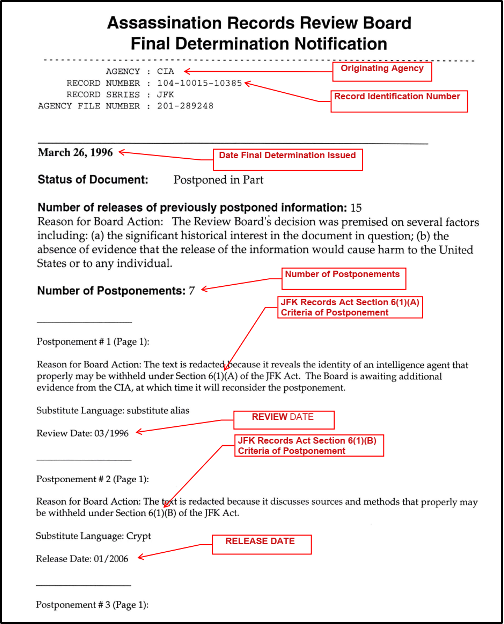
Pursuant to section 9(c)(3), each Final Determination was required to contain a description of the actions of the ARRB, including the justifications for the actions (i.e., postponing the release of a record) and a description of the proceedings of the ARRB relating to the specific record or action. In addition, each Final Determination required the ARRB to indicate a specified time or occurrence following which the associated record or postponement was to be reviewed by the Archivist and the originating agency or the date or occurrence when the record or redaction was to be released to the public.
Below is an example of the Final Determination Notification for RIF# 104-10015-10385. A larger image of the form can be found here. As you can see in this document, specific dates are set out for both the periodic review of a redaction and also for a release date.
Jeremy Gunn was the Legal Counsel for the ARRB. At pages 6-7 of his brief, titled Analysis of the John F. Kennedy Assassination Records Collection Act, 1992, Gunn highlighted the reporting and notice requirements of the Act that legally compelled the ARRB to publish copies of all of their Final Determinations in Annual Reports and to transmit copies of all Final Determinations to the Archivist of the United States. These reporting and notice requirements were mandatory under the law.
Third, the Board must submit four ongoing reports regarding the results of its decisions to postpone or to release information. The Board has four separate reporting requirements for describing the ongoing results of its decisions. First, the Board is required to report the results of its decisions on a document-by-document basis to the government office whose records it is reviewing as well as to the President (or to Congress in the case of legislative records). Second, the results of decisions must be reported in the Federal Register within 14 days of the date of the decision. Third, the Board must make a monthly summary report in the Federal Register. Fourth, the Board must prepare a document-by-document report to be submitted to NARA that describes the decision-making process for each record. Sec. 9(c)(3).
Fourth, the Board must produce an Annual Report to Congress. The Board must submit an Annual Report to Congress on the anniversary of the enactment of the legislation. Thus the Board's first Annual Report is due on or before October 6, 1995. The Annual Report must include information on the following topics: (a) finances; (b) progress made on review; (c) estimates for completion of the review; (d) any special problems (including the degree of cooperation of government agencies); (e) a record of the volume of records reviewed and a summary of decisions; (f) an explanation of any additional needs of the Review Board; and (g) an appendix containing copies of reports of postponed records. Sec. 9(c)(3).
By law, all of the 9(c)(3) legal orders (called ARRB “Final Determinations”) were required to be publicly disclosed in Annual Reports that were to be published for each year the ARRB was in operation between 1994 and 1998. Further, copies of each Final Determination were also required to be sent to the Archivist of the United States, who had the statutory ministerial duty to preserve all assassination records in the Collection at NARA….. including copies of all ARRB records, such as the ARRB Final Determination Notifications.
Section 7(o)(3) of the JFK Records Act states that, “Upon termination and winding up, the Review Board shall transfer all of its records to the Archivist for inclusion in the Collection, and no record of the Review Board shall be destroyed.” This means that the Archivist of the United States has a continuing non-discretionary legal duty to maintain all of the ARRB’s records (including all of the ARRB Final Determinations) in the JFK Records Collection and to make them publicly available unless the records had been ordered postponed from public disclosure under the standards of the JFK Records Act. As will be highlighted below, ARRB Legal Counsel Jeremy Gunn has stated that with regard to the ARRB Final Determinations, “Thus, from my understanding and recollection, 100% of the Final Determination forms should be housed at NARA and available for inspection, even if the associated document has not been released.” Further, it is strictly against the law for the Archivist or the National Archives to destroy any of the ARRB records.
The purpose of the ARRB Final Determinations was to fulfill the overarching mandate of the JFK Records Act to create an accountable and enforceable process to ensure the timely release of all assassination records.
Judge John Tunheim, Chair of the ARRB, has consistently and publicly stated that all of the ARRB’s decisions were binding and enforceable final actions, subject only to the President’s sole override authority, which was established by section 9(d)(1) of the Act. However, it should be understood that the President only had 30 days after the ARRB issued a Final Determination to reject and override an ARRB decision. If the President did not overrule an ARRB Final Determination within the statutory 30-day period, the ARRB Final Determination became the governing agency final action (legal order) for the subject assassination record. President Clinton, who was President during the entire tenure of the ARRB, did not overturn any of the ARRB’s decisions.
The authority of the ARRB to issue final binding and enforceable legal orders governing the postponement, periodic review and release of JFK assassination records has not been challenged. Even the CIA’s Assistant General Counsel Robert J. Eatinger Jr.’s December 14, 1992 analysis of the JFK Records Act acknowledged and confirmed that the Act codifies the judicial review process for all ARRB decisions.
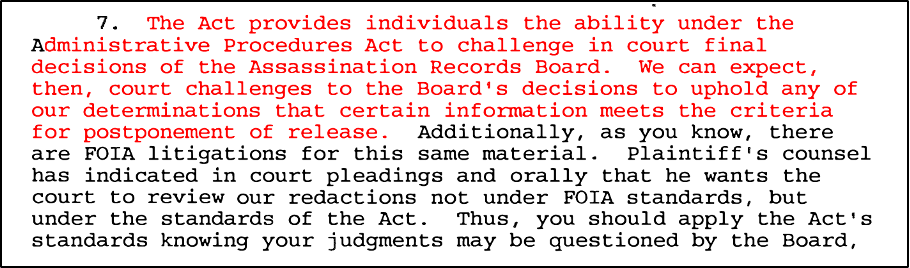
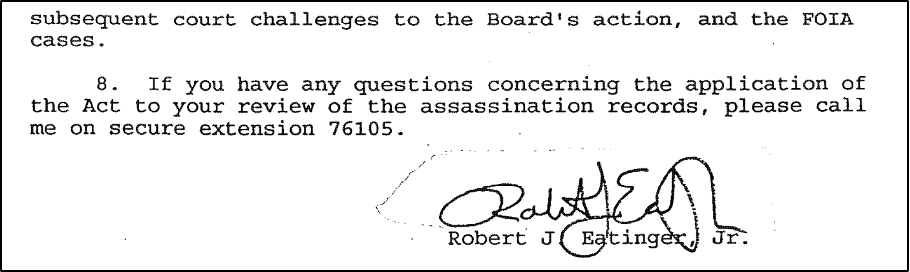
Once the 30-day “appeal” period mandated by section 9(d)(1) of the Act expired, the periodic review dates and release dates on all ARRB Final Determinations became final agency actions and were subject to judicial review pursuant to section 11(c) of the Act. If the Archivist of the United States failed to comply with the ARRB’s orders, such action or inaction could be challenged in court pursuant to the Administrative Procedures Act or a writ of mandamus.
The entire legal framework of the JFK Records Act was built around the basic concept that the ARRB’s Final Determinations could be enforced by the public to ensure that the government could be held to account for any unjustified delay in the release of the assassination records. Once the ARRB terminated its operations, this singular issue should have been squarely in the focus of all lawyers, researchers, and the National Archives. Any lawsuit for the release of records should identify section 9(c)(3) of the Act and seek disclosure of the ARRB Final Determinations and compliance with the ARRB orders. This is not only the key that unlocks the enforcement mechanisms of the Act with respect to postponed records, but it is the key to understanding which records avoided Board review.
Some attorneys have commented on public forums that due to President Trump’s January 2025 Executive Order that the ARRB Final Determinations are now “moot” and only a matter of “historical interest”. This suggestion, which is not supported by the law or by President Trump’s Executive Order itself, ought to be raising eyebrows, if not alarm bells.
To be precise, President Trump’s Executive Order:
- only calls for the creation of a “plan” to release the records (a plan no one has yet seen);
- contains no enforcement provisions or mechanisms; and
- explicitly requires that the plan shall be “implemented consistent with applicable law”.
The argument that the ARRB Final Determinations are now “moot” also completely ignores Section 11(a) of the JFK Records Act, which makes it 100% clear that:
PRECEDENCE OVER OTHER LAW.— When this Act requires transmission of a record to the Archivist or public disclosure, it shall take precedence over any other law (except section 6103 of the Internal Revenue Code), judicial decision construing such law, or common law doctrine that would otherwise prohibit such transmission or disclosure, with the exception of deeds governing access to or transfer or release of gifts and donations of records to the United States Government.
Further, the Senate Report from 1992 specifically addressed that a statutory process was established, rather than going the route of executive order and congressional resolution, intentionally because an executive order would lack the enforceability of a law. The Report states:
The Committee also closely examined the issue of whether legislation was necessary and concluded that it was. While disclosure of the records could be achieved through a non-statutory approach–by each House of the Congress passing a resolution pertaining to its records, and the President issuing an executive order to the same effect–a statute is necessary to ensure an independent and enforceable mechanism for disclosure under uniform standards for review.
Whether intentional or not, arguing that the ARRB’s final agency actions are now “moot” is tantamount to saying that the John F. Kennedy Assassination Records Collection Act of 1992 is no longer of any legal force or effect. Without having copies of all of the ARRB Final Determinations to reconcile whether they have been complied with, it is speculative and reckless to state categorically that they are “moot” as a matter of law. Again….this ought to be raising eyebrows everywhere in the JFK research community.
Because these issues are so serious, they will be expanded on in the sections below.
Evidence of ARRB Compliance
In Part Two of the Kennedys and King article mentioned above, it was discovered and confirmed that despite section 9(f)(3)(G) of the JFK Act mandating the ARRB to publish copies of all of its Final Determinations in a separate annex in Annual Reports during each year of its operations, not only did the ARRB fail to publish copies of all of its Final Determinations in Annual Reports for the years 1996, 1997 and 1998; it did not even publish Annual Reports at all in 1997 and 1998 when the ARRB issued the vast majority of its decisions.
Further, after a three-day visit to the National Archives in November 2024 and two formal FOIA/JFK Records Act requests for the production of all ARRB Final Determinations by this author, NARA has not produced even a single copy of a Final Determination Notification. And as a coup de grâce, as recently as June 2025, NARA has denied being able to find or identify any set of ARRB Final Determinations in the JFK Assassination Records Collection.
What is to be made of the enigma of the over 27,000 missing “binding and enforceable” legal orders issued by the Assassination Records and Review Board? Did the ARRB fulfill its statutory mandate under section 9(c)(3) of the JFK Records Act to create and transmit to the archivist a report for each postponed assassination record specifying the reasons for postponement and a time or occurrence when the record was to be released…. or not? As we will set out below, information strongly supports the fact that the ARRB did issue a Final Determination Notification for each record that was reviewed and postponed from public disclosure. However, with a little more than a year before the expiration of the ARRB’s mandate, there appears to have been a fairly radical policy change at the ARRB that caused a serious departure in the ARRB’s review process and the mandated content of its Final Determination Notifications.
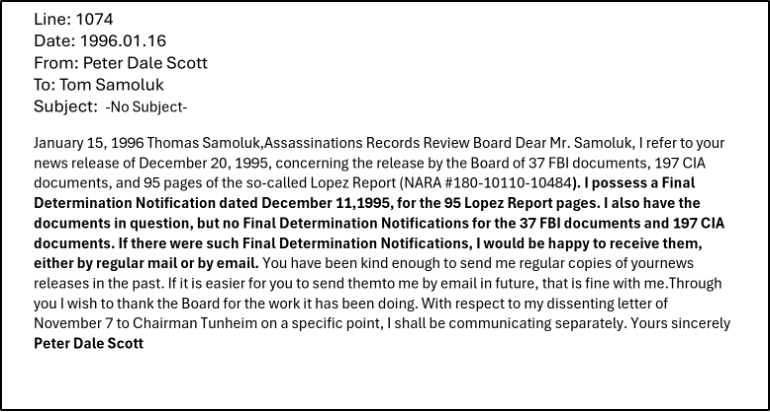
While the ARRB was in operation, several well-known assassination researchers were closely tracking the ARRB’s activities, and particularly the issuance of Final Determination Notifications. Email messages sent to the ARRB show that the Final Determinations were being issued by the ARRB and disseminated to the public. Eileen Sullivan and Tom Samuluk, to whom the email messages below were addressed, were both senior ARRB staff members. Note that the date of the second email message is May 13, 1997. This was in the penultimate year of the ARRB’s existence, and at a time that the ARRB was at full capacity in terms of issuing decisions.
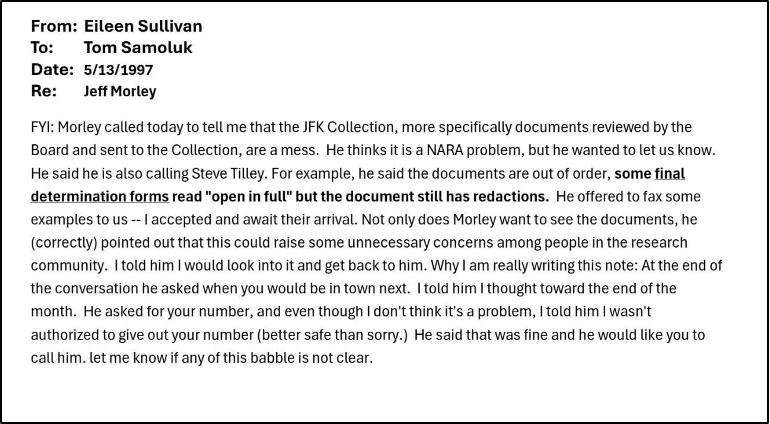
The full volume of ARRB decisions can be verified by visiting the Federal Register website and viewing all of the public notices of the Formal Determinations of the ARRB. In addition to the public notices of Formal Determinations published in the Federal Register, the ARRB was required, pursuant to section 9(c)(4)(A) of the Act, to send originating agencies a Notice of Formal Determinations within 14 days after the determination was made.
NOTE: There is a distinct difference between ARRB Formal Determinations and Final Determinations. Formal Determinations were streamlined public notices of decisions containing limited information, such as RIF#s, the record’s originating agency and very limited review or release date information. A sample Notice of Formal Determinations can be seen here. Final Determinations, on the other hand, were the binding and enforceable legal documents issued by the ARRB for each postponed record that set out the specific reasons for each postponement based on the Board’s review under section 6 of the Act, and were physically attached to each record before the record was transmitted to the National Archives to be included in the Collection.
The ARRB was statutorily mandated pursuant to section 7(o) of the JFK Records Act to submit a Final Report to the President and to Congress. Pages 37-38 of the ARRB Final Report detail the ARRB’s process of issuing Final Determinations.
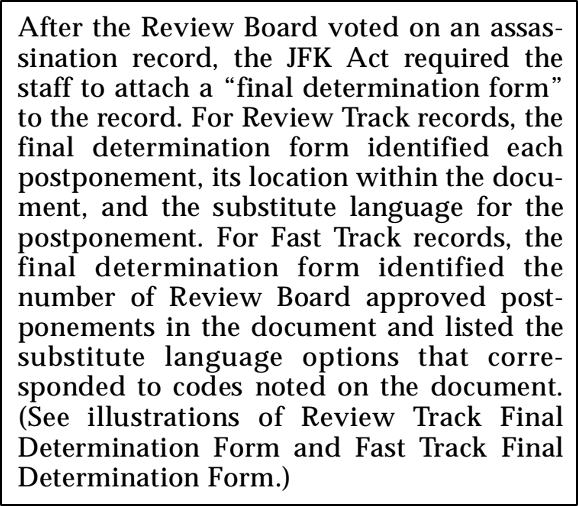
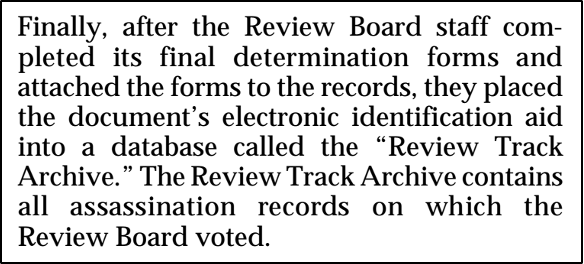
Despite the overwhelming evidence that a) the ARRB issued Final Determinations; b) attached them to the associated record; and c) placed them in NARA’s tracking database, an extremely small handful of researchers and NARA still seem to deny this happened.
Since there still seems to be isolated pockets of doubt about whether the ARRB fulfilled its existential objective to implement an accountable and enforceable statutory process for the public disclosure of assassination records, it appears that additional evidence is required to establish the fact that the ARRB actually did issue Final Determinations for each record that was postponed from public disclosure and that all of the Final Determinations were physically transferred to NARA for archiving in a meticulous and lasting manner.
In Part One of the two-part article published by this author in May and June 2025, Jeremy Gunn, Legal Counsel for the ARRB, is quoted as stating in an email dated October 26, 2024,
“... we planned that the wording of the forms [ARRB Final Determination Notifications] be such that even if the record were postponed from release, the form should be subject to release even if the content of the record remained classified. I have a vague memory from an oral statement by Kermit Hall at a Board meeting that the wording on the forms should be preserved so that future scholars could better understand the thinking process that went into decisions to release or postpone. There was no dissent from that observation. Thus, from my understanding and recollection, 100% of the Final Determination forms should be housed at NARA and available for inspection, even if the associated document has not been released.”
In an email dated March 15, 2023, former Chair of the ARRB, Judge John Tunheim confirmed that, “All of the Board’s determinations were ‘Final Determinations.’ We did not make any determinations about records that did not fit into that category.” During his May 20, 2025 testimony before Congress, Judge Tunheim confirmed that the ARRB issued over 27,000 individual rulings with release dates attached to them. In 2017, Judge Tunheim, while speaking at a National Press Club event, commented that, “If the date specific releases haven’t happened, someone has not pulled out the record to show that it should have been released.”
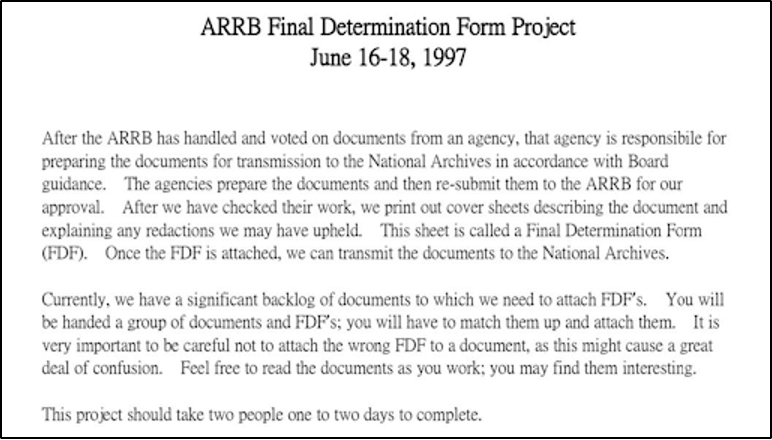
Part One of the May 2025 article also referenced an internal ARRB memoranda dated June 16-18, 1997, showing that with a little more than a year until its mandate was to expire the ARRB was pushing out a large volume of Final Determinations, which were required to be physically attached to each assassination record before the records were transmitted to NARA to be added to the JFK Assassination Records Collection.
Literally 8 days before the ARRB closed operations, the Analyst and Assistant Computer Specialist at the ARRB wrote an internal email to all ARRB staff notifying them that the ARRB’s CIA Team had to print out over 14,000 paper copies of the Final Determination Notifications.
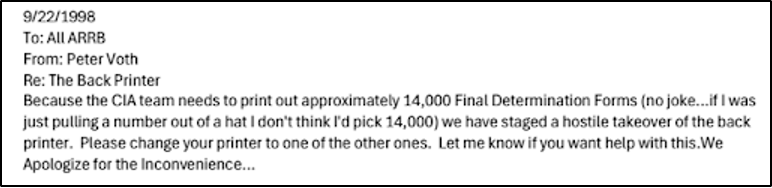
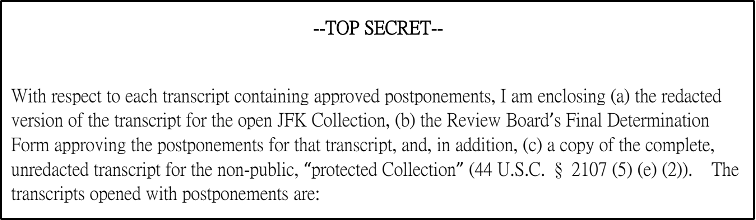
Further evidence of the issuance of ARRB Final Determination Notifications can be seen well into 1997 and 1998 and is found in correspondence between the ARRB Legal Counsel and the Senate Select Committee on Intelligence (SSCI) in regard to the SSCI’s Church Committee records.
The first excerpt (below) is from a June 2, 1998, letter from Ronald G. Haron, Associate General Counsel ARRB, to Kristen Wilhelm at the Center for Legislative Archives, National Archives and Records Administration.
The second excerpt (below) is from a September 25, 1998, letter from Ronald G. Haron, Associate General Counsel ARRB, again to Kristen Wilhelm at the Center for Legislative Archives, National Archives and Records Administration.
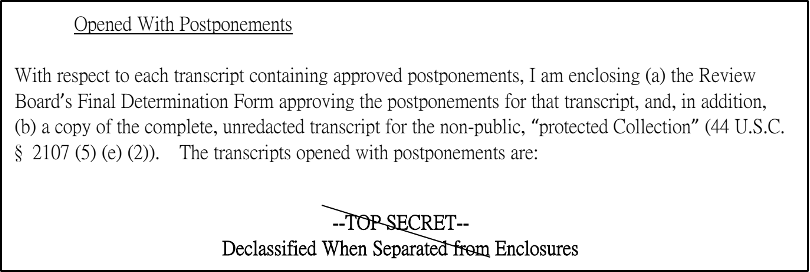
The two excerpts above are part of a series of numerous letters between the ARRB and the SSCI between 1996 and September 1998, wherein the ARRB notifies the SSCI of the status of its review of SSCI records and confirms the transmission of ARRB Final Determination Notifications to the SSCI for their records and to help track completion of processing of the SSCI collection of records.
Interviews With Senior ARRB Staff
Several telephone interviews were conducted in the summer and fall of 2025 with ARRB staff, including Chet Rhodes (Computer Specialist), Peter Voth (Analyst/Assistant Computer Specialist), Doug Horne (Chief Analyst for Military Records) and David Marwell (Executive Director), in order to get to the bottom of how the ARRB’s assassination records filing system and the processes involving the ARRB Final Determination Notifications actually functioned in practice.
Interview with Chet Rhodes - ARRB Computer Specialist
In a 2024 telephone interview with Chet Rhodes, the ARRB’s senior Computer Specialist, Rhodes confirmed that the ARRB’s Board and staff worked feverishly reviewing records and issuing Final Determinations right into the very last hours on its final day of operations on September 30, 1998, before this independent agency was shuttered and its lights turned off for good. This is supported by notes to the last Review Board meeting in the ARRB Federal Register Publication dated October 6, 1998. The final meeting of the Board took place on September 28, 1998, and a large volume of Final Determinations was issued that day.
Rhodes further confirmed that in fulfilling his responsibilities to wind up and transfer the ARRB computer system, he prepared 2-3 computers and the servers to contain all of the software and data from the ARRB’s system, including the full Lotus Notes tracking system which held all of the ARRB Final Determinations data, along with all of the other records, communications, and materials created by the ARRB and stored electronically during its operations. He packaged up the entire system, along with back-up copies of the data, before it was transferred to the National Archives, along with a detailed memo that Rhodes had prepared for the Archives staff, so that they could continue to operate the tracking system, perform mandatory periodic review, and comply with the ARRB Final Determinations. Rhodes further included his contact information and offered his continuing assistance to NARA if they needed help with any aspect of the system. He never heard back from NARA.
2025.11.07 Interview with Peter Voth - Analyst/Assistant Computer Specialist
Peter Voth holds a B.A. from Penn State and an M.A. from American University. He served an internship at the National Security Archive, where he dealt with FOIA requests. Voth started work at the ARRB in 1995 as an Analyst on the ARRB’s CIA Team and then shifted into a dual role of being the primary CIA Team Analyst and Computer Specialist working under Chet Rhodes. One of Voth’s primary responsibilities was to design reports and forms in the Lotus Notes system. Voth’s work with the ARRB continued until the last day of the ARRB’s operations on September 30, 1998.
In a telephone interview conducted on November 7, 2025, Voth recounted that the Board issued the large majority of their decisions in 1997 and 1998. One of his responsibilities was to print out the ARRB Final Determination Notifications once the ARRB had made their final decisions and to physically attach the Final Determination Notification (FDN) forms to the actual assassination record. Once the FDN was attached to the associated record, the finalized record was put into the ARRB records storage room where finalized files were kept before being sent to NARA to be added to the JFK Assassination Records Collection. This was explained in detail by Voth.
Voth further confirmed that the ARRB’s Lotus Notes system contained all of the data and information regarding the ARRB’s review process and decisions and that the Lotus Notes system was also the program used to print out all of the reports and forms required under the Act. Voth confirmed that the Lotus Notes system would contain all of the ARRB Final Determination Notification data.
With respect to how he and the ARRB’s Team of CIA Analysts handled the assassination records and the Final Determinations, Voth stated that all records were contained in grey archival boxes and kept in the ARRB’s secure Sensitive Compartmented Information Facility (“SCIF”). Inside the grey archival boxes, each assassination record would be contained within separate file folders for each record. Analysts from each review team would access the SCIF and take a box of records to their work area in order to review the records and assess the agency’s postponement requests, working through each postponement and entering the information and the analyst’s recommendation into the Lotus Notes system. When an analyst completed reviewing the record and all information would have been entered into Lotus Notes, the analyst would print off a draft Final Determination Notification and physically attach it to the assassination before returning the record to the grey archival box. Reviewed records would then be returned to the SCIF file storage room and wait to be reviewed by the Board for final approval. Again, a very precise and meticulous records processing system.
When the Board completed voting on a record, ARRB staff would finalize the records file by physically attaching the Board-approved version of the Final Determination Notification to each assassination record so that it would act as a coversheet and tracking aid for the record.
Once the Board had voted on a record and the Final Determinations had been affixed to the front of the assassination record, the file folder would be put back into a grey archival box and returned to the SCIF to await transfer to the National Archives to be added to the Assassination Records Collection.
In regard to his internal email dated September 22, 1998, mentioned above in this section, Voth confirmed that the ARRB staff worked right until the very last day printing out Final Determination Notifications. As he and the other CIA Team members were responsible for processing ARRB Final Determinations on an ongoing basis from 1996 through September 1998, and had been attaching Final Determination Notifications to the records throughout their time at the ARRB. It was his best recollection that the last-minute print job at the end of September 1998 was completed in order to compile a single consolidated volume of paper copies of the Final Determination Notifications issued for the CIA Team records--which was to be transferred in hard copy to NARA. This is corroborated by the ARRB Final Report which shows that the Board voted on 14,079 CIA records (see below).
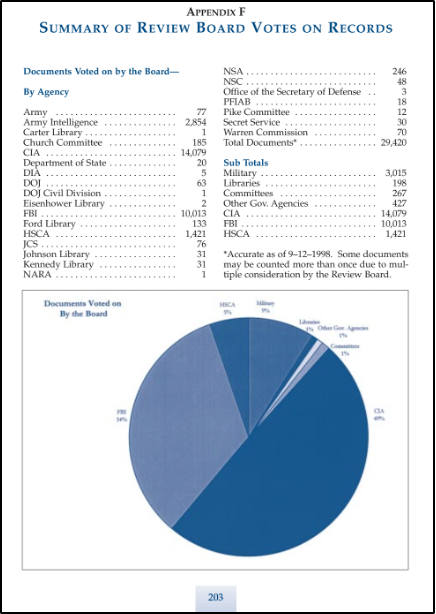
Once NARA accounts for the 14,079 Final Determination Notifications for these associated CIA records, the public will finally be able to know the status of these postponed records. The public will also be able to determine precisely which CIA records, whether in the JFK Collection at NARA or not, were never seen by the ARRB.
2025.11.10 Interview With Doug Horne - Chief Analyst for Military Records
Doug Horne graduated cum laude with a B.A. in History from Ohio State University before serving ten years on active duty as a Surface Warfare Officer in the U.S. Navy. He then served another ten years as a Navy civil servant operations manager in a Pearl Harbor logistic support field office specializing in anti-submarine warfare. Horne joined the ARRB staff in August 1995 and was promoted to Chief Analyst for Military Records, a position he held until September 30, 1998, when the ARRB’s operations came to an end.
Horne supervised a staff of four Analysts on the ARRB Military Records Team, operating out of the ARRB office located on the second floor at 600 E Street NW in Washington, D.C. The Military Records Team had its own section within the ARRB office space. Horne described in detail the large secure records storage room at the back of the ARRB office, where floor-to-ceiling shelving held the grey archival boxes containing the assassination records. There were never any open or loose papers or files left in the file storage room. Everything was contained in the grey archival boxes. The SCIF storage room was secured by a numbered keypad lock, which he and members of his team would access to acquire assassination files for review. Horne confirmed that the archival boxes were numbered and displayed the name of the originating agency. The archival boxes contained manila colored file folders with handwritten RIF#s and the name of the originating agency on the outside of the folders to identify each record.
The file folders were all organized in a precise fashion according to ARRB policy and practice. Inside each file folder, all of the paper documents were secured together with a clip; either a regular paperclip for records containing only a few pages, or for larger records, the papers were held together with a black spring clip. There were no loose papers in any of the file folders, as it was an ARRB policy that all papers were required to be secured together inside every file folder.
When Horne and his team members initially accessed a file to begin their review, the top page was always a Record Identification Form (“RIF”), or more properly an Identification Aid, specific to each record that acted as a coversheet for the underlying assassination records.
Horne and his team reviewed and processed each record for which it was responsible. Once the review was completed, the team would print off a draft Final Determination Notification for the Board’s review and affix the Final Determination Notification to the top of the rest of the documents, so as to become the new coversheet inside the file folder. Once the record review process was completed for each record and a Final Determination Notification was secured onto the rest of the contents of a file, the file folder would be returned into the numbered grey archival box and returned to the secure file storage room. This process was consistently followed for all of the records the Military Records Team reviewed in accordance with ARRB policy.
2025.11.12 Interview With David Marwell - Executive Director of the ARRB
David Marwell served as Executive Director of the Assassination Records Review Board from August 1994 until October 1997. Prior to his position at the ARRB, Marwell attended Brandeis University, where he obtained a B.A. in English before receiving a Ph.D. in Modern European History from the State University of New York at Binghamton. Before joining the ARRB as Executive Director, Marwell served as Chief of Investigative Research at the Office of Special Investigations at the Department of Justice and was the Director of the Berlin Document Center, where he oversaw the declassification of millions of records of the Third Reich.
David Marwell was the first staff member appointed by the ARRB Board after it assumed office in April 1994. Since the ARRB was a newly created agency with no office, no staff, no policies and no operational history, it was Marwell’s responsibility as the chief officer to scale up the organization from nothing into a functional government agency with a very short lifespan and a significant set of duties and deliverables. From acquiring secure office space to seeking approval of a budget and funding from Congress, to establishing agency policies, Marwell’s responsibilities were onerous.
One of his first tasks was to secure office space that would operate under the strict government requirements of being a Sensitive Compartmented Information Facility (“SCIF”) that would contain millions of pages of the most sensitive government records regarding the assassination of President John F. Kennedy. Marwell described the facility at 600 E Street NW in Washington, D.C. as having been previously classified as a SCIF, which required less retrofitting than would a wholly new facility. With respect to the secured file storage room, Marwell explained that the space already had a secure file storage area with slab walls and a solid ceiling. The floor-to-ceiling shelving with a center aisle of shelving was also already in place from the previous occupant of the premises.
As for the rest of the large office space, Marwell explained that each of the four major research teams had their own area that included an office for the Team Leader and a large central common work table for the staff. As the work of the ARRB advanced, staff would also work remotely at the originating agency offices.
One of the earliest staff members that Marwell hired was Chet Rhodes, who Marwell would work closely with to develop the ARRB’s Lotus Notes record tracking system and the creation of the various forms required by the JFK Records Act.
In respect to the process of review and the organization of the record files, Marwell shared a wealth of knowledge and information. He confirmed that the assassination records were all kept in grey archival boxes, and some of the larger volumes of records were kept in brown heavy banker-type boxes. Inside the grey archival boxes were manila file folders containing the assassination records. Each folder had the RIF# labeled on the outside of the file, and the contents of each file were required to be clipped together so there were no loose papers.
The contents of each assassination record file folder, as it was received by the ARRB, were consistently organized with the Identification Aid (RIF form) acting as a coversheet situated on top of the actual assassination record. Underneath the RIF form and the assassination record were briefing notes from the ARRB staff as well as notes and a briefing document created by the originating agency. The actual assassination record consisted of two separate copies, one completely unredacted copy and a copy with requested redactions and notations created by the originating agency.
Marwell also elaborated on the review processes conducted by the staff analysts and by the Board itself. He noted that 90% of the postponement requests from the agencies became “routine” after the Board had established its “common law”, which was the ARRB’s track record of decision-making. As records were input into the Lotus Notes system, they would be assessed and assigned a color-coded review level consisting of Green, Yellow and Red tracks. Records designated Green would be expedited, as there were no disputes flagged by the Analysts. Yellow-marked files meant that the Analysts were unsure of the Board’s position on an issue and sought guidance from the Board. Red-flagged records would be fully reviewed by the Board, as they dealt with more contentious issues.
At regularly scheduled closed Board meetings, Board Members would vote on postponements, and staff would record the votes, which would be reflected in the Lotus Notes system. Once the Board had completed reviewing and voting at a meeting, Final Determination Notifications would be printed out, and ARRB staff would be tasked with matching the Final Determination with the file folder containing the related assassination record. Staff would then physically attach the Final Determination to the assassination record so that it would become the coversheet inside the file folder. Once each of the records reviewed at a Review Board meeting had a printed copy of the Final Determination attached to the assassination record inside the file folder, the completed folder would be returned to the SCIF, where all the completed files from the same meeting would be boxed together in sealed boxes to be transferred to the National Archives. This process was followed the entire time that David Marwell was Executive Director of the ARRB.
Interview Wrap-up
What these interviews with senior ARRB staff provide is a corroborated and detailed inside glimpse of the meticulously organized and consistent policies and system that the ARRB established to implement its mandate pursuant to the JFK Records Act. Rhodes, Voth, Horne, and Marwell all confirm that the review process culminated in the physical printing of Final Determination Notifications for each record that was reviewed and voted on by the ARRB Board for postponement of disclosure. Further, the interviews confirm that ARRB staff were directed to physically attach each printed Final Determination to the front of each assassination record which was contained in a file folder, before the completed record was transferred to NARA to be added to the JFK Records Collection. Finally, the interviews confirm that all ARRB activities and records, including the Final Determinations data, were in the Lotus Notes electronic database, backed up, and delivered to NARA.
Exactly what happened to the ARRB Final Determinations and how they were handled once they arrived at NARA has been a real mystery that requires resolution so that the issue of secretly held records regarding the assassination of President Kennedy can be put to rest once and for all.
A Large Potential Wrinkle
While there is overwhelming evidence that the ARRB did indeed issue more than 27,000 Final Determination Notifications, attach each notification to the related assassination record and transferred all of the notifications and records to the National Archives, there remains a serious and yet to be explained glitch in what should have been a very straightforward review process and release process. A recently released Secret CIA memo dated March 5, 1997, authored by Barry Harrelson, Chief of the CIA’s JFK Records Project, indicates that in the early spring of 1997 (a time when the ARRB was churning out review decisions at full capacity), the CIA and senior ARRB officials were in discussions about changing the review process–specifically in respect to streamlining the content of the Final Determination Notifications.
As the excerpts below from the March 5, 1997, memo show, the changes being proposed were significant.
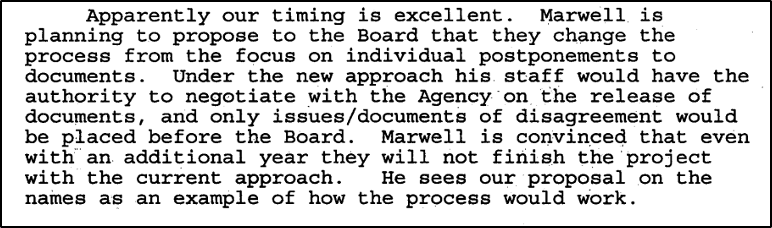
Most troubling in the above paragraph is the proposed shift from individual postponements to documents. The JFK Records Act specifically mandates the ARRB and the agencies to be precise with any withheld information, authorizing postponement of only the portions of a record that could disclose information that was shown to be demonstrably harmful, as evidenced by an agency to meet the standards of section 6 of the Act.
To shift from individual postponements to document-based postponements would represent a significant departure from the strictures of the Act.
Below is an outline of the new review process that was being proposed.
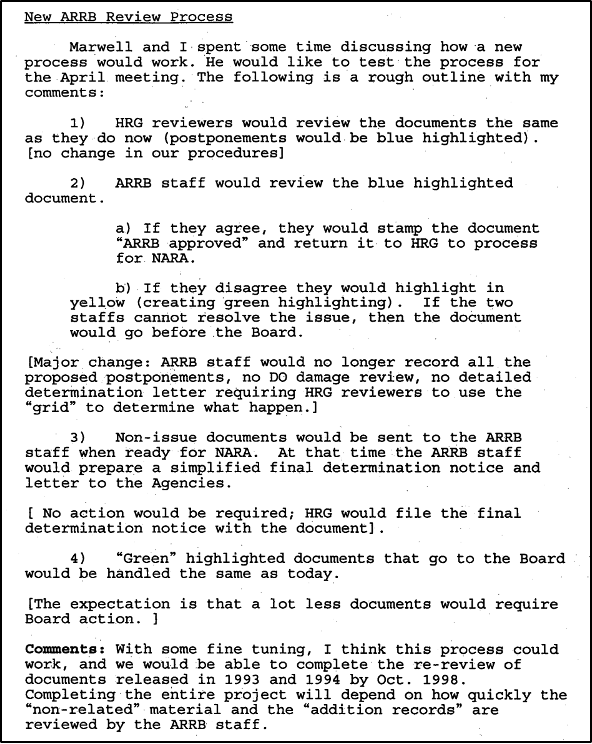
Particularly concerning is paragraph 3, which states that “the ARRB staff would prepare a simplified final determination notice and letter to the Agencies. [No action would be required; HRG (Historical Review Group) would file the final determination notice with the document].
What this Memo suggested was a sea change in terms of the ARRB’s review process that would operate to stop the ARRB from using a scalpel to redact certain protected words or small sections of a record, and instead start to use a heavy cleaver to postpone the release of entire documents. Added to this approach to the review process was a massive change to the ARRB’s Final Determinations that seems to have stripped out the legally critical content of the FDNs mandated by section 9(c)(3). This included reasons or justifications for the ARRB’s postponement decisions and actions (including the section 6 basis for postponement) and the ARRB’s prescribed dates for periodic review or release of the assassination record.
Whether these proposed changes to the review process and the content of the Final Determination Notifications were ever voted on and approved by the ARRB Board Members is presently uncertain.
Several pieces of correspondence have been sent to Judge Tunheim, David Marwell and/or to Jeremy Gunn to seek clarification and confirmation whether the ARRB’s policies in fact changed in early 1997 with regard to the review process and the content of the Final Determination Notifications. As of the date of this article, there has been no response.
Without access to copies of all of the issued Final Determinations from 1997 and 1998, in addition to all recordings and minutes of all ARRB meetings and the Lotus Notes database, it is not possible to fully understand with certainty what happened.
If the proposed changes were approved and postponements started to be issued on a record-by-record basis and the Final Determination Notifications were “simplified”, what would these changes have looked like in practical terms? In a number of the document releases from 2025 and 2026, we have been given a very small glimpse of a few FDN’s issued in 1998. As an example, below is a copy of one such 1998 Final Determination issued by the ARRB.
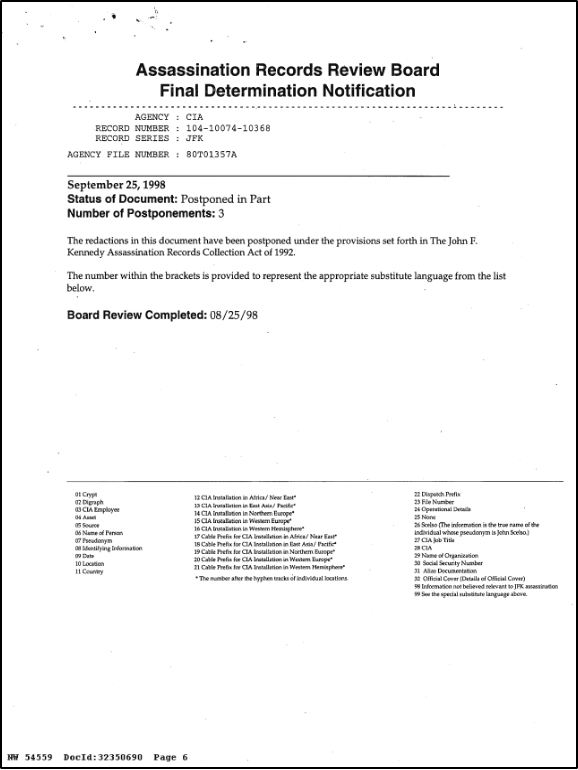
In legal terms… this 1998 ARRB Final Determination is a blank piece of paper.
Comparing the 1998 Final Determination immediately above to the 1996 Final Determination posted above in this section of the article and linked again here, you can see a startling difference in the content of the ARRB order. Particularly absent in the 1998 document are any of the reasons justifying the postponement under the standards of section 6 of the JFK Records Act. The 1998 Final Determination also does not stipulate the review or release dates. Both the section 6 criteria for postponement and the review or release date are mandatory requirements for all ARRB Final Determinations pursuant to section 9(c)(3) of the JFK Records Act.
Further problems arise when examining the 1998 Final Determination under the standards of the Administrative Procedures Act which requires all agency final actions subject to judicial review to articulate adequate reasons that would set out a rational connection between the facts found and the decisions made by the agency.
The example of the 1998 Final Determination Notification above is nothing more than a boilerplate form that provides none of the legal elements required under either the JFK Records Act or the Administrative Procedures Act. As a result, there is nothing binding or enforceable contained in this document, and it is the definition of an arbitrary and capricious agency final action.
Since very few FDN’s issued by the ARRB in 1997 and 1998 have been publicly disclosed by NARA, it is difficult to draw any firm conclusions whether the proposed policy shift detailed in the March 5, 1997, CIA Memo was fully or partially implemented. Clarification from former ARRB leadership regarding this specific issue would likely resolve any remaining uncertainty.
Final Take-Aways Regarding the Final Determination Notifications
In the third section of this article subtitled “The Special Operation On the Congressional Records”, we provided evidence of the CIA holding back (until the very end of the ARRB review process in 1998) all of the most sensitive HSCA, Church and Schweiker-Hart investigative records after the CIA came to terms with a) the ARRB’s expanded definition of “assassination records” and its determination to review and process them; and b) President Clinton’s unwillingness to entertain any agency appeals of ARRB postponements (of far less sensitive records). Perhaps the CIA was counting on former CIA Director and President George H.W. Bush to win the 1992 election and to be in place to rubber-stamp all of the agency’s appeals. When Bill Clinton won the 1992 election in a surprise victory, the agencies needed to retool their strategies to contend with an uncertain new independent agency and a President who took a hands-off approach to resolving disputes between the ARRB and, particularly, the CIA and FBI.
Without access to the Final Determinations of the ARRB and the redaction-by-redaction orders for periodic review and the enforceable release of records on specified dates or events, there has been no way for the public to track or seek judicial review of the actions or inaction of the Archivist of the United States, who is the official mandated with the sole legal ministerial (non-discretionary) duty to implement and comply with the ARRB’s final agency orders.
The ARRB Final Determinations provide the bedrock of the Assassination Records Collection held at the National Archives. They establish with certainty the entirety of the assassination records reviewed by the Board. Understanding the scope and details of the Final Determinations, alongside a comprehensive subject guidebook and index of all records transferred to NARA, would provide the public and researchers the ability to comprehend the two other tranches of records that form the Collection, (a) records transferred to NARA prior to the passage of the JFK Records Act and (b) records transferred to NARA after the ARRB terminated its operations.
Without access to the Final Determinations and an index, it is impossible to track which records have been unlawfully withheld and which records remain undisclosed. This was and is the essence of the accountable and enforceable process for the review and release of assassination records and the entire purpose of the JFK Records Act. These problems are explained in detail in the September 29, 2025 letter sent to Representative Luna and the Congressional Task Force on the Declassification of Federal Secrets by Mark Adamczyk, Andrew Iler and Jeff Crudele, as will be revisited in the last part of this article.
Oliver Stone and Doug Horne were both witnesses before the Luna Task Force early last year. Both of these men have put in the time and done substantial work to significantly advance the public’s understanding of the assassination and the failures of the government’s investigations and handling of evidence. In the months following their testimony to Congress, both Horne and Stone wrote separate letters to Representative Luna and to Secretary Marco Rubio (also Acting Archivist of the United States), specifically calling on the government to comply with the JFK Records Act and to publish the ARRB Final Determinations (Horne Letter / Stone Letter). In addition to these formal letters Mark Adamczyk, Andrew Iler and Jeff Crudele have sent formal correspondence to Representative Luna and other congressional leaders on the House and Senate Oversight Committees, calling on Congress to perform its mandated oversight duties over the JFK Records Act and specifically regarding complying with and releasing the ARRB Final Determinations and publishing an accountable index of all assassination records at NARA. To date, there has been no formal response to any of the correspondence sent to Representative Luna or to Secretary Marco Rubio, nor has there been any public acknowledgment of the problems surrounding the ARRB Final Determinations or the absence of a complete index of records in the JFK Assassination Records Collection. Furthermore, there is a noted divergence between recent public statements from researchers advising the Task Force and the available documentary record on these specific issues.
PART VI
Key Takeaways – the Luna Task Force and An Alternative Universe
As of June 2025, NARA is on record regarding their lack of ability to identify or locate any Final Determinations of the ARRB, which are final orders. As demonstrated in this article, we know with certainty that these critical legal orders were created by the ARRB and transferred to NARA in a meticulous process. None of them were overturned by President Clinton during the ARRB’s term, which was the President’s right to do. Since NARA would have had to physically remove the ARRB Final Determinations from each record before digitally scanning them, there is a legitimate oversight question on what happened to the over 27,000 ARRB Final Determination Notifications. This raises another related inquiry on why the release of ARRB’s Final Determinations could possibly be problematic for NARA and others.
In effect, a public release of these Final Determination orders not only discloses the binding release decisions of the ARRB and whether they have been complied with, but it also completes the three (3) tranches of records that require oversight. Specifically:
a. A written record of sensitive records transmitted to NARA before the enactment of the JFK Act that were probably handled under agency-controlled declassification rules;
b. A written record of the assassination records that were not reviewed for declassification by the ARRB during its operations; and
c. A written record of the black hole of unknown periodic review and arbitrary dump(s) of NARA releases since the ARRB shut down in 1998.
Anyone either downplaying or discounting the Final Determinations either does not understand their legal significance or otherwise resists dealing with their current legal enforceability and the crucial role they play in completing the statutory requirements of the JFK Records Act and the JFK Records Collection. The truth is that the ARRB’s Final Determinations create the foundation of a complete and accurate JFK Collection at NARA. Without them, the public does not know what records were handled under separate postponement rules, as well as what review standards (if any) were used to withhold records from public disclosure and when, and who conducted this process.
Taking a step back and looking from a higher altitude, the records released by NARA since September 30, 1998, create more questions than answers about the transparency and thoroughness of the actual JFK Records Collection at the Archives. There have been releases on NARA’s dedicated website of over 73,000 files since 2017. All other releases go back to the “bulk collection” that was archived by NARA by September, 1998. None of the post-ARRB releases have been backed by a record-specific certification from the President, as required by the JFK Act. None of the releases are tied to an index of the over 27,000 legal orders issued by the ARRB. And none of it is based on an accountable publicly facing catalog and index of each assassination record ever handled by NARA as required by the JFK Act.
Almost a further decade has now passed since the October 26, 2017, statutory deadline for the release of all assassination records. Given that both Presidents Trump and Biden’s postponement orders did not disclose reasons for the continued withholding of records on a record-by-record basis as required by law, all we do know about this delay is that the 2017-2026 releases were done after 20+ years of relative secrecy at NARA. For all intents and purposes, the ARRB’s Final Determination orders have been buried. To this day, one can only speculate at the number and status of assassination records that were required to be properly archived and indexed, how many have been released as ordered by the ARRB, and how many still remain protected, sequestered and withheld. According to numerous experienced assassination records specialists and staff at NARA, the JFK Records Collection “is a mess”.
What is the solution with Congressional oversight? It’s not as complicated as you may think. There are many examples of records that were partially or fully declassified after the ARRB closed operations in 1998. For instance, the ARRB had a high level of interest in the HTLINGUAL operation (the CIA’s illegal mail intercept program) and specifically sought access to those files as early as 1995 and 1996. HTLINGUAL files would later show the activities of CIA officer Reuben Efron, who was directly responsible for handling the mail intercepts involving Lee Harvey Oswald as early as 1959 through to possibly 1963. Surprisingly, Efron also shows up in the Warren Commission records as having acted as an interpreter for Marina Oswald during her Commission depositions. The record, however, shows that Efron did not disclose either that he was then working for the CIA or that he was directly involved with the interception of Oswald’s mail as part of the HTLINGUAL program.
A formal FOIA/JFK Act records request to NARA was served by Mr. Iler on July 31, 2025, specifically targeting ARRB Final Determinations for three records relating to Reuben Efron’s activities. NARA acknowledged receipt of the FOIA/JFK Act request, but has since not produced the records or followed up in any manner to advise whether NARA has the records or when they would be produced. Metadata on the Identification Aids for these three records show that the records were transmitted to and received at NARA in April 1998, so it appears that they would have been subjected to review by the ARRB, which would have caused a Final Determination Notification to be issued for each record.
Even though Efron died in 1993, his name remained redacted until the records were released in 2023. There is almost a zero chance that the ARRB would have postponed release much past 1998, let alone until 2023 (6 years past the absolute deadline of 2017 in the JFK Act). Where are the Final Determinations for these records and when did the ARRB order the records released?
An obvious administrative solution is for Congressional oversight committees to require the production of transmission detail records for the transfer of records from the agencies to NARA before and after the ARRB, together with all internal communications between NARA and agencies in these periods. The February 10, 1992, CIA memo(s) discussed earlier in this article suggest that this piece of oversight is critical for addressing records and collections (including Operational files) that were handled by rules and criteria not established by the JFK Act and the ARRB. The Reuben Efron records are a perfect test case to understand how NARA handled the ARRB Final Determinations and files that were withheld beyond any reasonable period permitted by the JFK Records Act.
It is especially important to identify and track all records transmitted to NARA after September 30, 1998. Why? These records were not processed by the ARRB under its exacting legal standards. Without a reliable index and inventory of all records transmitted to NARA after the ARRB’s operations, the public has no way of knowing if the 2017-2026 document dumps on NARA’s dedicated website include all records previously withheld. The public also has no way of knowing the extent of records that are still protected in a “sequestered” collection in violation of the JFK Act. This data, along with disclosure of the Final Determinations issued by the ARRB, would be an enormous move toward meaningful accountability and disclosure of the JFK Collection. It would show the public that Congress actually remains dedicated to ensuring that there are no longer any federal secrets with respect to the JFK case.
The final piece of oversight for NARA and the Archivist of the United States is right in the JFK Act, which has not changed since enacted in October 1992.
Section 12(b) of the JFK Act provides that the Archivist, at some point, must certify to the President and to Congress that “all assassination records have been made available to the public in accordance with this Act.”
In order to be in a position to make this certification, the Archivist must comply with sections 4(a)(1) and (2) of the JFK Act, which requires the Archivist to “prepare and publish a subject guidebook and index to the (JFK) Collection”. By law, the Collection consists of all assassination records that were transmitted (or required to be transmitted) to the National Archives. Specifically, the JFK Act requires that the Collection shall include all assassination records:
- That were transmitted to the National Archives prior to October 26, 1992 (the date of enactment of the JFK Act);
- That were transmitted to the National Archives after the passage of the JFK Act; and
- That were postponed from public release under the JFK Act.
Further, sections 4(a)(1) and (2) of the JFK Act require that a publicly facing JFK Records Collection shall also include all records of the Assassination Records Review Board (ARRB) and a central directory of identification aids created for each record transmitted to the National Archives for review under the Act (i.e. “RIF Forms” for tracking purposes).
JFK assassination researcher and former military intelligence officer John Newman addressing a 2017 conference stated that in carefully tracking NARA’s identification aids for assassination records in the JFK Records Collection, he had noticed that important information contained in the identification aids had gone missing or been changed and that the system had been tinkered with itself. These types of problems should be identified and rectified through congressional oversight.
The requirements of sections (4)(a)(1) and (2) of the JFK Act could not be clearer. It is now 2026, and the Archivist has not made its final certification to the President, Congress and the public. It cannot be done without a complete catalog and index of all assassination records ever handled by NARA, in addition to all records of the ARRB. This should not be debatable. Congressional oversight committees, both House and Senate, maintain perpetual jurisdiction over this Collection under the JFK Act until full compliance is achieved; accordingly, the exercise of that oversight authority is now long overdue.
President Trump’s 2025 Order and the Luna Task Force: An Alternate Universe
On January 23, 2025, President Trump issued Executive Order 14176 concerning declassification of assassination records. The order not only deals with assassination records in the JFK case, it also covers the assassinations of Robert F. Kennedy and Dr. Martin Luther King. The full order can be seen here: Declassification of Records Concerning the Assassinations of President John F. Kennedy, Senator Robert F. Kennedy, and the Reverend Dr. Martin Luther King, Jr. – The White House.
In the order, President Trump stated: “It is in the national interest to finally release all records related to these assassinations without delay…I have now determined that the continued redaction and withholding of information from records pertaining to the assassination of President John F. Kennedy is not consistent with the public interest and the release of these records is long overdue.”
This sounds clear and powerful enough. However, with respect to assassination records in the JFK case, what does President Trump’s order actually require in terms of legal action?
First, the order required the Director of National Intelligence and the Attorney General, in coordination with the White House, to present a plan to President Trump for the “full and complete release of records relating to the assassination of President John F. Kennedy.”

The actual plan presented to the President has not been released to the public. Earlier in this article, we addressed how Trump’s Executive Order does not make compliance with the JFK Records Act and its legally required orders of the ARRB a “moot” issue. Rather, the Executive Order does require that it be implemented consistent with applicable law (i.e., the JFK Records Act), which we will address shortly. While we applaud both President Trump’s actions to push for a plan to release the assassination records and the resulting release of additional files, it should be well noted that an Executive Order does not override section 11(a) of the JFK Records Act, which ensures that any final actions of the ARRB (i.e. ARRB Final Determinations) to release records to the public takes precedence over all other laws.
As far as the public record is concerned, the known results of Trump’s order thus far are as follows. First, the National Archives posted 2,569 files on its dedicated JFK Assassination Records website between March 18 and April 3 (2025). Another 140 files were recently posted on January 30, 2026. Similar to all other posts or releases by NARA since 2017, these files are not organized by or tied to a subject guidebook and index as required by the JFK Act.
Two hearings were conducted on April 1 and May 20 (2025) by Representative Luna’s Task Force on the Declassification of Federal Secrets. Those hearings featured impactful testimony from several assassination experts and witnesses.
Following those hearings, we have seen news coverage on additional records that the Task Force has been able to procure from agencies and foreign governments, notably the George Joannides’ personnel files, records on William K. (Bill) Harvey and Russia’s JFK dossier.
Finally, we can expect a final report from Representative Luna’s Task Force in the near future. Presumably, that final report will be based on the Congressional Record created at the two (2) hearings and the additional records later secured by the Task Force.
Noticeably absent, however, from the Task Force’s public hearings and additional records searches has been testimony from past and present senior Archivists regarding the accountability of the JFK Records Collection as administered by NARA. While the focused search for additional select records highlighted by individual researchers has led to some new information, this course of action ignores the fact that the entire JFK Records Collection, as defined in the JFK Records Act, is not yet available to the public.
As explained in painstaking detail in this article, the only way to get this done is to require the disclosure of all ARRB records and a complete catalog and index of every assassination record transmitted to NARA as of October 26, 1992 and later. In other words, we are nowhere closer to knowing the full extent of what the JFK Records Collection is (or is not) as required by the JFK Act. As previously discussed, other than Judge Tunheim’s brief but powerful testimony on May 20, 2025--during which he incredulously stated that a flood of records recently released were not submitted to the ARRB for review and were transferred to NARA “at a later time”-- there is no known congressional oversight of the material issues and problems discussed in this article.
It is therefore fascinating to speculate on an alternative universe of events following President Trump’s executive order in January 2025.
The starting point is to acknowledge that President Trump’s order requires that it be “implemented consistent with applicable law.” The JFK Records Collection Act of 1992, unanimously passed by Congress more than 33 years ago to ensure that each assassination record was released by October 26, 2017 at the very latest, is the only law of the United States that directly deals with declassification of JFK assassination records, and it takes precedence over any other law, judicial decision or common law doctrine that would otherwise prohibit transmission of a record to the Archivist or public disclosure [see section 11(a), JFK Records Act.]
The Senate Report for the JFK Records Act is clear on this–the JFK Act was necessary to ensure an independent and enforceable mechanism for disclosure.
Senate Report 102-328
The Committee also closely examined the issue of whether legislation was necessary and concluded that it was. While disclosure of **2969 the records could be achieved through a non-statutory approach–by each House of the Congress passing a resolution pertaining to its records, and the President issuing an executive order to the same effect–a statute is necessary to ensure an independent and enforceable mechanism for disclosure under uniform standards for review.
In terms of ensuring the complete declassification of all assassination records in the JFK Collection maintained (or required to be maintained) at the National Archives, the Archivist of the United States has a mandatory, non-discretionary ministerial duty to prepare and publish a subject guidebook and index to the Collection, which again consists of:
- all records transmitted to NARA before and required to be transmitted to NARA after the passage of the JFK Act;
- all postponed records as determined by the ARRB;
- all records of the ARRB; and
- a directory of identification aids for tracking purposes.
Again, NARA is mandated by the JFK Records Act to publish and disclose these materials to the public.
In order to implement President Trump’s order consistent with applicable law and meet the stated goals of both President Trump and the Task Force to Declassify Federal Secrets, it is critical for the public to finally know, a) what records were turned over to the National Archives under the JFK Act, b) what records were reviewed and ordered declassified by the ARRB, and c) what records remain withheld or postponed -- all to be tracked by a subject guidebook and index and central directory of tracking aids.
Certainly, the witnesses who appeared before the Task Force put some important information on the Congressional record, which will hopefully result in a new investigation of those matters.
We have addressed ARRB chairman Tunheim’s powerful testimony on May 20, 2025 and how that requires an investigation of assassination records never seen by the ARRB and transferred to NARA “at a later time.”
Doug Horne, mentioned previously in this article, testified on May 20, 2025, regarding serious evidence of conflicting autopsy reports, known missing autopsy records, photographs, x-rays, bullet fragments, and the President’s brain. Horne also testified in respect to chain of custody issues with the Zapruder film and evidence of tampering with the film. These are documented issues of evidence that should be in the custody of the government and which require congressional oversight to resolve.
Dan Hardway, HSCA investigator, testified on May 20, 2025, that his work at the HSCA led him to conclude that the CIA used Oswald operationally in Mexico City before the assassination, and he was likely impersonated there. Hardway also testified about the covert CIA operation against the HSCA involving CIA officer George Joannides.
The media blackout of the May 20, 2025, public testimony presented by Tunheim, Horne and Hardway at Representative Luna’s hearing has largely allowed the Task Force so far to avoid the serious problems and issues raised by these highly qualified and credible witnesses. Listening carefully to their testimony alongside the evidence and concerns raised in this article fills in many of the gaps that the government and media have actively refused to acknowledge.
Since the testimony of Judge Tunheim, Doug Horne and Dan Hardway was made part of the Congressional record, however, we should expect to see them addressed in Representative Luna’s Final Report with recommendations for specific oversight and further investigation.
Again, what has been missing so far is sworn testimony from past and present leaders at the National Archives regarding the compliance issues raised in this article and the status of the JFK Collection itself. Announcements from NARA that unspecified records are continuing to be “digitized” are not sufficient oversight. The public should be aware of what NARA is digitizing and whether that activity fully meets the Archivist’s ministerial and non-discretionary duties under sections 4(a)(1) and (2) of the JFK Act to create and publish a subject guidebook and index to the entire JFK Records Collection.
Section 12(b) of the JFK Act provides that the law remains in effect until the Archivist certifies to the President and Congress that “all assassination records are available to the public in accordance with this Act.” Remarkably, it is now 2026, and the Archivist has still not made this certification. And in reality, the Archivist cannot lawfully do so until there is full compliance with the aforementioned duties and requirements of the JFK Act.
In a universe where the power of Congressional oversight was fully utilized for the JFK Records Collection, what specific issues would a congressional investigation and resulting report focus on? What might Representative Luna’s final report look like in an alternative universe? Most certainly:
- Release the ARRB Final Determination orders as required by the Act.
- Release all records of the ARRB, including Lotus Notes electronic records and review tracking system.
- Require the preparation of a subject guidebook and index to the complete JFK Records Collection, to include each assassination record ever transmitted to NARA, including the sequestered or segregated collections from prior congressional investigations in their entirety.
- Remove any special rules for the sealing and/or sequestering of congressional investigative records and release all records of the Church Committee, Schweiker-Hart sub-committee and HSCA, including staff notes and all transcripts from executive sessions.
- Pursue known to exist Bethesda autopsy records and evidence.
- Require the Department of Defense, including military intelligence, to release all assassination records.
- Question the Archivist (past and present) under oath, on the reasons for non-compliance with the ARRB’s Final Determination release orders.
- Question past and present Archivists and JFK Records staff at NARA under oath regarding records transferred to NARA after termination of the ARRB on September 30, 1998, including disclosure of a complete inventory and specific reasons for internal postponement decisions from September 30, 1998, until the present day.
- Release all internal NARA records relating to the JFK Records Act and the Collection, including legal opinions.
- Appoint a new ARRB to handle final declassification decisions of every postponed record in an indexed Collection not reviewed by the original ARRB and which still may require legitimate protection under the standards of the JFK Act as determined by the new ARRB.
Again, we have provided Representative Luna with two letters outlining many of these oversight needs and recommendations (Letter dated August 11, 2025, from Mark Adamczyk; Letter dated September 29, 2025, from Jeff Crudele, Mark Adamczyk and Andrew Iler). It is now incumbent upon the relevant Congressional committees to decide if they will assume the oversight tasks outlined in the preceding letters and this analysis.
FINAL CONCLUSION
The failure to produce and make accessible the ARRB’s Final Determinations is not a mere clerical oversight; it is the decoupling of the JFK Records Collection from the very law that governs it. By treating these 27,000 legal orders as disposable or "lost," NARA and its partner agencies have effectively dismantled the only mechanism for public accountability established by Congress. Without these orders, the "bulk collection" remains a chaotic warehouse rather than a transparent public archive, leaving the American people to guess whether a record was released because the law was followed, or because a specific agency simply decided the time was right. As the Reuben Efron case demonstrates, when records are withheld decades past the legal deadline without an ARRB order to justify it, the system isn't just "a mess"—it is in active violation of the JFK Act.
Ultimately, the choice facing the current Archivist and the Luna Task Force is whether to continue the era of "voluntary" transparency or to return to the era of "statutory" mandate. Executive Orders may open doors, but only the JFK Act, through the missing Final Determinations and the unpublished Subject Guidebook and Index, can push those doors open. Until the Archivist fulfills its ministerial duty to certify the JFK Collection's completeness based on a comprehensive index of every record handled since 1992, the JFK Act remains an unfulfilled promise. Congressional oversight must move beyond the excitement of new random document "dumps" and confront the structural rot of non-compliance that has allowed these secrets to persist into 2026.
True closure for the JFK Assassination Records Collection requires more than the digitization of old files; it requires a restoration of the rule of law. If Representative Luna’s Task Force is to succeed where others have stalled, Congress must stop asking agencies what they are willing to give and start demanding what the law already requires them to yield. The roadmap exists within the 1992 Act itself—a clear, enforceable path toward a final, certified, and indexed collection. Anything less is merely a continuation of the same operational shell game that began the moment Oliver Stone’s cameras stopped rolling. The time for speculation is over; the time for the legally mandated truth is thirty-three years overdue.


