
New revelations from the recently released RFK files - Part 2
Hints of an earlier plot to kill RFK
By Lisa Pease, author of
A Lie Too Big to Fail: The Real History of the Assassination of Robert F. Kennedy
The files released in 2025 on the RFK assassination contain key information pertinent to a curious report that emerged shortly after the assassination. In Mid-May, 1968, a report circulated indicating Senator Robert F. Kennedy had been shot while campaigning for the Democratic presidential nomination. Given that this was three weeks before RFK’s actual assassination, I thought there might be an interesting thread there, but when you write a book, you can’t put in everything you know, so this was one of the many stories I decided not to investigate further. However, newly released records give this report increased significance. I now believe those reports may have reflected an earlier, failed plot to kill RFK that did not come off, necessitating the action at the Ambassador Hotel in June.
On June 8, 1968, just two days after Senator Robert Kennedy had died, Philo Dibble, outwardly a Foreign Service Officer but evidently working for the CIA in Counterintelligence Operations in the Near East division (CIOP/NE), alerted the Department of State, the FBI, the White House Situation Room and several people at CIA, including James Angleton as the head of Counterintelligence (CI) and the official CIA point person on the RFK assassination investigation to this report (see my earlier article on Angleton’s secret role in the LAPD’s RFK investigation here). The releasing officer on this communication was Birch D. O’Neal. O’Neal was the chief of Angleton’s Special Investigations Group (SIG), the group that controlled Oswald’s CIA file after his so-called—but not actual—“defection” to the Soviet Union. Angleton rescued O’Neal after Allen Dulles fired him from his position as station chief in Guatemala when O’Neal voiced opposition to the CIA’s planned coup there.
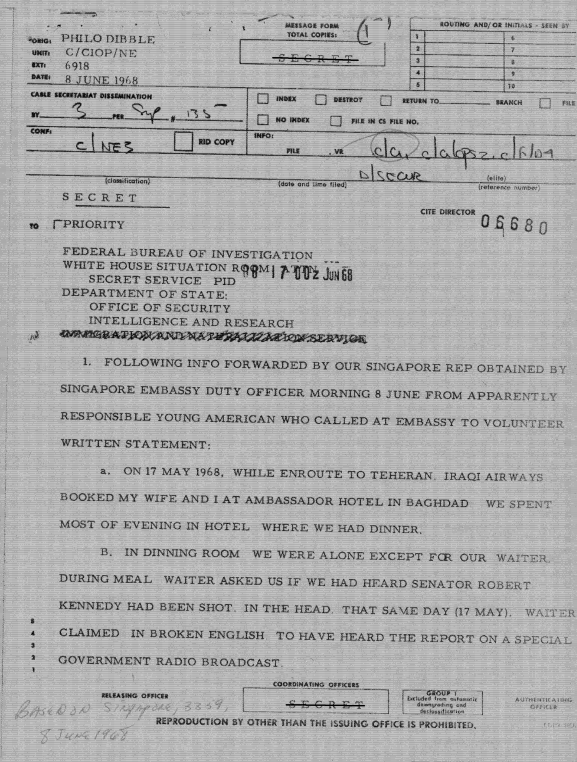
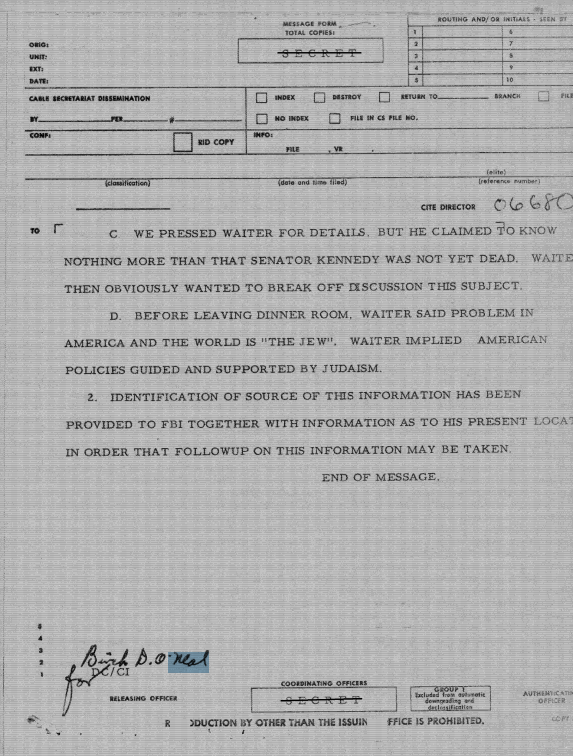
On the same day, the FBI began receiving similar reports from people who had been traveling abroad at the time. One person reported hearing it on the BBC, and other reports indicate it might have come from a Reuters report. Most of the people reporting had only heard this second-hand. So what happened in Mid-May to give rise to these reports?
On May 15, 1968, RFK had given a speech at Valley College in the San Fernando Valley in California. As he was leaving the scene in an open car, a projectile of some sort struck Kennedy in the head, but the object and his reaction varied widely in the reports.
According to the Reuters account published in the Toronto Star on May 16, 1968: “Senator Robert Kennedy was reported struck by a pebble as he left a campaign meeting last night. The incident happened as New York Democrat’s [sic] open car moved out from Valley College.”
The Times Standard, published in Eureka, California, added a couple of details: “Senator Kennedy’s drive in California was marred in its first hours when he was struck by a pebble apparently thrown by youngsters from a Los Angeles overpass under which he was driving in an open car. A Kennedy spokesman said he was not hurt.”
Across the pond, papers in England and Ireland reported a story that seemed more serious in their wire versions:
“Senator Robert Kennedy was struck by a missile as he left a campaign meeting in Los Angeles last night.
“An eye witness [sic] said he was knocked to his knees inside his car by the impact. Police said he was not injured.”
The report from The Daily Mail in Hull, Humberside, England, also noted the crowd was so large that 5,000 people could not get in.
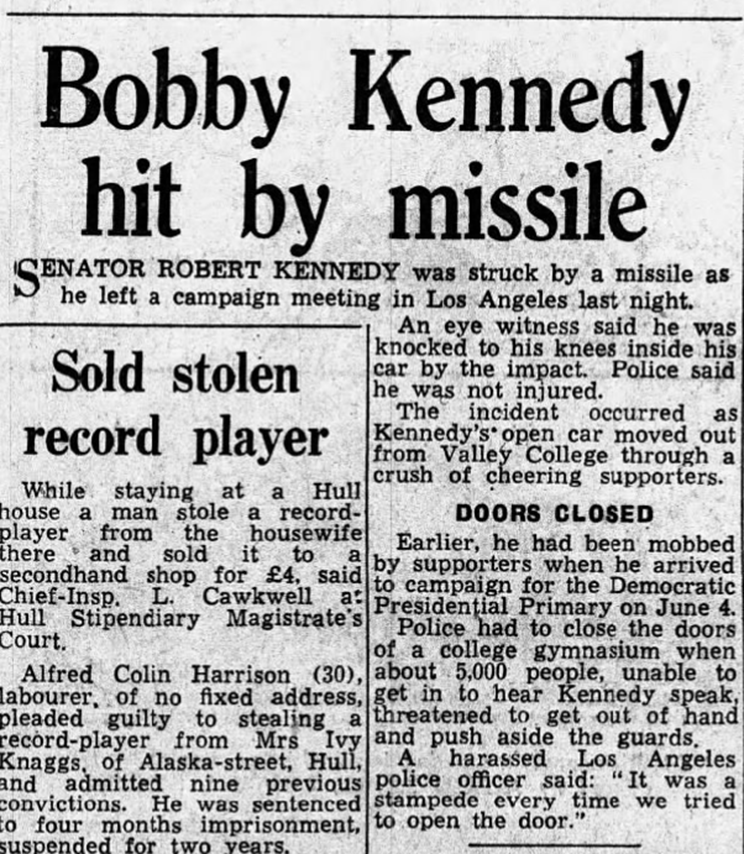
It’s easy to see how an overly eager radio reporter, seeing the headline “Bobby Kennedy hit by missile” coming across the wires, would report that Robert Kennedy had been “shot.” But no reports that I found suggested he had been hit by a bullet. That doesn’t mean someone wasn’t trying to kill him.
I remember going to Dealey Plaza for the first time, the spot where Bobby’s older brother, JFK, was shot. I was with a coworker who had formerly been a Marine sniper, and he was eager to explore the plaza with me. I asked him to “pick his spot,” and after we went behind the 90-degree angle of the picket fence on the “grassy knoll,” he said, “I don’t even need a gun. I could kill him with a stone from here.” So as I read these reports, it occurred to me that the hurler of the “missile” or “pebble” may have been someone with special expertise.
The LAPD’s Final Report says a “small missile (possible flash bulb)” reportedly struck RFK on the forehead. An FBI report says Officer P. J. Piampiano “saw the object and described it as very small.” A separate LAPD summary notes “An officer saw the object and reported that it was possibly a flashbulb.” It’s curious that the object could not be definitively identified.
I also remembered from my research for my book A Lie Too Big to Fail: The Real History of the Assassination of Robert F. Kennedy that bullets could be concealed in other objects. I wondered if something could have been concealed in an object like a flashbulb designed to detonate on impact (like nitroglycerin), because a bomb threat to the event had been called in shortly before RFK spoke that night.
An anonymous male had called the LAPD’s West Valley division claiming his brother had been talking for a couple of weeks about planting some kind of explosive at “the Kennedy thing at Valley College.” He said his brother had left with a paper bag (according to an FBI report) or a “small suitcase containing a bomb” (per an LAPD report), and he had not seen him for three hours. “He’s talking like he’s going to blow up the auditorium,” the caller said.
The newly released RFK files allowed me to make a connection I couldn't have before because a key piece of info had been redacted when the file was originally released. I believe the call came not from a “brother” but from the would-be bomber himself, who, we now know thanks to the 2025 file releases, was a student at Valley College and had literally been granted parole that same day under extraordinary circumstances.
On March 23, 1968, according to an FBI report dated June 6, 1968, Stephen Dale Ahern had called the Greek Theater in Los Angeles. RFK was scheduled to appear there the next day. Ahern told the theater operator, “There is a bomb inside, it will go off tomorrow afternoon at 4:30 p.m.” He knew Kennedy was scheduled to speak there at 4:15 p.m. He then called the Los Angeles Times and told “whoever answered” that RFK would be shot. Next, he called American Airlines and said RFK would be shot when he got off the plane. Ahern then went to the airport to see Kennedy land and even shook his hand. Then he drove to the Greek Theatre and attended the entire rally. He told the FBI he originally made those three calls “to see what news” his reports would generate. That’s the end of his signed statement in the FBI files.
But right after that, in the same file, Special Agent (SA) William J. Rehder added something extraordinary. The Monday after RFK’s appearance at the Greek Theatre, Ahern made an appointment with his psychiatrist, Dr. Cagle of the Oliveview [sic] Sanatorium, “to explain to Dr. Cagle that he had an urge to kill Senator Kennedy for some reason which he was unable to explain within himself.”
At this, Dr. Cagle notified Ahern’s probation officer, Officer Gottlieb (who does not appear to be related to Sidney Gottlieb, the head of CIA’s MKULTRA mind control and chemical research programs) to have Ahern’s probation suspended, begging the question of why he was on probation in the first place.
On May 9, 1968, Ahern was interviewed by two court-appointed psychiatrists who declared him sane, one of whom, Eric Marcus, would later weigh in on Sirhan’s mental state. If Ahern were truly sane, then he was likely acting under a hypnotic compulsion, as I described in my book. That could be why he felt an “urge to kill Senator Kennedy” that made no sense to him logically. Did he attempt to follow through? With a small object, perhaps a tiny bomb that didn’t go off? Did he really not want to kill him, as indicated earlier, and the small object was simply innocuous or unrelated to Ahern?
The day of RFK’s appearance at Valley College, Ahern was put back on “active probation” under the supervision of Officer Gottlieb, under the condition that he would continue to see a psychiatrist. So he was essentially released on his own recognizance the very day RFK was to speak there. The bomb threat wasn’t called in until approximately 7:50 p.m., long after court had closed for the day, but shortly before RFK’s much delayed appearance there at 8:30 p.m.
Even after this bomb threat, and even though officers were “assigned to clear a walkway overpass,” Kennedy was still hit by something as he went under an overpass at about 10 p.m. Per an FBI Headquarters report (FBI RFK File HQ 62-587 Bulky, Vol 1, Serial 1208), “While passing under an overpass, a small object fell from overhead and struck him on the forehead. The object was possibly a flashbulb since there were numerous individuals taking pictures from the overpass.” Frank Mankiewicz, RFK’s press secretary, also said it was a flashbulb that had fallen “near” the Senator. RFK was not injured from this in any way.
So you have a student at Valley College with an urge to kill RFK released just in time for him to get to the event. If the FBI connected Ahern to the Valley College bomb threat, I have not found it in their files, but it would have been true to Ahern’s pattern if he had called in a bomb threat and then driven over there, newly freed and likely still with the weird desire to kill RFK that he couldn’t explain. I also don’t buy Ahern’s explanation that he called in the earlier bomb threats to see what publicity that would generate. That sounds like the explanation someone gives when they’ve been hypnotized to do something but don’t know it, who invent explanations as to why they do seemingly crazy things. (See the “Mind Games” chapter in my book for more information about this commonly observed phenomena of people making up false explanations when acting out a post-hypnotic suggestion.) Was Ahern being set up to be either an assassin or a plausible patsy in a plot that didn’t come off on May 15?
It’s clear that the assassination of RFK on June 5, 1968, was the result of a carefully plotted, well-thought-out and possibly rehearsed plan, as I described in my book. So I’ve often wondered why Thane Eugene Cesar, the guard holding RFK as he led him into the kill zone, joined the plot so “late.” He only joined Ace Security, the company the Ambassador Hotel in Los Angeles called to beef up their own security for the California primary events, on May 25, 10 days after the Valley College incident and 10 days before RFK’s appearance (June 4) and subsequent assassination at the hotel (June 5). Cesar’s last-minute arrival to the plot would make a lot more sense if there were one or more earlier plots that did not include him that had failed. Only then did Robert Maheu, perhaps in desperation, since the window of opportunity was rapidly closing, decide to use someone who could ultimately be linked back to himself (but who wasn’t until I first exposed the link with the publication of my book in 2018).
Cesar had worked for Bel Air Patrol, co-owned by Robert Maheu and former LAPD officer Jack Hooper in Los Angeles, set up to protect Howard Hughes when he lived there, before he moved to the Las Vegas desert. Cesar was also reported to be one of Hughes’ bodyguards when Hooper was Hughes’ security chief. Cesar was known to John Meier, a top Hughes lieutenant. Shortly after the assassination, Cesar’s name surfaced in a press report. When Meier brought up Cesar’s presence in the pantry, Hooper got very angry and told him never to mention that name again.
Meier always called Maheu an “assassin” to me, to the point where I had to ask if Maheu had killed someone. “No, I mean he planned assassinations,” Meier told me, which explains why the CIA entrusted their Castro assassination plots to Maheu. Meier told me that when he talked to J. Edgar Hoover about Maheu and his suspicions of Maheu’s involvement, Hoover told him, “We know [the RFK assassination] was a Maheu operation. But I’m powerless against the CIA.” To bring this full circle, James Angleton, who talked to Maheu frequently and spoke at Hughes’ private funeral, was alleged to have a photo of Hoover having sex with his aide Clyde Tolson, which would explain that comment. Angleton was the original Jeffrey Epstein, leveraging sexual blackmail when needed to bring the FBI Director to heel.
Everywhere you turn, Angleton connects to both the assassinations of JFK and RFK, which makes sense because RFK was surely killed in part to prevent him from exposing the JFK assassination conspirators.
And if Angleton were an early Epstein, Ahern may have been an early victim. He was a young, gay boy who was attracted to politics. But he came of age at a time when the American Nazi Party and the Republican Party were very different entities. After exposing a plot by American Nazi Party (ANP) officials to take over the Young Republicans in Long Beach, California (and, if that succeeded, the entire state of California) in 1965 to then Assemblyman and later Governor George Deukmejian, Ahern apparently joined the Marines. FBI records list him as a Valley College student in 1968, so it appears he joined the Marines sometime after high school and before entering Valley College. We also know the Navy was conducting mind control experiments in the 1960s, and Ahern appears to have been a victim of some hypnotic programming.
Ahern was finally committed to a mental hospital in February of 1969, but he didn’t stay there long. By 1971 he was performing in gay pornographic films in Houston, flown there by Roy Ames in response to an ad in The Advocate. In 1973, he wrote the police to say male child pornography in Houston was a large industry and tried to link Dean Corll, who raped, tortured and killed at least 29 young male boys, directly to Roy Ames, the man who had brought Ahern into the porn industry in Texas. Houston police did find that Roy Ames had a warehouse of pornographic films featuring underage boys, 11 of which were victims of Corll, but declined to do anything more about that connection. (See the Wikipedia article on Ahern for links to primary sources for these points.) So it appears that Ahern was probably being set up to be a patsy, not an assassin, as he seemed to have a penchant for trying to expose crimes wherever he went. Ahern passed away in 2011.
There are many more stories in the newly released RFK files, but one seems to dramatically overshadow the rest and will be the subject of the third article in this series. That story has big implications for the JFK files as well.


