The Death of Tippit - Part 5
By John Washburn
In one of my prior articles, the ‘Death of Tippit – Part 2’, I touched on a story, the gist of which is that another police car was at the Tippit murder scene. That car, according to Doris Holan, was a police car “with a cherry on top” in a driveway between 410 and 404 E10th after she heard the shots. Holan referred to the driveway connecting with the alley parallel to and behind E10th, running from Patton to Denver. Tippit’s car was parked across the driveway entrance on E 10th.
As I refer to a critic of that story, Dale Myers, I replicate his summarized account from an article first issued in 2020 here, ‘Doris Holan and the Tippit Murder’. Myers states.
“The issue of Lad’s mother, Doris Holan, stated that she was in Oak Cliff at the time Tippit was shot. Looking out the window of a two-story house, she said she saw two men at the scene, observed Oswald fleeing toward nearby houses, and witnessed a second police car drive through a nearby driveway. She later reported what she had seen two police officers at the scene.”
One line of attack that Myers took to discredit that account is that Holan didn’t speak out until 2000, shortly before she died. Another is that there was no rear access to such a driveway, as there were structures blocking the drive. Another is that she could not have seen behind 410 E 10th if she were living at 409 E10th.
Taking these in reverse order.
The Holans lived at 113 ½ S. Patton in November 1963
The Holan family - per Myers’ article - has provided evidence showing they were living on the second floor of 113 ½ S Patton by November 1963.
Evidence, including an interview in August 2025 with Gavan McMahon and her son Lad (derived from ‘Ladislav’) Holan, establishes that they moved there from 409 E 10th, which had been their first residence in Dallas. The 113 ½ S Patton apartment would give a clear line of sight to the rear of 410 E 10th from 150 yards. That can be seen in this FBI aerial photograph, to which I added several house numbers and a pale green line. The line will be referred to later.
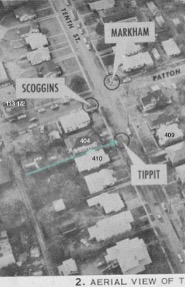
The request for that aerial view was made by Warren Commission chief counsel Rankin from J. Edgar Hoover on March 12, 1964, requesting it be taken from a helicopter.
This evidence from the Commission exhibits has picked up 113 ½ S Patton. It is the first building from the left, to the right of the telegraph pole. The west side of 404 E 10th can be just seen on the extreme right.
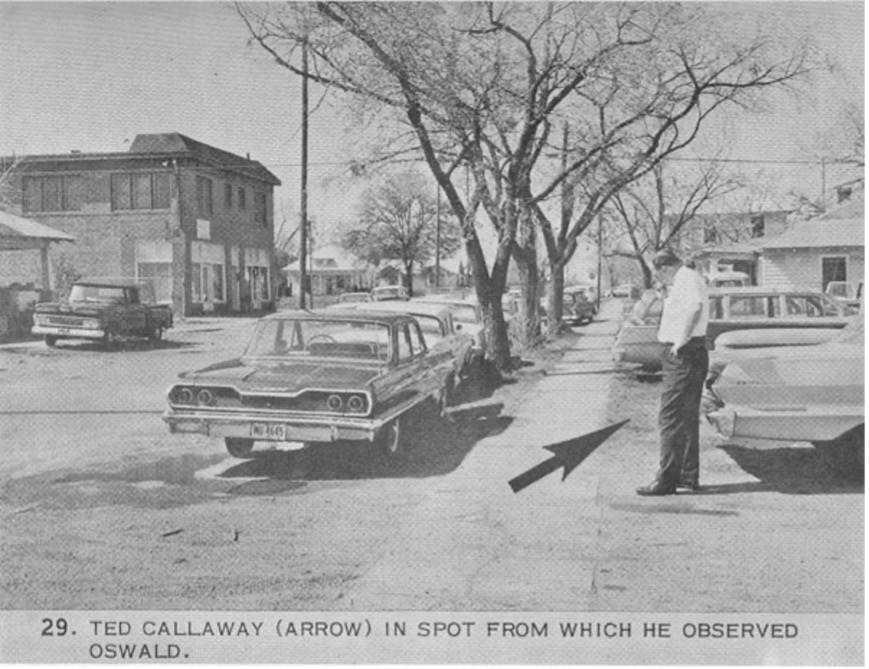
Confusion as to where the Holans lived on November 22, 1963, was relayed in the original story as 409 E10th. Clearly, 113 ½ S Patton does provide a view of the rear of 410 E10th.
There was a “street-alley” between the two houses.
Regarding the second point, Myers believes the driveway was blocked by a structure. (I cover his reasoning later.)
However, Domingo Benavides, who stopped his truck 15 feet from Tippit’s car, described a drive that provided access to his mother’s house, which was across the alley, behind 410 E 10th. This was from his Warren Commission testimony, covered in my prior article.
“At the time I walked out, I guess I was scared, so I started across the street--alley between the two houses to my mother's house.”
The aerial photograph above shows the driveway (my pale green-tinted line) extending from E10th at the front to the alley at the back. There is no structure blocking the driveway where Tippit’s car was parked. Rather, there is one structure and two cars behind 404.
This is Tippit’s car parked across the driveway entrance on E10th, which is between the two trees. 410 is the house on the left. 404 is the one on the right. Source: Portal to Texas History.
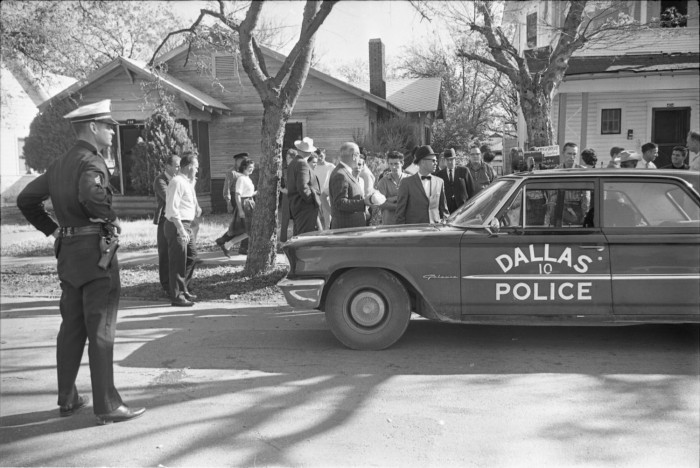
Today, both 404 and 410 have been demolished, and 410 has been renumbered 408 (with a new 410 occupying the plot behind modern 408). This is the driveway today, where the curb on either side of the drive is painted 408.
The place Tippit fell is still marked on the road surface with a cross. There is a boundary fence in a straight line from front to back. The drive is on the plot of 410 (now 408), not the plot of 404. The photo from the rear alley shows similar, and runs on the 410/408 side of the boundary. The front lot, 410, and back lot, 408, are today separated by a fence, given that they are now separate lots.
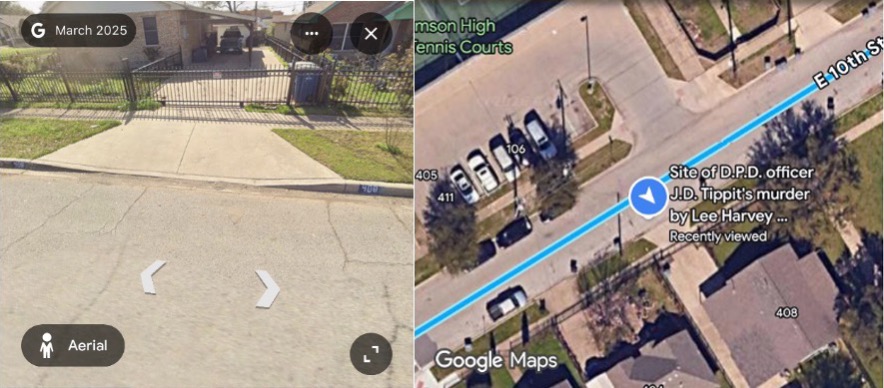
On the basis of the above, including Benavides’ testimony, the driveway was not blocked.
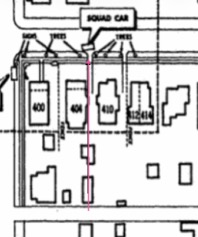
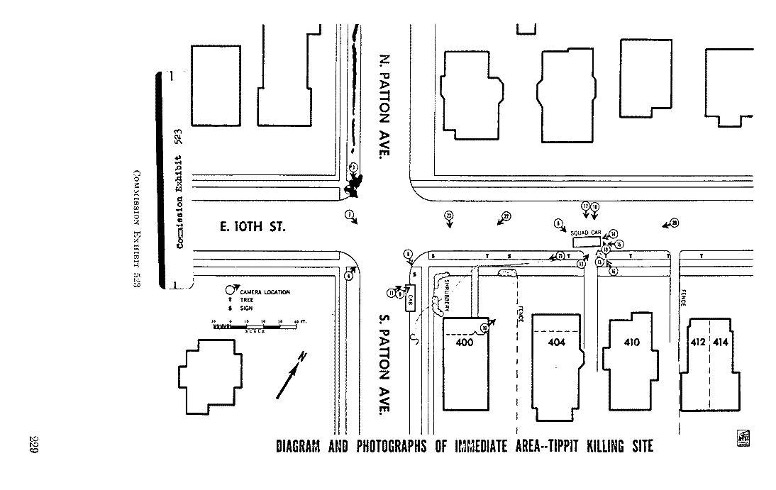
From this, at the Markham testimony session, the map was produced late. Mr. BALL. We have a map coming from the FBI. We thought it would be here this morning.
This FBI map does not accord with the aerial photograph in several respects. The map shows two structures vertically aligned, but they have been shifted to the right (eastwards).
Also, the shape of what can be seen in the aerial photograph doesn’t accord with that shown in the FBI map.
By the aerial photograph, at least two of the objects are cars, possibly a third, or a truck of some kind. But either way, there is no structure over the drive.
Therefore, the FBI map gives the appearance of a blocked drive as the map has shifted whatever was behind 404 towards and behind 410.
There may have been communal access from the driveway to both houses. The cars behind 404 must have gotten there somehow. Benavides did refer to it as a “street-alley”.
The question therefore arises as to whether the map was intentionally wrong, as the drive was known to be a sensitive issue. There is precedent for that. This is Commission Exhibit 1968.
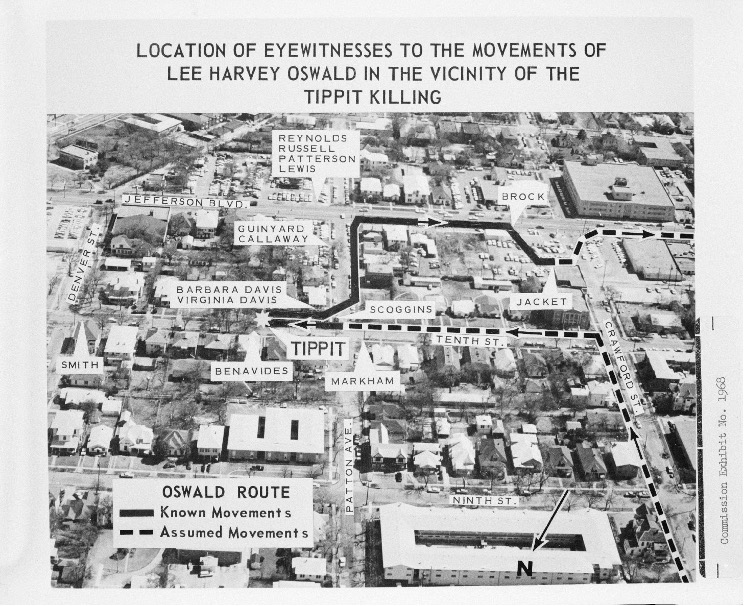
There is a problem with CE1968. A dotted line has been superimposed after “Jacket,” which shows the fugitive heading back onto Jefferson. But no witness at Brock’s garage saw the fugitive do anything other than run to the alley (which is immediately above the word ‘Jacket’). Warren Reynolds, who followed the fugitive from his lot, saw him enter the alley -- and he looked up and down it.
Back to the issue at hand. A structure can be seen above the ‘IS’ of the Barbara Davis tag. That is adjacent to the alley between Denver and Patton, parallel and halfway between Jefferson and E10th.
But that is to the right (westwards) of Tippit’s vehicle and on the plot of 404.
FBI photographs have been taken at such an angle that the side of house 404 can be seen.
Dale Myers – and cropped FBI photographs
In rebutting the Holan story, researcher Dale Myers has cropped FBI photographs.
The effect of that is to give the impression that the driveway was blocked. With that perspective, a structure can be seen. But with the full photographs (as in the one above), the perspective is consistent with something behind 404 itself, or further behind that.
His article doesn’t point out that, in the two FBI aerial photographs, the driveway isn’t blocked. Nor does it refer to Benavides stating that there was a “street-alley” between the two houses.
Myers also did not consider whether the Patton address would have provided a clear view.
Instead, he refers to Lad Holan in 2020, telling him his mother sometimes wore glasses for nearsightedness. But needing to wear glasses sometimes - such as for driving - wouldn’t prevent someone from identifying a police car - given the siren on top - from 150 yards.
Someone who sometimes wears glasses might not be able to read a license plate without them, but needing glasses would not be a reason not to identify a police car.
Rather than being fully objective, the article comes across as agenda-driven. Reference is made to Doris Holan being an alcoholic. But being an alcoholic isn’t the same as being drunk in terms of memory loss. Just as needing to wear glasses isn’t an indication someone is blind.
The Myers article identifies Doris Holan’s car on S. Patton on November 22, 1963, from on-the-day photographs. In one photograph, her car has moved, indicating she was capable of driving.
On the third point. Timing.
Myers also discredits the Holan story on the basis that she didn’t tell her story until 2000. But according to Lad Holan in 2025 in an interview, Myers sent Lad video footage of his mother talking to the police in the vicinity of the Tippit murder scene, taken on November 22, 1963.
That does not feature in the article.
Myers refers to the fact that the police did not record Doris Holan as a relevant person on November 22, 1963. But if any element of the Dallas police was involved in an ambush of Tippit, then that would not be surprising. The Tippit case is full of examples of witnesses who were ignored. Indeed, as referred to above, FBI maps were wrong on more than one matter.
Further, Myers acknowledges that Sam Guinyard also claimed to have seen a police car. He states:
Holan’s account of a second police car at the scene of the murder is supported by the comments of Sam Guinyard, who told Brownlow in 1970 that he saw a police car in the alley shortly after the police shooting. The man in the driveway was apparently also seen by others: a resident of the neighborhood, who spoke on condition of anonymity, told Pulte in 1990 that he had heard about a man in the driveway who approached Tippit’s car.
Myers rebuffs that on the basis that this, too, did not appear in police records from the time. But again, if a car were there for a nefarious purpose, then that would be expected.
Myers also said that Brownlow and Pulte couldn’t be credible as they got it wrong that the Holans were still living at 409 E 10th on November 22, 1963. He said of that:
Had anyone bothered to fact-check any of these deplorable claims, they would have found what I did during the course of a seven-month investigation I launched in early January of this year.
If someone were making up a story, they wouldn’t make up a story with errors in it that could then be improved with the accurate facts: 113 ½ S Patton being a better vantage point.
There is also an element of double standards, as Myers’ first article was also wrong. It put Doris Holan at 113 ½ Patton in 1963, and then moving to 409 E 10th in 1964. His 2000 article was republished for correction on June 4, 2021, and revised again on March 10, 2024.
So, in total, Doris Holan and Sam Guinyard said a police car was present when Tippit was shot. Virginia Davis (house 404) testified that police were at the scene before the ambulance arrived for Tippit. The first officers officially at the scene in response to the emergency call were Officers Jez and Poe, and then Sergeant Owens. All arrived a few minutes after the ambulance had arrived.
But also, in this part of her testimony, Helen Markham referred to seeing a policeman at the scene almost immediately.
Mr. BALL. Did some man come up immediately thereafter?
Mrs. MARKHAM. Yes.
Mr. BALL. What kind of a car did he have?
Mrs. MARKHAM. Not immediately.
Mr. BALL. Soon?
Mrs. MARKHAM. Soon.
Mr. BALL. In a pickup truck?
Mrs. MARKHAM. Yes. I very frankly remembered this truck, but I remember it the way it took off.
Mr. BALL. He stopped though, didn't he?
Mrs. MARKHAM. Yes.
Mr. BALL. That is the man who called over the police radio, wasn't he?
Mrs. MARKHAM. I don't recall.
Mr. BALL. What did he look like, the man in the pickup truck?
Mrs. MARKHAM. This man had a hat on. I thought he was a policeman.
Mr. BALL. A dark man, looked somewhat Spanish?
Mrs. MARKHAM. I don't recall. I was screaming and crying and trying to get help, begging for somebody to help me.
Mr. BALL. When did you start screaming?
Mrs. MARKHAM. I started screaming by the time I left where I was standing and screamed plumb across the street.
There is an element of cross-purposes here. Ball assumed that Domingo Benavides was the first on the scene. Hence his reference to the truck. But Markham refers to a policeman by his hat.
Cars: Hill, Croy and Westbrook
Myers has interviewed Jerry Hill over the years, and Hill died in 2011.
But my article Death of Tippit 2 set out discrepancies in the accounts of Sgt. Jerry Hill, head of personnel, Captain Westbrook, and Reserve Sgt. Kenneth Croy.
Myers didn’t flag that Hill’s Commission testimony gave a time-warping story which had him arriving at the scene before the person he alleged took him there - Sgt. Owens - had arrived. Added to which, Owens never placed Hill in his car. Owens said he took Captain Westbrook and DA Bill Alexander. The patrol radio shows he arrived at 1:16 pm.
Evidence points to a car numbered 207 being outside of 1026 N Beckley at approximately 1:03 pm, which tooted before the man thought to be Oswald left. Though attempts were made to discredit Earlene Roberts for seeing that number, no alternative police vehicle was identified. TV footage shows Jerry Hill getting out of car 207 at 12:50 pm in Dealey Plaza.
Sgt. Croy didn’t give a credible account of what he was doing from 12:30 pm, nor how he got to the Tippit murder scene so quickly. Westbrook didn’t give a credible account of his movements either. My article Death of Tippit 2 set out how he claimed to have walked solo from City Hall (approximately a mile) to the Depository building but then referred to using his car radio and arriving as “we” in the plural.
Sgt. Owens places Westbrook as arriving at the murder scene with him at 1:16 pm. But Dallas Morning News reporter Jim Ewell said he left Dealey Plaza with Sgt. Stringer, with Westbrook driving. From Ewell’s account, it was approximately 1:28 pm.
Car 207 was allocated to Officer Valentine, who drove it with Hill and Ewell from City Hall to the Depository Building. Oddly, it was Westbrook – not Valentine – who vouched for the whereabouts of car 207, because of the attention it was given in light of Earlene Roberts seeing it. But why would the head of personnel vouch for the whereabouts of a motor vehicle, rather than Valentine himself?
In Westbrook’s testimony, he couldn’t remember who drove him to the murder scene: only that it was an unknown officer who took Westbrook and Stringer. Westbrook had a similar memory loss as to how he later got to the Texas Theater. He said he went with Stringer, an unknown driver, and parked at the rear. Ewell, again, said Westbrook drove him and Stringer and parked at the front.
There are several components to reconcile here. Hill and Westbrook’s movements are not explained. The movement of car 207 is not explained. There is an unexplained police car at the Tippit murder scene approximately 7 minutes after car 207 was seen outside 1026 N Beckley. Hill did not arrive with Owens, so how did he arrive, and before Owens? Westbrook arrived once with Owens driving Owens’ patrol vehicle, so how and why did he arrive again with Ewell and Stringer in some other vehicle?
My conclusion is Hill was back in car 207 again, after 12:50 pm, and left the depository, then passed 1026 N Beckley at 1:03 pm. That car then headed to the Tippit murder scene, hence being the car seen in the rear driveway by approximately 1:09 pm. Westbrook seems to have had an objective of denying he had a vehicle.
The simplest explanation – i.e., the motive - for his false account is to cover up the fact that he arrived at the Tippit murder scene twice. First, as Owens said, with Owens driving. Then again, as Ewell said, with Westbrook driving.
The motive was that Westbrook wanted to hide that car 207 needed to be taken back to the Depository, away from the murder scene. Having taken car 207 back, Westbrook then drove back to Oak Cliff with Stringer and Ewell. That journey was made in Westbrook’s own car, which he’d left at the Depository on driving from City Hall to the Depository.
Essentially, Westbrook needed to cover up that his own car was used for his second arrival in Oak Cliff, having returned car 207. But because of that, he had to invent a story as to how he got from City Hall to the Depository, and then again in going to the Texas Theater.
Any indication he’d used his own car would betray that he’d arrived twice, due to the returned car 207.
