
The Death of Tippit - Part 4
By John Washburn
The closest eyewitness to the shooting of Officer JD Tippit was a mechanic and part-time mortuary barber, Domingo Benavides.
But Benavides was handled in such a way as to censor the earliest statements he made. His County of Dallas affidavit of November 22, 1963, is missing. A record of his FBI interview that day is also missing. I set out the documents, which revealed that there were missing documents later.
Benavides was recorded, absent these now missing documents, as a man who merely arrived after Tippit’s murder, then picking up, and then handing over, two spent ammunition cartridges.
However, in his appearance for the Warren Commission (the ‘Commission’) he made clear he was a witness to the shooting itself, seeing Tippit fall to the ground. Having had a close sight of the fugitive who had shot Tippit. He was also – incorrectly - credited with being the person who raised the alarm using Tippit’s own patrol radio.
The treatment of Domingo Benavides provides a case study in just how soon important facts were being altered in the immediate aftermath of Tippit being shot.
Leavelle Exhibit A - “Markham the only eyewitness”
Commission Leavelle Exhibit A is an account of Detective Jim Leavelle, who led the Tippit investigation, written after Oswald was shot on November 24, 1963. It covers the activity of November 22, 1963, as well as Oswald’s murder. That retrospective - by two days - account refers to Helen Markham as being the only witness to the murder of Tippit.
Domingo Benavides was referred to by Leavelle as Exhibit A, in limited terms such as “he went to the scene of the shooting and picked up two empty hulls and gave them to Officer Poe.”
Following the ‘only Markham’ line is this from the Memorandum re Galley Proofs of Chapter IV of the Report, September 6, 1964. (Counsel, Wesley J. Liebeler.)
“I forgot to mention that some question might be raised when the public discovers that there was only one eyewitness to the Tippit killing, that is, one person who saw Oswald kill him. All the rest only saw subsequent events. Mrs. Markham is nicely buried there, but I predict not for long.”
The final report achieved the result of “nicely buried” for Markham by referring to her after setting out others who had been connected to the aftermath (page 167). But a fuller reading of all of the Warren Commission’s output negates Liebeler’s assertion that Helen Markham was the only eyewitness to the shooting. Warren Commission Page 166 states.
“Another witness, Domingo Benavides, was driving a pickup truck west on 10th Street. As he crossed the intersection a block east of 10th and Patton, he saw a policeman standing by the left door of the police car parked along the south side of 10th. Benavides saw a man standing at the right side of the parked police car. He then heard three shots and saw the policeman fall to the ground. By this time the pickup truck was across the street and about 25 feet from the police car. Benavides stopped and waited in the truck until the gunman ran to the corner. He saw him empty the gun and throw the shells into some bushes on the southeast corner lot.
It was Benavides, using Tippit's car radio, who first reported the killing of Patrolman Tippit at about 1:16 p.m.: "We've had a shooting out here." He found two empty shells in the bushes and gave them to Patrolman J. M. Poe who arrived on the scene shortly after the shooting.
Benavides never saw Oswald after the arrest. When questioned by police officers on the evening of November 22, Benavides told them that he did not think that he could identify the man who fired the shots. As a result, they did not take him to the police station.”
Benavides’s seeing an officer “standing” and then “falling to the ground” contradicts the line that Markham was the sole eyewitness to the shooting. As I cover later, cab driver William Scoggins also saw Tippit, mid-execution, grasping his stomach as he was shot. Liebeler’s statement ‘all the rest only saw subsequent events’ is factually incorrect, even if any leeway for deceitful use of legal exactitude is given. Where Liebeler was potentially correct was in his saying that it was only Markham who saw Oswald perform the shooting, i.e., a positive identification of Oswald.
But, as I cover later, Markham, in testifying to the Commission in person in Washington, stated that she didn’t pick anyone out in the 4:30 pm November 22, 1963, lineup which had Oswald in it.
Is the sum total then that no one saw Oswald shoot Tippit?
Domingo Benavides
This is from Benavides’ Warren Commission testimony of April 2, 1964.
Mr. BENAVIDES. I then pulled on up and I seen this officer standing by the door. The door was open to the car, and I was pretty close to him, and I seen Oswald, or the man that shot him, standing on the other side of the car.
Mr. BELIN. All right. Did you see the officer as he was getting out of the car?
Mr. BENAVIDES. No; I seen as he was, well, he had his hand on the door and kind of in a hurry to get out, it seemed like.
Mr. BELIN. Had he already gotten out of the car?
Mr. BENAVIDES. He had already gotten around.
Mr. BELIN. Where did you see the other man?
Mr. BENAVIDES. The other man was standing to the right side of the car riders side of the car, and was standing right in front of the windshield on the right front fender. And then I heard the shot. Actually I wasn't looking for anything like that, so I heard the shot, and I just turned into the curb. Looked around to miss a car, I think.
And then I pulled up to the curb, hitting the curb, and I ducked down, and then I heard two more shots.
Mr. BELIN. How many shots did you hear all told?
Mr. BENAVIDES. I heard three shots.
Mr. BELIN. You heard three shots?
Mr. BENAVIDES. Yes, sir.
Mr. BELIN. Where were you when your vehicle stopped?
Mr. BENAVIDES. About 15 foot, just directly across the street.
Benavides’ use of the phrase “Oswald, or the man that shot him” leaves open the matter of whether the shooter was indeed Oswald. Benavides then went on.
Mr. BELIN. Did you see the policeman as he fell?
Mr. BENAVIDES. Yes, sir.
Mr. BELIN. What else did you see?
Mr. BENAVIDES.Then I seen the man turn and walk back to the sidewalk and go on the sidewalk and he walked maybe 5 foot and then kind of stalled. He didn't exactly stop. And he threw one shell and must have took five or six more steps and threw the other shell up, and then he kind of stepped up to a pretty good trot going around the corner.
Mr. BELIN. You saw the man going around the corner headed in what direction on what street?
Mr. BENAVIDES. On Patton Street. He was going south.
From that, it is obvious that the reason Benavides was later able to discover the shells was that he’d seen the gunman throw them there. Benavides testified that he was close enough to see that the fugitive from the Tippit murder scene had a square, not a tapered, haircut. Oswald had a military-type tapered cut. The Commission Report was then disingenuous with this statement.
“When questioned by police officers on the evening of November 22, Benavides told them that he did not think that he could identify the man who fired the shots. As a result, they did not take him to the police station.”
Because Benavides was not questioned by “officers” – plural. Two detectives visited Benavides that evening, but only Jim Leavelle questioned him, taking him to one side.
What Benavides couldn’t do was identify the person as Oswald.
II
Detective Leavelle and the missing affidavit
Benavides gave an affidavit on November 22, 1963. That is apparent in a Supplementary Offense Report (‘SOR’) of November 22, 1963, from Leavelle. That SOR thus predates the account set out in Leavelle Exhibit A.
The SOR first refers to witnesses Ted Callaway and Sam Guinyard, who heard shots and saw “subject” (by then determined from Leavelle’s perspective to be Oswald) run from the scene. It then states, with my emphasis:
“The first witness, Helen Markham, was found in the Hospital Emergency Room at City Hall. She was shown the same suspect in a lineup early at 4:30 pm, where she identified him as the #2 man in a 4-man lineup.
Another witness who saw the officer lying in the street, but did not see suspect, was a Domingo Benavides, 509 East Jefferson, WH 2-0559. He was at the scene and picked up 2 spent 38 hulls and turned over to officer J. M. Poe, 1175, who in turn gave them to Crime Lab Investigator, Pete Barnes, who was present and dusted the police car for prints.
There is another witness who has not viewed the suspect, who I have talked to on the phone, who stated that he was driving Oak Cliff Cab, Number 213, and that he was parked about 20 feet away at the time shooting took place, that the suspect ran past him in a matter of a few feet, that he heard the man mumble, “The poor dumb cop”, about twice. He will be able to identify this man. The witness’s name is W. W. Scoggins, 3138 Alaska, WH 4-2955. He works at the Oak Cliff office, 938 West Davis, WH 2-6203.
All of the above witnesses, with the exception of Scoggins, made affidavits. Witness Callaway took the officer’s pistol and got in the cab with Scoggins and persued [sic] suspect, but was unable to catch him.
Scoggins did then make an affidavit the next day, November 23, 1963. But Scoggins withdrew his identification of Oswald two days later. The affidavits for Markham, Callaway and Guinyard are also available, but that of Benavides is missing.
It is not just that affidavit that is missing. An FBI report dated March 1, 1967, states.
“It was BENAVIDES belief that BERENDT [from Esquire Magazine] was trying to place Vaganov at the scene possibly as the man in the “red Ford” which he (BENAVIDES) had alluded to in his statement to the FBI on the date of the assassination.”
Leavelle’s SOR misrepresented the facts in terms of “saw him lying in the street but did not see the suspect”.
Even the Commission Report itself stated that Benavides saw Tippit “fall to the ground”.
Leavelle’s account gives the impression that Benavides didn’t see anyone. But in unadulterated terms, Benavides did see Tippit being shot, did see the shooter and saw him run away and discard the cartridges.
What Benavides didn’t see was that person as being Oswald - by then referred to by Leavelle as “the suspect”.
Leavelle’s obfuscation continued when he testified to the Commission at 9:30 a.m. on Tuesday, April 7, 1964. His initial account to Counsel Ball omitted Benavides altogether. But because Benavides had testified five days earlier, Ball asked this.
Mr. Ball. You also talked to Domingo Benavides?
Mr. Leavelle. Yes.
Mr. Ball. D-o-m-i-n-g-o B-e-n-a-v-i-d-e-s [spelling]. I would think it would be spelled differently.
Mr. Leavelle. He was supposed to be Mexican descent but that Benavides is actually an Italian name, I believe.
Mr. Ball. Well, did you talk to him also?
Mr. Leavelle. I talked with him but I do not believe we ever took an affidavit off him that I recall-may have.
Mr. Ball. Didn't he tell you that he picked up some empty hulls?
Mr. Leavelle. Yes, he told me he picked them up and gave them to the officer. I remember the officer told me he had gotten the hulls from someone who gave them to him, and when I talked to Domingo, he said he was the one picked them up and give them to the officer.
Mr. Ball. Did you bring any of these men downtown?
Mr. Leavelle. No.
Mr. LEAVELLE. I believe Sergeant Bud Owens was the sergeant there and one of the uniformed officers was-I may be in error on this, but I believe it was Poe.
Mr. BALL. J. M. Poe?
Mr. LEAVELLE. Yes; P-o-e [spelling].
Mr. BALL. At that time someone told you some empty .38 caliber hulls had been picked up. Did Poe tell you that?
Mr. LEAVELLE. Yes; I believe he did.
Mr. BALL. Did he give you the hulls?
Mr. LEAVELLE. No; he did not give them to me. I think my instructions to him were to turn them over to the crime lab.
Mr. BALL. Did he show them to you?
Mr. LEAVELLE. I don't think so; he may have but I do not recall. He may have. He did say that there was an eyewitness to it but he didn't know her name at the time. So, while I was talking to him was when the call came out they seen the suspect go into the Texas Theatre, so I proceeded to the Texas Theater, but due to the heavy traffic, I didn't get there until after the arrest was made and they had left, so I returned to the scene and talked with the officer some more and I believe that he also told me that a man in a car lot down there had seen Oswald running from the scene.
At that stage in giving testimony, Leavelle was still holding back that Benavides was an eyewitness to the shooting itself, merely referring to a female eyewitness (Markham).
Leavelle had enough knowledge of Benavides to know he had Mexican ancestry despite wrongly thinking Benavides was an Italian surname (which almost exclusively ends in a vowel). Leavelle’s statement “but I do not believe we ever took an affidavit off him that I recall - may have.”, looks like managed forgetfulness, with a get-out option if the affidavit resurfaced.
Ball then raised Benavides as an eyewitness to the shooting itself.
Mr. Ball. Do you know why Domingo Benavides was never brought down for the showup?
Mr. Leavelle. I think he said he never saw the man actually. I believe he said later on he did not see the man.
Mr. Ball. He testified here he saw the man running.
Mr. Leavelle. But he—either that or he told me he could not recognize him, one or the other.
Leavelle’s use of “the man” means Oswald. But Ball’s use of the term means any man. A witness to any shooting would only ‘recognize’ the shooter if they’d seen them prior to or after. Therefore, from the day of the assassination itself to the day he testified to the Commission, Leavelle was unforthcoming about Benavides as an eyewitness.
Pertinent to Leavelle’s handling of Benavides is the testimony of Detective L C Graves. Graves was on a day off but returned to work at City Hall at 2:00 pm, given news of the assassinations. He arrived at the Tippit murder scene after returning Helen Markham to her home after her lineup at 4:30 pm.
Graves gave his testimony at 3:10 p.m. on April 6, 1964, the day before Leavelle testified, and four days after Benavides had.
Mr. BELIN. From my interpretation here from what we have, Ted Callaway and Sam Guinyard gave affidavits, but Domingo Benavides did not. Is there any particular reason that you know of why Benavides did not come down to give an affidavit or view a lineup?
Mr. GRAVES. No; I wouldn't have any idea.
Mr. BELIN. Well--
Mr. GRAVES. Because after this little episode with them, I never saw them or had any occasion to talk to them any further.
Mr. BELIN. Do you remember any conversation particularly with Domingo Benavides?
Mr. GRAVES. No.
Mr. BELIN. Well, I am going to try and refresh your recollection to see if I can help you a little bit. I believe that he was driving a pickup truck at about the time of the Tippit shooting, and actually was the first one to place a call over Tippit's radio that Tippit had been shot. Does this strike a chord in your memory?
Mr. Graves. Not to me. He didn't tell me that. Leavelle talked to him to one side.
Mr. Belin. Oh, I see. You weren't the one he talked to?
Mr. Graves. He didn't tell me that.
Mr. BELIN. But Officer Leavelle would be the one he talked to?
Mr. GRAVES. Yes.
Graves, in his summary report of late November 1963, puts a time to that. Around 5 pm on November 22nd, he went with Leavelle to meet with Callaway, Guinyard and Benavides at Dootch Motors, 501 E Jefferson. But Leavelle cut Graves out, despite Benavides having been the closest eyewitness to the homicide. As a result, Benavides was not taken to City Hall for the 6:30 pm line up of Oswald along with Callaway, Guinyard and bus driver Cecil McWatters.
I can only conclude that within three hours of Tippit being shot, Leavelle had decided to exclude a witness who could exonerate Oswald for the murder of Tippit. Or, Benavides had by then been threatened by someone else and been told not to co-operate. Leavelle was tripped up by Ball’s questioning because Benavides and Detective Graves had testified before him. However, when the Warren Commission Report was published, its conclusions were much closer to Leavelle’s misleading position.
There are more discrepancies than that.
III
The first radio call to report the shooting
The Warren Commission (from above) stated. “It was Benavides, using Tippit's car radio, who first reported the killing of Patrolman Tippit at about 1:16 p.m.: "’ We've had a shooting out here.’"
That is doubly incorrect. The call was actually made by Temple Bowley, who said he chanced on the scene at 1:10 pm. (The time per corrected elapsed time on the police tapes - see my K&K article - is also closer to 1:10 pm. Certainly not 1:16 pm, as the tape starts at 12:15 pm and only lasts for 60 minutes, but has 5 minutes of activity after the Bowley call).
Temple Bowley appears nowhere in the Commission files. It was independent researchers who found his affidavit later. Bowley's affidavit of 2 December 1963 - which predated any public transcript of the patrol radio tapes – gives an accurate statement of what Bowley said. It can be heard on the tape itself and is matched in all three official patrol radio transcripts.
Bowley’s affidavit also states that when he arrived at 1:10 p.m., he encountered a man trying to make a call but who couldn’t make the equipment work.
If Bowley’s and Benavides’ observations had been properly dealt with on the day itself, Oswald could have been eliminated as the assassin of Tippit on both timing and identification grounds very soon after Oswald had been arrested. Bowley’s evidence would rule out the idea that Oswald had managed to arrive on foot to kill Tippit, having left his rooming house almost a mile away at 1:04 pm.
Bowley said he encountered the scene, having picked up his daughter from RL Thornton Elementary School in Singing Hills at 12:55 pm, on the way to picking up his wife from her workplace at the intersection of Zang and 9th Street.
To have encountered E 10th from the east, the direction of Marsalis Avenue, means he didn’t use the RL Thornton Freeway (exiting at Zang itself) but drove up Marsalis Avenue most of the way, the more direct route, turning left onto E 10th.
Most of the Marsalis route from Singing Hills to E 10th is the same as the Marsalis bus line. The schedule for that bus route was 8 minutes from E Jefferson to its terminus. Adding a further 5 minutes from the school to the Marsalis terminus (via E. Redbird Lane), then even a bus could do it all in 15 minutes.
It would be difficult to argue that Bowley’s watch time of 1:10 p.m. was more than 6 minutes wrong if the circumstances of his end-to-end journey proved it was right. By December 2, when he made his affidavit, he would surely know if his watch had been wrong. His wife would have been kept waiting due to those six minutes plus the time spent being tied up at the Tippit murder scene. Accounts and actions of other police officers and FBI agents revealed some of the facts.
There is a further problem with Leavelle’s statement here.
“So, while I was talking to him was when the call came out they seen the suspect go into the Texas Theatre, so I proceeded to the Texas Theatre, but due to the heavy traffic, I didn't get there until after the arrest was made and they had left, so I returned to the scene…”
Other police officers were able to get to the Theater triggered by the same alert. Even the press managed to get there before Oswald was escorted out under arrest. So how was it that Leavelle was caught in traffic that the others weren’t?
My article, Oswald, Beckley and the Tippit Wallet, sets out discrepancies with the time that Oswald’s rooming house at 1026 N Beckley was first visited and then searched by the police.
In that article, I concluded that the first police response was triggered by the wallet ‘found’ at the Tippit murder scene, with the Beckley address in it.
Therefore, a reason for Leavelle making up an excuse as to why he didn’t get to the Texas Theater merely follows from an assumption that he’d already gone somewhere else instead.
That scenario, to a degree, exonerates Leavelle from having prior knowledge of a plan to plant evidence. Else he wouldn’t have led a search that messed things up.
What all of this does indicate is that Leavelle was an accessory after the fact in the framing of Oswald for the murder of Tippit.
IV
Benavides and the Commission files
How did it come about that Benavides was called to testify? There is no record in Benavides’ Commission file of his November 22, 1963, affidavit or his FBI statement.
Of course, paperwork could have been there in 1963 and then gone missing. However, the first information on file is a memo from Counsel Rankin of 24 March 1964 setting out the schedule for taking testimonies in Dallas. That has Benavides misspelled as “Benavenitos” twice, in type and also in red pen ink.
In the letter to Benavides of March 26, arranging his appearance before the Commission on April 2, 1964, he is called “Domenjo Benavenitos”. In a memo to Barefoot Sanders, who organized testimony and transcription sessions, he is also referred to as “Domenjo Benavenitos,” and again in the letter to the Secret Service (whose role was to ensure witnesses acknowledged attendance). Benavides’ name was spelled properly in the Commission files only after he had testified.
That suggests to me that neither the missing affidavit nor the record of the FBI interview ever made it to the Commission’s files. Had they done so, then the Commission staff would not have persistently got his name wrong. Leavelle’s SOR had spelled it correctly on day one.
Helen Markham was treated as a ‘star witness’ as she appeared before the Commission itself in Washington, DC, on March 26, 1963. Benavides’ testimony was taken in Dallas the following week.
Discrepancies regarding Benavides repeat with CE523, the Commission’s map of the murder scene. The numbers are positions from which photographs were taken.
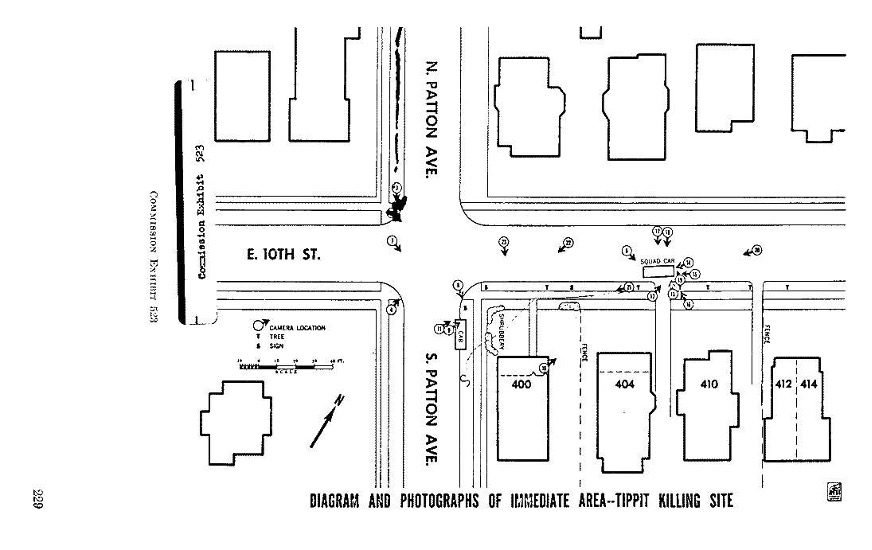
Tippit’s car is drawn in; Scoggins’ cab is drawn in. Neither Benavides nor his truck appears. Nor was any photograph indicated which would show that truck.
CE523 was presented when Markham testified. A marker pen arrow shows where she stood at the northwest corner of the intersection. CE523 wasn’t presented at the Benavides testimony session the week after. No alternative map or diagram was presented either.
V
The context for the problems in how Benavides was dealt with
Some researchers have questioned whether Benavides was a reliable witness. I believe the circumstances of how he was handled indicate he was reliable but inconvenient for the purposes of the desired outcome.
Benavides was not an exception. Temple Bowley was airbrushed out entirely for investigation purposes, and there is no Commission file for him.
But Benavides appears to have been painted back in, having previously been painted out. Perhaps having Benavides testify was a trade-off. Including him, however inconvenient, made up in part for solely relying on Markham’s account. Also, bringing Benavides back into the picture also achieved the leaving out of any reference to Temple Bowley altogether by attributing his radio call to Benavides.
In his testimony and also in a later TV interview, Benavides believed that he made the call that Bowley did. He is a confident and articulate speaker. If Benavides said similar things in fumbling with the equipment to what Bowley had later repeated, then Benavides could genuinely believe that his call had got through, and that was what was in the transcripts.
Witness intimidation?
Like a witness on East Jefferson, Warren Reynolds, Benavides considered that his life was endangered because of what he saw.
Benavides’ brother Edward, aged 29, was shot and killed on February 16, 1965. Benavides considered he was shot because of mistaken identity for him.
Reynolds had survived being shot in the head on January 23, 1964. After giving an interview to the FBI on January 21, 1964, which failed to positively identify Oswald as the man he saw fleeing down Patton, along Jefferson and then west into the alley between Jefferson and E10th Street. Some researchers have erroneously claimed that, as with Reynolds, the shooting of Edward Benavides was in early 1964. But the timelines of Benavides and Reynolds are subtly different.
Prior to the Commission calling him to testify, Benavides had been airbrushed out of the picture. That wasn’t the case for Reynolds. Benavides became a problem after he testified. The handling of Bowley and Benavides is also relevant in the light of the documentation and commission testimonies of other police officers who attended the Tippit murder scene on the day itself.
The first – official - responders Officer Poe (with Jez) and Sgt. Owens (with DA Bill Alexander and Captain Westbrook) arrived six minutes later, in response to Bowley’s call. None of them, on or after November 22, 1963, refer to Benavides being a witness to the shooting, merely his finding the shells afterward. None of them refer to Bowley.
The same goes for colleagues of Benavides: Sam Guinyard and Ted Callaway. Callaway was a salesman at a used car business - and Sam Guinyard a porter - Harris Motors, 501 E Jefferson, which was also the address of repair business Dootch Motors, also run by Mr Harris, where Benavides was a mechanic. Dootch Motors was adjacent to Patton, and the alley that ran behind 410 E 10th.
Callaway and Guinyard were not witnesses to the shooting but arrived after hearing the shots and seeing a fugitive running from E 10th down Patton. It was Callaway who made the second radio call approximately two minutes after Bowley’s.
Both men were taken to City Hall for the line-up at 6:30 pm, from which Benavides was excluded. The question then arises as to why Benavides was quiet and from what moment. He did drop some clues. From this part of his testimony, he temporarily left the scene after that radio call.
Mr. BELIN. Then what did you do?
Mr. BENAVIDES. At the time I walked out, I guess I was scared, so I started across the street--alley between the two houses to my mother's house, and I got in the yard, and I said I'd better go back, or just caught myself until I got over there, I guess, so I went back around there. (Emphasis added)
Mr. BELIN. When you went back, what did you do?
First of all, was there anything up to that time that you saw there or that you did that you haven't related here that you can think of right now?
Mr. BENAVIDES. Well, I started—I seen him throw the shells and I started to stop and pick them up, and I thought I'd better not so when I came back, after I had gotten back, I picked up the shells.
The 1961 Dallas City Directory shows that Benavides’ parents did indeed live where he described, which was at 517½ E Jefferson, immediately behind 410 E 10th. Taking what Benavides said at face value - on timings as he was back when Callaway made his call - then he was gone for just under 2 minutes.
That account begs several questions.
Given he’d seen the fugitive running south down Patton, then his going towards the alley behind 410 E 10th (also south) would have risked another encounter with the armed fugitive. By the time he left, he had the protection of the crowd and the ambulance crew. A police sergeant - Croy - was on the scene in uniform. Benavides also had his own pick-up truck to retreat to.
He would have been safer staying where he was. And trespassing through private property is an odd way to go somewhere. Was he scared for another reason?
By coincidence or otherwise, Benavides’ description of that driveway and alley he went to (see my earlier ‘Death of Tippit’ article for K&K) is precisely where I believe patrol car 207 was parked just before Tippit was shot. In that article, I set out how the patrol radio recorded that, at 1:16 pm, Officers Jez/Poe and immediately afterward Sgt. Owens arrived in their patrol vehicles.
But Sgt. Jerry Hill’s account contradicted itself. Hill claims to have interviewed witnesses at the murder scene and then seen Jez pull up, whilst claiming to have arrived with Owens. An impossibility, as well as ruled out by Owens’ account of who he drove to the scene.
CE 2645 is an inventory of police cars produced in response to Earlene Roberts seeing car 207 honk its horn before the man she thought was Oswald left the rooming house at 1026 N Beckley at around 1:03 pm.
Attempts were made to muddy the waters with claims that she muddled up the police car number. But by CE2645, no other police car number or crew accounted for such a sighting. That muddying was trying to have it both ways when either she saw a car or she didn’t. The last person seen with car 207 was Jerry Hill in TV footage of the Texas School Book Depository at approximately 12:50 pm.
Also, in her Warren Commission testimony, Virginia Davis said police were outside her home, before the ambulance arrived, and after her immediate call to the police, having seen the fugitive run across her lawn. Sgt. Croy said he arrived as Tippit’s body was loaded into the ambulance, having been over a mile away on hearing the call over the radio.
Such an arrival time cannot have been triggered by the call of Bowley, as the ambulance arrived at the end of Bowley’s call in response to a more immediate civilian telephone call. Furthermore, the police dispatcher confused the location immediately after Bowley’s call due to his reading out locations on E. Jefferson, because that was where civilian phone calls were made from.
On the following basis:
That Croy and Hill arrived earlier at the Tippit crime scene than they wished to reveal.
That Car 207 honked its horn outside 1026 N Beckley at the time the person alleged to be Oswald departed at approximately 1:04 pm.
That Tippit was shot at approximately 1:09 pm by someone who wasn’t Oswald but bore some similarity to him.
Then I would strongly suggest that Hill and Croy arrived at the scene just before Tippit’s murder, in car 207, by reversing up the rear driveway of 410 E10th from the Lansing alley behind. A maneuver seen by Doris Holan because Hill, Croy, and a decoy to implicate Oswald were setting up the ambush of Tippit.
If my assumption is correct, then Hill and Croy would have been aware of Benavides being a problem witness as soon as the shooting was over. Had Benavides seen a police car behind 410 E10th and gone towards it? Hence, Benavides’s being ‘scared’ could have been because of intimidation by Hill and/or Croy as soon as Bowley had completed the call that Benavides had tried to make.
Officer Poe, who arrived at 1:16 pm testified on April 9, 1964. Poe said of his own volition, “I talked to a Spanish man, but I don’t remember his name. Dominique I believe”.
Unlike Leavelle, Poe did proffer Benavides without being prompted, indicating that Poe at least wasn’t withholding key facts. Poe’s Supplementary Offense Report of November 22, 1963 referred to “unidentified witness handed Officer Poe two empty hulls in an empty cigarette package and stated, “these were the bullets that killed the officer”.
Furthermore, there is nothing on the police radio indicating that Benavides had been an eyewitness. There is this call from Officer Summers (at approximately 1:30 pm) stating, regarding a male witness.
“Might can give you some additional information. I got an eye-witness to the get-away man. That suspect in this shooting is a white male, twenty-seven, five feet eleven, a hundred sixty-five, black wavy hair, fair complected, wearing a light grey Eisenhower type jacket, dark trousers and a white shirt, and (...?). Last seen running on the north side of the street from Patton, on Jefferson, on East Jefferson. And he was apparently armed with a .32 dark-finish automatic pistol which he had in his right hand.”
That was Summers from Ballew Motors describing a male witness to the fugitive on E Jefferson, not the shooting, thus not Benavides. Nor did Benavides ever describe the gun in such detail. Nor did that type of weapon match the one allegedly found on Oswald at the Texas Theater.
The dispatcher then refers to a male person as an “eyewitness to the shooting”. However, two minutes later, Summers said, “I’m in front of 404 West -- East -- Tenth right now.” And “I've got two witnesses; one that talked with the officer and one that observed the man.”
The “talked to the officer” must be Helen Markham. The “one that observed the man” must be Ted Callaway.
At 2:00 pm, officer call sign 26 made this call from City Hall indicating he’s got Helen Markham with him, “Go back there [the murder scene] and get this witness's shoes. She left them on the hood of the car [Tippit’s car], and we'll be in the Homicide Bureau”.
If Markham was important enough to take down to City Hall by 2:00 pm, then why wasn’t Benavides, the closest eyewitness, taken down as well?
I can only conclude that Benavides’ full experience, until he testified under oath, was subject to censorship. The process was already in place by the time of his first interaction, just after 1:16 pm with Officer Poe.


