Helen Markham – the Nightmare Witness to the Shooting of Officer Tippit
by John Washburn
I set out in my article for K&K on Domingo Benavides, how his being airbrushed into the Warren Commission witness pool was a reaction to a predicament. That predicament was that the Commission found having Helen Markham as the star witness to the shooting of Officer J. D. Tippit.
Evidence for that embarrassment is in the Memorandum re “Galley Proofs of Chapter IV of the Warren Commission Report, September 6, 1964.” (Counsel, Wesley J. Liebeler.)
I forgot to mention that some question might be raised when the public discovers that there was only one eyewitness to the Tippit killing, that is, one person who saw Oswald kill him. All the rest only saw subsequent events. Mrs. Markham is nicely buried there, but I predict not for long.
But looking more deeply into non-published files reveals how problematic she was to the official line. But in a different way.
This is a memo from Counsel Burt Griffin to Counsels Joe Ball and David Belin dated April 3, 1964. A week after Markham testified to the Commission in Washington, DC.
“Helen Markham – Commission Document 105, Page 354” (my underlines)
“Is there any significance in the fact that Helen Markham, 325 E9th Street Dallas, Texas, who witnessed the killing of Officer Tippit by Lee Harvey Oswald, has known Jack Ruby for the past two years or more. Ruby is a customer at the Eat Well, Cafe where Miss [sic] Markham is employed as a waitress.
Mr Roland C. Carpenter independently reported to the FBI that when he was discussing the assassination of President Kennedy and the possible association of Oswald and Ruby with Jimmie Gambulos, manager of the Eat Well Restaurant, Gambulos declined to continue conversation after some undisclosed point because, according to Carpenter, Gambulos stated he did not wish to get involved. (Commission Doc 7, page 459). Of course, when the FBI interviewed Mr Gambulos and his brother, no significant information was developed.
Does the connection between Markham and Ruby suggest any reason for Oswald being at the corner of 10th and Patton when he shot Tippit? Does Miss Markham’s explanation of why she was at 10th and Patton give any clue as to why Oswald might also have been there?”
Eat Well was where Helen Markham was a waitress, and per her March 26, 1963, Warren Commission testimony, is where she was heading for a 2:30 pm - 10:30 pm shift when she witnessed Tippit getting shot. (WC Vol. III pp. 306 and 319) What the Memo doesn’t state is actually apparent from Crafard Exhibit 5226. Eat Well was also where Ruby employee Larry Crafard ate daily when staying at Ruby’s Carousel Club.
Crafard’s eating habits appeared in his first FBI interview on November 28 with the FBI in Michigan. He said Ruby didn’t pay him a salary, so he took money from the cash register to pay for meals at Eat Well. That questionable account of his finances indicates to me Crafard was also in receipt of some other form of remuneration for the 6 weeks he was in Dallas.
It is also a fact that there were numerous sightings of Jack Ruby with Oswald. These could be corroborated as being ( Ruby with Larry Crafard. The Commission staff knew that. (see my K&K Article on Crafard)
Consider one sighting by Wilburn Litchfield. Counsels Leon Hubert and Burt Griffin recognized, in their joint memo of March 6, 1964, that although the Dallas Police Department had tried to discredit Litchfield, the facts stacked up.
It is also known that an employee of Ruby, Larry Crafard, closely resembles Oswald. Litchfield's story checks out, moreover in other significant details including the description of a man resembling Alex Gruber of Los Angeles, California who is known to have visited Ruby at the Carousel during the period to which Litchfield refers.”
A natural outcome of that evidence is that, if it was Crafard who shot Tippit, then Markham knew the killer immediately and knew he was an acquaintance of Ruby. That sets an entirely different context to her behavior from the moment Tippit was shot. Her family background is highly relevant.
Helen Markham and the Barrow Gang
Helen Markham was born Helen Louise Hamilton in Dallas, Texas, in July of 1922. She was the first cousin of Raymond and Floyd Hamilton, foundational core members of Bonnie Parker and Clyde Barrow’s infamous Barrow Gang. Her mother died in 1931 when she was 9 years old. So she moved in with her aunt, uncle and cousins Raymond and Floyd in West Dallas, where the extended Hamilton and Barrow families lived.
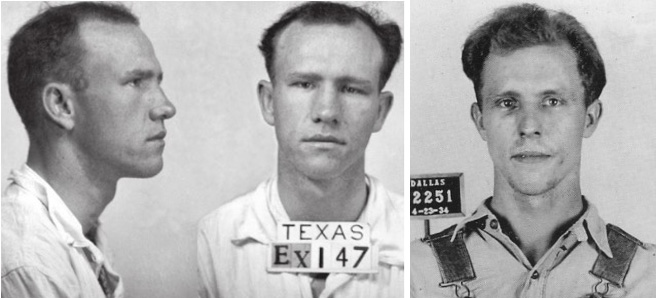
Raymond Hamilton (1914-1935) [left] — Floyd Hamilton (1908-1984) [right]
Parker and Barrow broke Raymond Hamilton out of jail in January 1934, and he was hunted down by a young deputy, Bill Decker. Parker and Barrow were shot on sight on May 23, 1934. On May 10, 1935, Raymond Hamilton was executed in the Texas electric chair.
Her family history does not make Markham a criminal. It does, however, challenge the portrayal of her as merely a naive, eccentric and wholly independent bystander to Officer Tippit’s shooting.
If she encountered a man she knew to be associated with Jack Ruby—a figure linked to organized crime—she may have well understood that speaking openly could carry consequences.
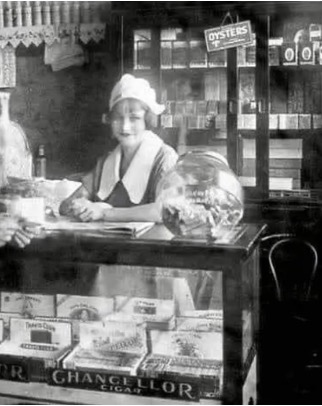
Bonnie Parker (1910-1934), working at Marco’s Café, Dallas, 1929.
When she testified to the Commission in Washington, Markham was asked if she recognized the person in the 4:30 pm assassination day lineup as the person who shot Tippit. Instead, she answered as if the lineup was a test of personal acquaintance. "I didn't know nobody."
Griffin then challenged that incongruity. This was the full exchange.
Mr. BALL. Did you recognize anyone in the lineup?
Mrs. MARKHAM. No, sir.
Mr. BALL. You did not? Did you see anybody-I have asked you that question before--did you recognize anybody from their face?
Mrs. MARKHAM. From their face, no.
Mr. BALL. Did you identify anybody in these four people?
Mrs. MARKHAM. I didn’t know nobody.
Mr. BALL. I know you didn’t know anybody, but did anybody in that lineup look like anybody you had seen before?
Mrs. MARKHAM. No. I had never seen none of them, none of these men.
Mr. BALL. No one of the four?
Mrs. MARKHAM. No one of them.
Mr. BALL. No one of all four?
Mrs. MARKHAM. No, sir.
Markham’s Failure to Recognize Oswald
There are 17 pages (9,000 words) of testimony for Markham. Not once does she use the word “Oswald”. Whether it was describing the shooting, then the lineup and then the shooting again. She merely says, “the man”.
Allen Dulles prompted her three times with the phrase “the man, now known as Oswald”. Yet each time, she reverted to “the man”. That abstraction seems unnecessary for a witness who had seen the shooting, later viewed the alleged gunman in a line-up and, by then, knew his name because of Oswald’s international notoriety. Oswald himself said the line-ups weren’t fair given he’d been given a black eye on arrest, and anyone could have picked him out.
At 4:30 pm there would be no reason for her to recognize the 2 ½ hour arrested Oswald from TV, as she’d been at the police department before any TV coverage of his arrest.
Jimmy Gambulos – thought he’d seen Jack Ruby and Oswald at his cafe
The way Markham’s boss Jimmy Gambulos was treated fits the same pattern as the cases of - at least - Litchfield, William Crowe, Mary Lawrence, Terry Friedman, Laura Kittrell and Carroll Jarnagin. As covered in my prior Crafard article. (Click here https://www.kennedysandking.com/john-f-kennedy-articles/larry-crafard-the-leads-the-warren-commission-lost)
A John Monahan told the Tulsa FBI on December 2, 1963, per CE2815, that a former colleague, Roland Carpenter, the General Manager of the ‘Petroleum Engineer Publishing Company’, 1309 Main Street, Dallas, had told him that the elderly Greek-descent owner of a restaurant near the Carousel Club had seen Jack Ruby and Oswald eating there together two or three times.
Monahan said that Carpenter told him that the owner “is an elderly man who did not want to get involved in any inquiries”. Monahan did not know the owner’s name, surname, nor the name of the restaurant.
Per CE2815, Agents Johnson and Albert of the Dallas FBI then traced Carpenter that day. Carpenter said that at the Eat Well restaurant, Main Street, Dallas, at lunchtime on Tuesday, November 26, 1963 (the same day as the Naval Intelligence lead of Patterson, see later), he and Jimmy – he did not know his surname - had discussed Oswald being shot by Jack Ruby. The FBI report of December 2, 1963, states that Carpenter had said, “Jimmy did not want to discuss the matter any further because he did not want to get involved.”
On December 3, again per CE2815, Agents Johnson and Albert spoke to James ‘Jimmy Gambulos’, the owner. According to that interview, Jimmy Gambulos said he had not been in the restaurant often, but Sam Gambulos, his brother, was taking charge. Jimmy said Sam had mentioned Ruby, not Oswald.
In June 1964, the inquiry got back to the Eat Well again because Ruby’s roommate George Senator had gone there shortly after Ruby shot Oswald. That lead betrayed the line that Jimmy Gambulos did not often attend the Eat Well. Per CE 3023, June 15, 1965, Sam Gambulos said Jimmy, not Sam, was present on November 24, 1964, the day Ruby shot Oswald. On June 16, 1964, Charles Gambulos said his father Jimmy had had a stroke, but attended work there every day, nonetheless. (See CE 3024)
Further evidence that Jimmy was working regularly came from the Mark Lane episode. Lane, who had been engaged by Oswald’s mother Marguerite, had telephoned the Eat Well to extract information from Markham. In testifying to the Commission on March 4, 1964, Lane said that on February 28, 1964, “James Gambolis (sic) listened to her talking to [Lane]”.
Three waitresses were interviewed (per CE 3024). Mildred Pollard said on June 12, 1964, that Jimmy was at Eat Well on November 24, when Senator came in after Ruby had shot Oswald. Gloria Freeman, on June 12, 1964, said Jimmy came in on November 24 and was in on other days in a supervisory capacity. Pauline Childress terminated her interview on the basis that she did not “want to get involved in anything.”
CE3024 is an FBI report of June 12, 1964. Agent Howe states that Jimmy Gambulos had had an operation on his head prior to the assassination and this had “affected his alertness and thinking processes”. Therefore, the excuses flip-flopped. Firstly, the story was that he did think he saw Oswald with Ruby but was frightened to say more. Which seems highly likely. Then, he was ill and wasn’t there, so it was his brother Sam – the manager - who was there. In which case, how did the FBI Tulsa manage to trace it to Jimmy? And how did Carpenter get the idea that it was the owner who had said those things? Then, it was Jimmy who was there, but because he had a stroke, he was confused.
The final excuse actually fails as a cover story in any case. If Jimmy Gambulos was sharp enough to know Jack Ruby, but his stroke-impaired vision and thinking made him easily confused by facial details, then he was a perfect candidate to misidentify Crafard as Oswald.
…………………….
Any confusion over ages can be dismissed. There was sufficient age gap between Jimmy (82) and Sam (65). Charles was 32.
However, unequivocal proof of everything that can be inferred from above sits in Crafard’s own testimony in his first session, April 8, 1964, in Washington DC, p. 431.
Mr. HUBERT. But you did go to the Eatwell Restaurant on Main Street, I think it was?
Mr. CRAFARD. It was on Commerce.
Mr. HUBERT. Commerce.
Mr. CRAFARD. I went there most of the time for my meals. It was, meals were cheap, nice place to go to, it was close, and I sat around there and joked with the girls and the one guy who worked in there I got acquainted with him a little bit.
That must have been Charles, as Griffin then distinguished the two older men from him.
Mr. GRIFFIN. Do you remember the two fellows who ran the Eatwell Restaurant?
Mr. CRAFARD. Not too well.
Mr. GRIFFIN. Were there a couple of older men?
Mr. CRAFARD. One older man that worked behind the counter in the evenings.
Mr. GRIFFIN. Did Jack also eat at the Eatwell?
Mr. CRAFARD. He didn't eat there when I was there with him, after I went to work for him. I understood the guy knew Jack real well, in fact he got in the habit of calling me Jack Ruby, Jr., or Little Ruby, in a kind of teasing manner. He was a very friendly person.
Mr. GRIFFIN. Was that the older man?
Mr. CRAFARD. He was an older man; I believe the oldest man that I saw there.
Mr. GRIFFIN. You don't recall his name, first name, do you?
Mr. CRAFARD. No; I don't recall his first name.
Mr. GRIFFIN. Was one of the fellows in there called Jimmy, that you recall?
Mr. CRAFARD. Not that I recall. There is one of those messes of pictures I would like to get hold of. There is one side of them I would just as soon get a hold of and tear up.
(Brief recess.)
Therefore, the April 3, 1963 memo identifying that Markham worked at Eat Well was dated just 5 days before Crafard saying all the above. That memo raised information about Jimmy saying that Oswald had also been at Eat Well.
Crafard confirmed he ate during the evening shift. Which is the shift Markham said she worked and, most remarkably of all, he said that the older man – therefore Jimmy- called him Jack Ruby, Jr., or Little Ruby. And that he worked there in the evenings. The same as Markham. Crafard is therefore more than likely the person Jimmy thought was Oswald.
The last sentence, which is an outburst by an unhappy Crafard, then interrupted by the recess, can only be explained in my view as there being something in the FBI photographs Crafard didn’t like. As I set out in my previous Crafard article, that included the batch of photographs taken by Friedman, who thought the man in the front row was Oswald when it was in fact Crafard.
If there could be any doubt the Commission was a charade, that is the evidence for it.
…………..
Larry Crafard and Jack Ruby
Jack Ruby became a public figure from the moment he shot Oswald on live TV on Sunday, November 24, 1963. Henceforth, his connections became relevant.
My prior article for Kennedys and King, Larry Crafard - The Leads the Warren Commission Lost, set out how Naval Intelligence knew from 13:30 p.m. on November 26 (Tuesday), 1963, that Ruby employee Larry Crafard could be mistaken for Oswald. In that case, ex-sailor Robert ‘Kermit’ Patterson said Jack Ruby had visited his electronics shop at 2533 Elm St, Dallas, with Oswald. But that person was proven to be Larry Crafard, by Crafard’s own admission and a notebook entry. It was Patterson’s lead that led to the tracing of Crafard by the FBI to rural Michigan.
In his questioning of Crafard, Burt Griffin was curious as to why he had left Dallas in a hurry on November 23, 1963. He put it in terms of whether Crafard feared things would get him in trouble when he left Dallas.
Mr. Griffin. Did you fear when you left Dallas that things might be happening which would get you in trouble?
Mr. Crafard. No; it never entered my mind. I figured that that would be the end of things when they had caught Oswald, I kind of figured that would be the end of it and he would come to trial.
The end of “things”? I can only read that as a careless admission that whatever he’d been up to in Dallas was off his back once Oswald had been framed for it all. But the problem reared its head again when Ruby became a person of interest.
The full exchange has him indicating he left Dallas due to the notoriety Ruby had gotten due to his shooting of Oswald. But Hubert pointed out Crafard had left Dallas before Ruby shot Oswald.
Mr. Crafard. Well, the way I left, after I found out that Ruby shot Oswald, the way I left, I thought just suddenly like that, didn’t leave any word to anybody where I was going or anything.
Mr. Hubert. How would that connect you with the killing of Oswald?
Mr. Crafard. I had been working for Ruby. He had shot Oswald. It could be kind of insinuating circumstances why I left and everything like that.
Mr. Hubert. But you had left before Oswald was shot?
Mr. Crafard. Yes; I had left before Oswald was shot.
Mr. Hubert. So that really your concern was not that they would connect you with the killing of Oswald?
Mr. Crafard. No.
Mr. Hubert. But that——
Mr. Crafard. They might think that I had done something wrong, myself.
Mr. Hubert. With reference to what?
Mr. Crafard. To anything. I mean breaking the law in any way.
Mr. Hubert. With reference to the shooting of the President, too?
Mr. Crafard. How is that?
Mr. Hubert. With reference to shooting of the President?
Mr. Crafard. Well, it could be that they might have thought I was involved in that in some way or something like that, and I just figured if they thought, you know, the way I had left if they had any idea at all that would further their idea, I mean if they had any idea that any of Ruby’s employees were involved in it, that would further the idea that I had been involved in this, in it.
Mr. Hubert. You actually thought about that?
Mr. Crafard. Yes; I felt——
Mr. Hubert. That was the thing that gave you concern and that is what you talked to your sister about?
Mr. Crafard. Yes; it kind of bothered me a little bit.
Mr. Hubert. Couldn’t you have ended the bother by going to the nearest police force?
Mr. Crafard. I probably could have. I never even thought about going in like that, just walking in and talking to them, asking them about it or anything.
The narrative Crafard was giving is all over the place. He’d said he thought the arrest of Oswald was “the end of it all”. That would mean he had no reason to panic. But he then connected his leaving Dallas with the notoriety from the - yet to happen – shooting of Oswald by Ruby. He used a Sunday event to try to explain a Saturday panic. He’d also said that the arrest of Oswald was the end of it all. By retrofitting Ruby’s later actions into his own earlier timeline, Crafard inadvertently suggests that Oswald’s arrest was not “the end of it all”. Instead, it may have been the moment the panic began.
If Oswald was supposed to die at the Texas Theater, his survival meant the master plan had failed. Anyone connected to Ruby would have faced immediate and serious danger. With respect to that reading, Crafard ran because he knew time was running out—but he could not tell the Commission why.
There were indications of panic before Crafard left Dallas. Ruby had awakened Crafard in the middle of the night of November 22/23, 1963 to go to take photographs of an "Impeach Earl Warren" billboard downtown.
Markham, the line-up and the jacket
At 4:30 PM on November 22, Helen Markham was taken to view Lee Harvey Oswald in a four- man police lineup. Oswald was standing in that lineup jacketless. The official line was that he had discarded his jacket fleeing the Tippit murder scene.
Yet, when cross-examined by Assistant Counsel Joseph Ball about how she recognized – of sorts - the man in position number two, Markham explicitly stated under oath:
I looked at him... I recognized his jacket and his slacks.
The “screwball” view of her may be valid. But it also achieves a distraction from her Barrow gang connections. A major story which even Dorothy Kilgallen did not pick up on.
The extraordinary removal of Markham from the murder scene to City Hall – before any arrest
CE523, the Commission’s map of the murder scene, was presented when Markham testified. A marker pen arrow shows where she stood at the northwest corner of the intersection.
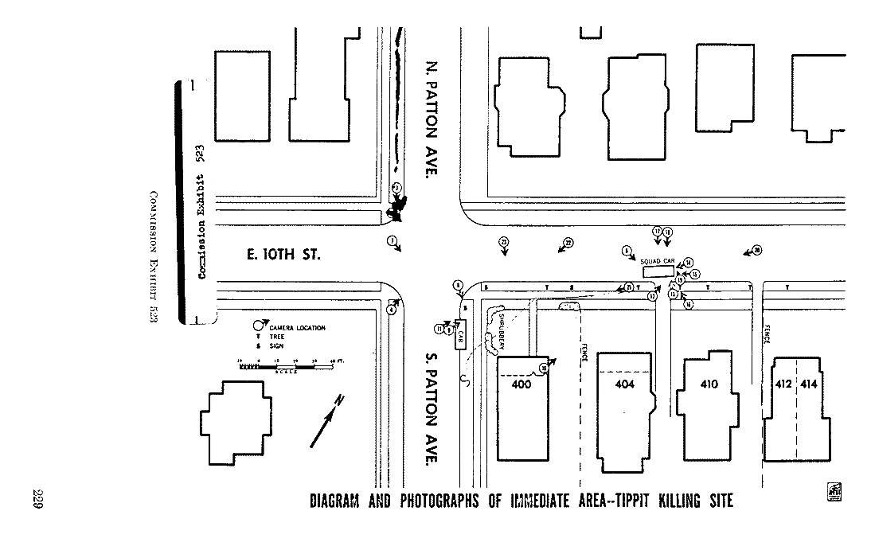
Officer Poe’s Supplementary Offense Report for the day itself refers to his first interaction with Helen Markham. “When she went to the aid of the Officer, the suspect threatened to kill her.”
In subsequent TV interviews, she is referred to as standing still on the northeast corner of 10th and Patton and covering her eyes. A scenario in which Markham recognized the shooter - but wished to give the impression that she had not - would also explain why, in later TV interviews, she was keen to stress that she had covered her eyes. A very different story to her earliest comment to Poe that the killer had threatened her.
At some point – as she testified - Markham took off and put her shoes on the roof of Tippit’s car.
At 2:00pm, an officer with call sign 26 made this call from City Hall indicating he’s got Helen Markham with him, “Go back there [the murder scene] and get this witness's shoes. She left them on the hood of the car [Tippit’s car], and we'll be in the Homicide Bureau.”
The fact she was at City Hall by 2pm is odd. She would have needed to have been on her way there before Oswald had been arrested and available to identify. Indeed, why take a prime witness away from the scene if the assailant still might be in the area?
From this, from Westbrook’s Commission Testimony - Vol VII, he was talking to her when the call of an alert at the Texas Theater came through.
Mr. Ball. You were near 10th and Patton?
Mr. Westbrook. And she was telling us what had occurred.
Mr. Ball. Do you remember her name?
Mr. Westbrook. No; the other officers got it.
Mr. Ball. Was it a Mrs. Markham?
Mr. Westbrook. It could have been, sir; I don't recall, because I directed someone there to be sure and get her name for the report, but she lived directly across the street, and she told us—or was in the process of telling us how it occurred—what she had seen, when someone hollered a patrolman hollered—"It's just come over the radio that they've got a suspicious person in the Texas Theater."
Then, Sergeant Stringer, I, and Agent Barrett got in another squad car, and I don't know what officer was driving this one, but then when we arrived and were approaching the theatre, I directed the patrolman to turn down into the alley instead of going around to the front because I figured there would be a lot of cars at the front. There were two or three at the back.
In the light of everything else I have written about Westbrook, the fact he interacted with Markham at around 1:45 pm before anyone was arrested - but is consistent with her arrival at City Hall by 2:00 pm - indicates he might have been behind her removal from the scene.
No other witnesses were removed. Indeed, Markham was removed so quickly her shoes were left behind, on top of Tippit’s car. If Crafard was the shooter and, as I have previously argued, was protected by a group of officers that included Hill, Croy, Mentzel and Westbrook, Westbrook could have been tipped off that Markham knew Crafard and therefore posed a problem.
Conclusion
The issue at stake here isn’t actually whether anything Markham said was true. What is relevant is why the obvious lead to Crafard wasn’t pursued. Clearly, the Commission was aware of them. The memorandum from Burt Griffin had no follow-through to a logical line of inquiry. There are substantial holes in what Markham and Crafard said to the Commission.
There is also her interaction with Westbrook before her extraordinary shoe-less removal from the murder scene before Oswald was arrested.
