
VANISHING ACT AT THE NATIONAL ARCHIVES:
THE SYSTEMIC BREAKDOWN OF THE JFK RECORDS ACT
November 21, 2026
By Andrew Iler and Mark Adamczyk
Decades after Congress mandated the public disclosure of all records related to the assassination of President John F. Kennedy, key legal enforcement records and original investigation files cannot be located at the National Archives, and the Collection of records has fallen into a state of disorder without a functioning master index of assassination records, rendering the JFK Records Collection effectively unsearchable and defying federal law.
In October 1992, in the wake of public outcry ignited by Oliver Stone's blockbuster film JFK, Congress passed the President John F. Kennedy Assassination Records Collection Act with unanimous bipartisan support. The statute was meant to serve as an uncompromising hammer against official secrecy, establishing a mandatory, independent legal framework designed to uncover every single government document related to the murder of the 35th president. It set a hard, statutory deadline: every record was to be fully disclosed to the American public by October 26, 2017. This included every assassination record obtained or created by the House Select Committee on Assassinations (HSCA) and the Church Committee during their investigations between 1975-1979.
Today, more than nine years past the statutory deadline, research reveals a systemic, multi-decade breakdown at the National Archives and Records Administration (NARA), the federal agency responsible for maintaining the JFK Records Collection as it is defined by law. Specifically, NARA cannot account for tens of thousands of binding legal declassification orders issued by the Assassination Records Review Board (ARRB or Review Board), cannot locate the ARRB's internal investigative files for each assassination record, and maintains an incomplete database system that leaves large parts of the JFK Records Collection unindexed.
As a result of this breakdown, the JFK Records Act has not operated as Congress directed, and the public continues to be denied complete access to the assassination records that were mandated for full release by October 26, 2017, or earlier. The Act's core legal architecture meant to enforce the public's right to full and prompt disclosure of assassination records has effectively been erased from public view.
At the center of this investigation is the unknown status of more than 27,000 legal declassification orders issued by the ARRB, the independent federal agency created by Congress to obtain and govern the release of all assassination records.
WHAT THE JFK RECORDS ACT REQUIRED
When Congress established the ARRB in 1992, it granted the Review Board sweeping authority to overrule agency secrecy. Under Section 6 of the Act, if an intelligence agency or government department wished to keep an assassination record secret in full or in part, it bore the heavy burden of providing "clear and convincing evidence" that disclosure would cause a current identifiable harm outweighing the public interest in the release of a record. The legal framework was mandated in 1992, then almost 30 years after the assassination. Every assassination record was treated with the presumption of immediate disclosure. In the Act, Congress further declared that only in the "rarest of cases" was there any legitimate need for continued protection of these records.
When the ARRB reached a final decision on the disposition of each assassination record it reviewed, it executed a binding and enforceable agency action known as a Final Determination Notification (FDN). These FDNs are formal legal orders mandating either a) immediate disclosure; or b) specific release or review dates for each record postponed for public disclosure, and in any event, no later than October 26, 2017. If an originating agency disputed an ARRB decision, the law provided that only the President, within a 30-day time-limited window of authority, could override the ARRB's decision. President Bill Clinton had the sole authority during his presidency to override these ARRB decisions, and he did not overturn a single ARRB Final Determination.
In sworn testimony delivered before the Congressional Task Force on the Declassification of Federal Secrets on May 20, 2025, former ARRB Chairman Judge John R. Tunheim confirmed that the Review Board executed more than 27,000 Final Determinations during its operating mandate from 1994 to 1998. By law, each of the legal orders was required to be transmitted to the Archivist of the United States; published within 30 days; and strictly implemented by the Archivist of the United States. Under the JFK Records Act, this mandated process had the purpose of downgrading and declassifying classified security information.
THE THREE TRANCHES
Functionally, the JFK Records Collection divides into three tranches of records: (1) records transferred to NARA or to congressional archives before the passage of the Act on October 26, 1992, including the HSCA and Church Committee files; (2) records reviewed by the ARRB between 1994 and 1998, together with the ARRB's own records; and (3) records transferred by agencies after the ARRB's mandate terminated on September 30, 1998. Problems exist in each group of records, but the second tranche, the legal core of the Collection, is where the evidence of breakdown is most concrete.
THE SECOND TRANCHE: THE MISSING LEGAL RECORD
Now approaching 63 years after the tragic death of President Kennedy, and despite FOIA requests and focused on-site searches at the National Archives, NARA has not accounted for, produced, or demonstrated public access to approximately 97 percent of the 27,000 binding legal orders.
The missing orders constitute the essential legal paper trail of the entire declassification framework. Without them, neither Congress nor independent researchers can verify whether postponed documents were released in accordance with the Review Board's determinations or whether federal agencies simply ignored the Board's legal commands once the ARRB closed its operations on September 30, 1998. Further, without access to this finite number of orders and a complete index of all assassination records (see below), researchers cannot determine the number of assassination records that bypassed the ARRB's declassification process altogether.
Senior ARRB executives and documentary evidence confirm that when the ARRB Board processed a postponed assassination record, a paper copy of the Final Determination Notification (FDN) was physically attached directly to the assassination record itself before the record was transferred to the National Archives. Records show that between 1994 and 1998, senior National Archives staff were diligently receiving, reviewing and tracking all of the ARRB Final Determinations.
To prepare the postponed records for digital release in recent years, NARA staff would have had to physically detach the FDN from each assassination record. Yet those FDNs have not been cataloged in NARA's digitized online databases. During on-site searches at NARA's primary facility in College Park, Maryland, in 2024 and 2026, only roughly three percent of the total number of issued FDNs were found—stashed inside random archival boxes labeled "Press and Public Contacts". NARA has not located the rest.
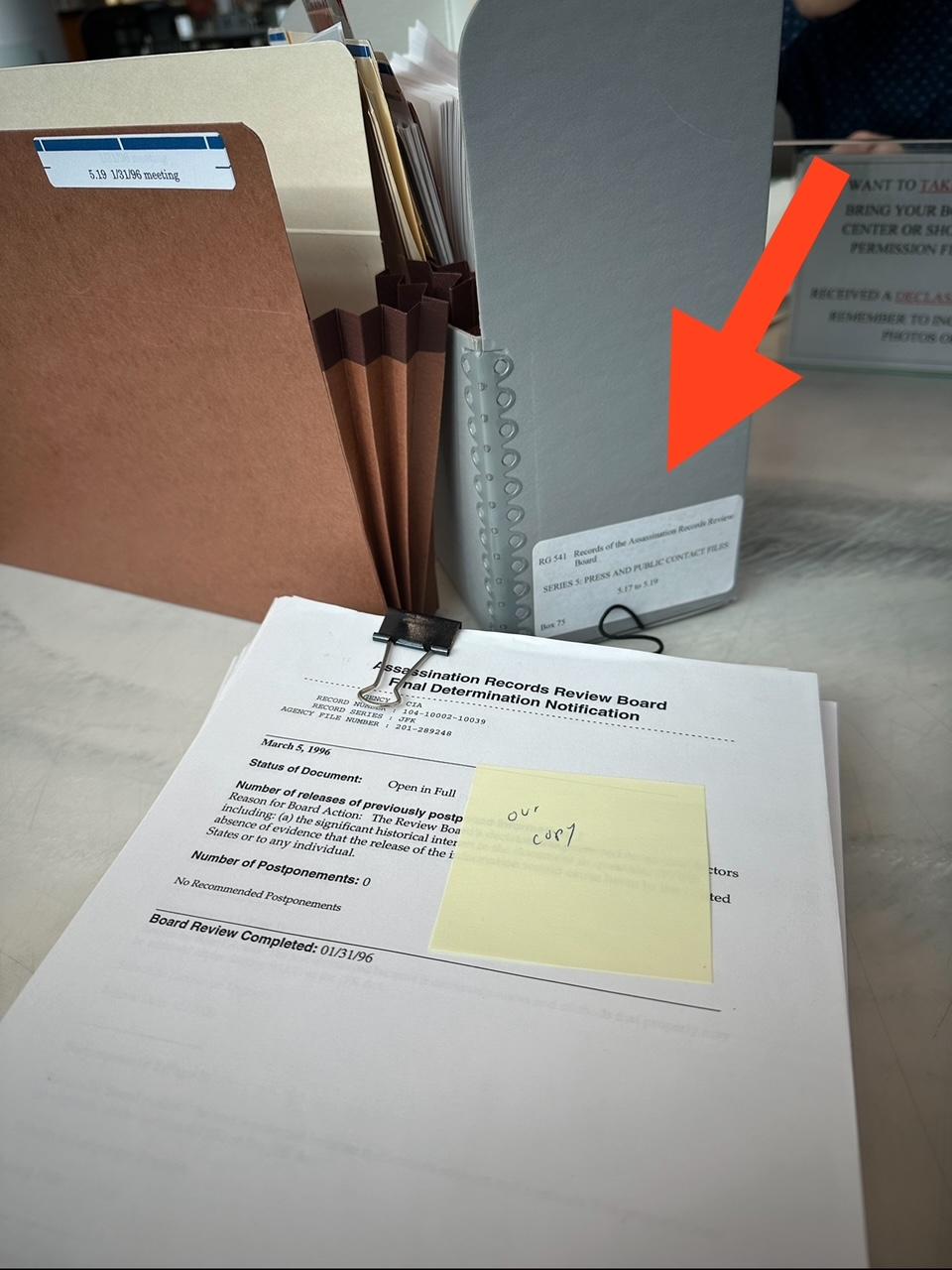
The legal importance of the ARRB Final Determinations cannot be understated. The JFK Records Act required that all of the ARRB FDNs be publicly disclosed and made each of the ARRB's FDNs a binding and enforceable legal order. Senate Report 102-328, which attended the passage of the Act stated that, "Finally, the determinations of the review board are reviewable and enforceable in a court of law." With tens of thousands of ARRB Final Determinations missing and unaccounted for, the mechanics of NARA and agency compliance cannot be measured and accounted for, and without access to the orders, the public has been denied its statutory right to seek judicial review under the Administrative Procedure Act to compel compliance. This has prompted serious questions about how NARA and the agencies have managed the entire JFK Records Collection, which has been marked by inexplicable delays in the release of records over the last thirty years.
Since the FDNs themselves contained no classified information and were mandated to be made public, it makes no functional or practical sense for NARA not to have digitized them along with each associated assassination record during the digitization projects that have taken place over the last 28 years. This would have permitted the public to seek enforcement of the orders through the judicial review process mandated by the Act. NARA received copies of all 27,000+ ARRB Final Determinations, in addition to the ARRB's Lotus Notes database for tracking them. Given that NARA in fact processed and accessioned each record transmitted by the ARRB into the JFK Records Collection, the only plausible explanation is that NARA had to physically remove the FDN from each assassination record before or during the digitization process. What has NARA done with the 27,000 legal orders governing the postponed assassination records?
The problem gets worse. Analysis of the small sample of Final Determinations discovered by author and researcher Andrew Iler reveals that virtually none of the assassination records ordered released by the ARRB on dates before the October 2017 deadline were in fact released on the dates set by the Review Board, demonstrating direct noncompliance with federal law. The remaining 97 percent of undisclosed Final Determinations would reveal declassification decisions on tens of thousands of additional postponed records, including the most sensitive assassination records that the ARRB struggled to obtain due to agency delay during the final two years of the ARRB's mandate.
THE MISSING 300,000 ARRB WORKING FILES
The "second tranche" of assassination records—those processed by NARA after October 10, 1992, and reviewed by the ARRB before its closure—is the central legal core of the JFK Records Collection. Significantly, this tranche also includes all records created by the ARRB itself, including the original investigative file folders created for each assassination record it processed. Between April 1994 and September 1998, the ARRB created an individualized, dedicated paper working folder for every single assassination record it processed—a trove exceeding 300,000 physical manila file folders. Each folder was clearly labeled with the specific Record Identification Form (RIF) number corresponding to the document under review.
These operational files of the ARRB document the why and how individual declassification decisions were made. Similar to the FDNs, NARA has not located these files. Each working folder held the complete operational anatomy of the declassification decision on a redaction-by-redaction basis, including:
● The ARRB's Final Determination Notification;
● The original Document Identification Aid;
● Two full copies of the assassination record (one fully unredacted master copy and one proposed redacted copy);
● Internal staff memos, legal analysis, and investigative notes;
● Formal briefs and postponement requests submitted by originating agencies such as the CIA, FBI, and Department of Defense; and
● Written correspondence between the ARRB and intelligence officials on specific redaction and postponement requests.
During the Board's tenure, over 300,000 of these working folders were housed inside a high-security Sensitive Compartmented Information Facility (SCIF) at ARRB headquarters in Washington, D.C. These ARRB materials were designated assassination records by law, and were ordered to be transmitted to NARA for archiving in the JFK Records Collection along with all other assassination records. As Review Board records, they are mandated to be part of the Collection pursuant to section 4(a)(2) of the Act.
To date, NARA has not been able to identify, locate or produce any of these folders and the contents created by the ARRB.
We confirmed this in May 2026, when we submitted advance pull requests to NARA staff before an on-site research visit to College Park. The requests specifically asked for the ARRB working folders associated with well-known published RIF's for CIA officer Reuben Efron and the HSCA's "Lopez Report" on Oswald and Mexico City. When we arrived, senior NARA staff advised that searches of the JFK Records Collection at College Park could not identify, locate, or produce any ARRB working file folders for those specific records or for any other published RIF's in the Collection.
Because the ARRB working file folders for each assassination record were transferred to NARA in 1998, and searches at NARA's College Park campus have not located them, the search must be expanded to include all holdings of other federal records centers, starting with the GSA/NARA Washington National Records Facility (WNRC) in Suitland, Maryland, where the records appear to have been sent at the end of the ARRB's mandate in 1998.
By potentially holding these records in off-site facilities under standard Federal Records Act rules rather than the mandatory disclosure provisions of the JFK Records Act, NARA may have insulated internal agency operations and compliance histories from public and congressional oversight. These records require immediate search and retrieval from NARA-controlled facilities, including the WNRC facility in Suitland, Maryland.
When the ARRB wound up its operations in September 1998, ARRB staff collaborated with a dedicated NARA oversight team to pack truckloads of administrative, operational, and investigative records. Until NARA demonstrates otherwise, these records were most likely shipped to the Suitland facility under Standard Form 135 (SF-135) transmittal manifests. Under federal archiving rules, SF-135 forms are critical tracking records: they record accession tracking numbers, box-by-box folder manifests, shelf location codes, and lifecycle disposition schedules. Because the SF-135 forms document the transfer of assassination records and were in part created by the ARRB, these too are assassination records and should have been added to the JFK Records Collection and made available to the public.
Our review of NARA's public catalogs found that NARA has not indexed or incorporated any SF-135 manifests, location records, destruction tracking documentation, or an index or catalog of WNRC Suitland holdings into the public JFK Records Collection.
The ARRB's working folders are a key to the entire legal declassification process. They are in effect mini 'court files' for each postponement, containing the unredacted master documents, the agency arguments for continued postponement, and the internal ARRB staff analyses. Without them, we cannot see what the intelligence agencies fought so hard to withhold and why. NARA must account for the 300,000 ARRB operational file folders, all of which are assassination records by law.
On August 12, 2026, we filed a formal Freedom of Information Act request that also invoked NARA's obligations under the JFK Act, seeking an expedited search for all 300,000 working folders, the missing 27,000 Final Determination orders, and all internal transmittal and accessioning data documenting the transfer of millions of pages of records from the ARRB to NARA. As of today, NARA has not confirmed whether the records have been identified or found.
On August 11, 2026, along with attorney Eli Frame, we served a formal Preservation Notice and Demand on Acting Archivist of the United States Edward Forst and NARA General Counsel Matt Dummermuth. The legal notice formally warned NARA against the spoliation or destruction of any ARRB materials stored at Suitland or College Park and demanded an immediate, line-item inventory and transfer of all off-site ARRB records to the public JFK Collection. We will report on any response from the Acting Archivist and NARA.
THE "INDEX"
The disappearance of the Board's legal orders is compounded by NARA's failure to complete the foundational navigation and search tools required by the 1992 statute: a Unified Master Subject Guidebook and Index to the JFK Records Collection as defined by law.
Section 4 of the JFK Records Act established a non-discretionary, mandatory duty for the Archivist of the United States to create a "subject guidebook and index" for the entire JFK Records Collection. This tool was designed to function as a living universal tracking system for declassification, assigning a standardized Record Identification Form (RIF) number to every assassination record in the Collection and detailing its precise provenance, status, and declassification history.
The mandatory contents of the JFK Records Collection itself remain a topic of public speculation and confusion. The Collection required by Congress in the JFK Records Act is not what the public can view on NARA's current online database. If created and maintained by the Archivist starting in 1992, this master indexing system over the years would provide both accountability and transparency to the public for the mandatory contents of the JFK Records Collection as defined in section 4(a)(2) of the Act, which consists, in substance, of the following:
1) All assassination records transmitted to the National Archives or disclosed to the public in unredacted form before enactment (October 26, 1992); and
2) All assassination records required to be transmitted to the National Archives under the JFK Records Act, including records postponed (from immediate disclosure) by the ARRB between 1994-1998 under the Act; and
3) All assassination records transmitted to the National Archives after the ARRB terminated its operations on September 30, 1998.
The Collection, by definition under the JFK Records Act, shall also include:
a) A central directory of identification aids created for the tracking of each record transmitted to the Archivist, to result in the creation of a uniform system of electronic records; and
b) All records of the ARRB.
More than three decades after the law's passage, NARA has not published a subject guidebook and index to the entire Collection, and its online database leaves out whole categories of records. What the National Archives offers is a patchwork of disconnected electronic spreadsheets searchable by RIF numbers (see here and here). The NARA spreadsheets a) cover only a portion of the digitized Collection; b) do not index ARRB records, including its Final Determination orders; and c) do not index assassination records processed at NARA before and after the ARRB's term, leaving large parts of the Collection completely unindexed and obscured.
The practical effect of this failure is that much of the JFK Records Collection is effectively unsearchable. Researchers searching for key historical subjects, covert operations, or agency personnel encounter missing RIF numbers, broken record chains, and unindexed record groups. When NARA periodically releases new tranches of digitized documents, the public has no mechanism to audit the releases, verify how many records remain withheld, or determine which agency is still withholding them.
Without a complete index, records can remain withheld in plain sight; because no one outside the government can see the full inventory. Significantly, without a compliant index of the Collection, the Archivist of the United States cannot legally fulfill Section 12(b) of the Act; which requires official certification to Congress and the President that all assassination records have been fully disclosed in accordance with the law.
Multiple lawsuits have been filed seeking to compel compliance with Section 4 of the JFK Records Act and the duty of the Archivist to create and maintain the mandated index and subject guidebook. The question is no longer whether NARA must produce these tools, but whether what it has produced complies with the Act. We contend that it does not--until all records of the ARRB are indexed, for comparison to an index of all assassination records that circumvented the ARRB with their current classification status disclosed.
THE FIRST TRANCHE: CONGRESSIONAL INVESTIGATIVE RECORDS
The absence of a master index has facilitated the continued concealment of undeterminable collections of historical records that were explicitly meant to be declassified under the 1992 law.
The "first tranche" of records includes all assassination records transferred to NARA or congressional archives, including congressional investigative records, before the passage of the JFK Records Act. Many of these records remained sequestered and classified under agency guidelines and sealing rules, notwithstanding the Act's requirement for independent review by the ARRB and prompt disclosure. The most severe compliance breakdowns in this tranche involve congressional investigative materials generated during the mid-to-late 1970s.
Following the 1979 conclusion of the House Select Committee on Assassinations (HSCA), Congress entered into administrative agreements with executive agencies—including the CIA and FBI—to lock away "sequestered collections" of investigative materials until the year 2029. Similarly, key files from the Senate's Church Committee and its Schweiker-Hart subcommittee, which examined intelligence failures in the Kennedy assassination and Lee Harvey Oswald's potential intelligence connections, were sealed under 50-year rules by Senate Resolution extending to 2026.
The 1992 JFK Records Act was designed specifically to override those secrecy arrangements and immediately expedite the release of congressional investigative files. The Act required congressional assassination records to be reviewed by the ARRB and made public under the same standards that applied to executive-branch records. The law provides no exceptions or different declassification process for congressional investigative materials that were previously sequestered. Any declaration from NARA stating that all information withheld from legislative-branch records has been released does not extend to congressional investigative records that were never reviewed, processed or indexed to the Collection, such as the Church Committee holdings discussed below.
However, internal agency records show that executive branch resistance was swift and deliberate. On February 10, 1992—just weeks after the release of Oliver Stone's film and months before the JFK Act was signed into law—the CIA drafted a secret internal memorandum outlining a strategy to effectively preempt the JFK Records Act and maintain existing CIA classification over the HSCA Sequestered Collection under agency guidelines, avoiding any independent agency's oversight.
Audio recordings of recently released closed ARRB executive sessions, along with internal ARRB reports and correspondence, reveal deep frustration among Board members, who expressed grave doubts over whether the CIA and FBI ever granted the Board full access to the sequestered legislative investigative files housed at NARA's Center for Legislative Archives. These recordings, together with hard-copy ARRB working files we inspected at the National Archives and the ARRB's Final Report itself, also reveal that the ARRB was attempting to access and process the Church Committee records holdings until the last days of its operations in September 1998. These holdings include the records and files of the Schweiker-Hart subcommittee, which specifically investigated intelligence agency connections to the assassination of the President.
The continued withholding of these records was highlighted during May 20, 2025 congressional testimony by former HSCA investigator Dan Hardway. Hardway described a covert CIA operation directed by CIA officer George Joannides that actively obstructed the HSCA's 1978 investigation into Oswald's activities in Mexico City and post-assassination propaganda efforts linking Oswald to Castro. Hardway testified under oath that his investigative work led him to conclude the CIA had used Oswald operationally in Mexico City before the assassination—a line of inquiry that he said Agency obstruction cut off.
Most recently, current Senator and Chair of the Senate Homeland Security Committee, Rand Paul, stated at a committee hearing on May 13, 2026, that he and his staff had been effectively denied access to the 450 boxes of Church Committee records held in the secured Legislative Archives controlled by the Senate Intelligence Committee.
Considerable concern has existed for decades that CIA operational files were never disclosed to the Warren Commission, the HSCA, the Church Committee, and even to the ARRB, despite intensive efforts to pry those records loose from the CIA. The ARRB spent four years battling with the CIA for access to operational records with limited success.
The agency's attitude towards its operational records is best summed up by a second CIA secret memorandum dated February 10, 1992 (still only partially disclosed), emanating from the Directorate of Operations, which in part stated:
I have no problem with the 30-year guideline for documents that were created as stand alone documents and not part of a structured project file, DO [Directorate of Operations] documents from project files should remain under the DO's control, however, and should be reviewed only in the context of the operation and not singularly. Many documents that on the surface appear nonsensitive would, in the aggregate, reveal sources and methods that we are obligated by law to protect. A more logical approach would be for the DO (not an independent entity) to review the entire project 30 years after its inception or perhaps 10 years after the project file has been retired. We should never relinquish control of DO documents simply because of their age.
As legendary researcher Malcolm Blunt has noted, until NARA publishes a transparent index of this early tranche of legislative investigative records and sequestered collections, the full extent of this disclosure problem will remain a black hole of secrecy.
THE THIRD TRANCHE: WAITING OUT THE ARRB
Researchers have identified a significant later "third tranche" of records that the ARRB never saw: thousands of documents quietly deposited at NARA by intelligence agencies after the ARRB's operating authority expired on September 30, 1998.
Former ARRB Chairman Judge John R. Tunheim addressed two important additional pieces of evidence on the congressional record in his May 20, 2025 testimony. Tunheim testified that federal agencies deliberately withheld large volumes of material until the independent Review Board ceased operations: "It did not take a rocket scientist to know that the agencies were waiting out the term of the ARRB." Tunheim further stated under oath that the ARRB never saw or reviewed many of the new (2025) NARA releases and that assassination records were transferred to NARA "at a later time." This testimony not only confirmed the agencies' strategy of waiting out the term of the ARRB, but it underscores the lack of accountability for the trove of assassination records that were processed at NARA without independent review under the precise standards of the JFK Records Act or the binding and enforceable mechanisms mandated by the Act.
By transferring records after 1998, agencies bypassed independent declassification review under the strict standards of the JFK Act, creating a vast "black hole" of unindexed, agency-redacted or fully withheld documents at NARA.
These late post-ARRB transfers to NARA, combined with NARA's failure to account for 97 percent of the ARRB's Final Determinations and its failure to complete the mandated index and directory of records, leave researchers and the general public with two serious problems when attempting to reconcile what has been made publicly available by NARA since October 26, 2017: 1) the public cannot accurately track the status of postponed assassination records reviewed by the ARRB and subject to an FDN release order; and 2) they cannot determine the total number of assassination records that are still withheld in full or in part.
PRESIDENT TRUMP'S EXECUTIVE ORDER 14176 AND "APPLICABLE LAW"
On January 23, 2025, President Trump issued Executive Order 14176. It stated: "It is in the national interest to finally release all records related to these assassinations without delay…I have now determined that the continued redaction and withholding of information from records pertaining to the assassination of President John F. Kennedy is not consistent with the public interest and the release of these records is long overdue."
For the issues discussed here, the Order did two (2) things:
1. It directed that, within 15 days, the Director of National Intelligence and Attorney General, in coordination with the White House, were required to present a plan to the President for the full and complete release of records related to the assassination of President John F. Kennedy; and
2. It required that the Order be implemented consistent with applicable law.
The Order deserves credit for NARA's posting of 2,700 assassination files on its dedicated website, and also for prompting the hearings and declassification work conducted by Representative Luna's Task Force on the Declassification of Federal Secrets.
However, it is important for the public to remember that the actual plan presented to the President for the "full and complete release" of assassination records has never been made public.
Most significantly, the Order's "applicable law" clause points directly back to the 1992 JFK Records Act. An executive order does not itself create rights that the public can enforce in court, so the Act remains the operative legal framework.
The JFK Records Collection Act of 1992, unanimously passed by Congress 34 years ago to ensure that each assassination record was released by October 26, 2017, is the only law of the United States that directly governs JFK assassination records, and, with limited exceptions, it takes precedence over any other law, judicial decision or common law doctrine that would otherwise prohibit transmission of a record to the Archivist or public disclosure [Section 11(a), JFK Records Act].
To implement the Order "consistent with applicable law" and meet the President's stated goals, the public must know: a) what records were turned over to the National Archives under the JFK Act, b) what records were reviewed and ordered released by the ARRB, and c) what records remain withheld or postponed -- all to be tracked by a complete subject guidebook, index and central directory.
Congressional oversight committees need to take sworn testimony from past and present leaders of the National Archives regarding the compliance issues raised in this article and the status of the JFK Records Collection itself. Announcements from NARA that unspecified records are still being "digitized" are not sufficient under the JFK Records Act, which had at its core the purpose of mandating an accountable and enforceable framework for the release of records. NARA officials should be asked what they are digitizing and whether their response after 34 years meets the Archivist's legal duties under sections 4(a)(1), 4(a)(2) and 5(d)(1) of the JFK Act.
CALLS FOR CONGRESSIONAL SUBPOENAS AND GAO AUDIT
The record above shows that voluntary administrative compliance has failed.
The JFK Records Act is undoubtedly the most important and powerful declassification law ever written. With meaningful oversight action, however, the purpose of the Act can still be met.
Section 12(b) of the JFK Act provides that the law remains in effect until the Archivist certifies to the President and Congress that "all assassination records have been made available to the public in accordance with this Act." Remarkably, it is now 2026, and the Archivist has still not made this certification. Under the law, the Archivist legally cannot certify that all requirements of the Act have been fulfilled until the Archivist of the United States has met the duties described above, beginning with a complete index of the Collection. These duties are not difficult to understand; Congress need only require that they be met.
At a June 9, 2026 meeting, researchers Mark Adamczyk, Andrew Iler and Jeff Crudele were advised by Representative Luna that her office would send a formal written request to the Government Accountability Office (GAO), seeking a GAO compliance audit on NARA's handling of the JFK Records Collection. The GAO is an independent, bipartisan agency in the legislative branch that acts as the investigative arm of Congress. To date, it is unclear whether or not the GAO has been tasked to conduct an audit.
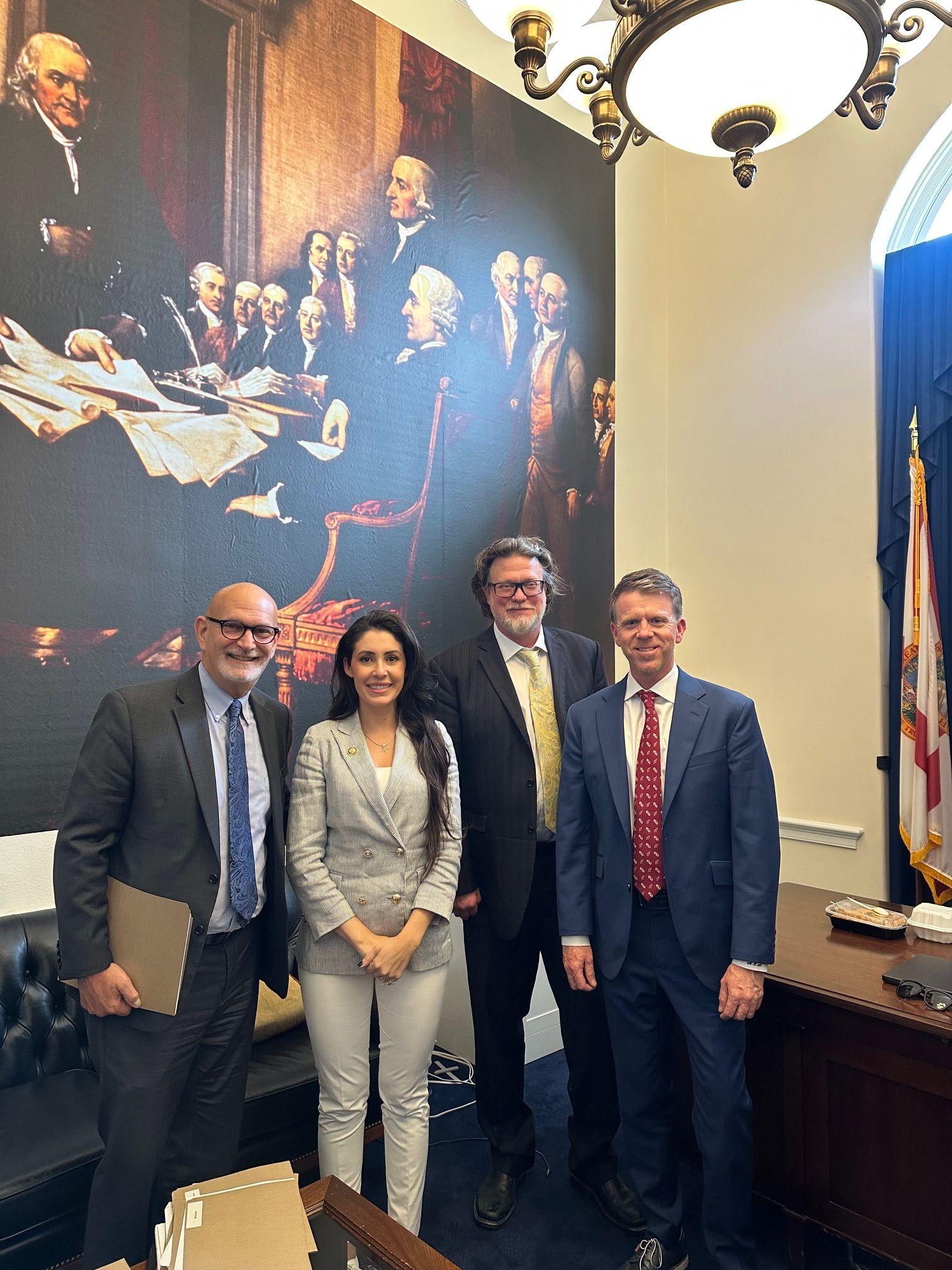 Jeff Crudele, Rep. Anna Paulina Luna,
Andrew Iler, & Mark Adamczuk
June 9, 2026
Going forward, congressional oversight committees, which have jurisdiction over the JFK Records Collection at NARA, should use their full investigative and legislative powers to begin:
Immediate Oversight
1. GAO Audit: Request that GAO conduct a full-scale physical and digital audit of the JFK Records Collection at College Park and the WNRC at Suitland, Maryland, to establish a complete, line-item inventory before any Archivist certification is accepted.
2. Subpoena Legal Orders: Subpoena NARA to produce and publish all ARRB Final Determination Notifications.
3. Subpoena Operational Records: Subpoena all 300,000+ ARRB working folders for each RIF it reviewed, internal Lotus Notes tracking databases, closed-session audio recordings, and staff inquiry files.
4. Release NARA Internal Files: Subpoena or require by statute the release of all internal policies, transmittal receipts, legal opinions, and agency correspondence regarding the administration of the JFK Act.
5. Sworn Testimony: Subpoena past and present Archivists of the United States and senior NARA officials to testify under oath regarding the missing Final Determinations, off-site record transfers, and post-1998 postponement decisions.
Specific Records
6. Unseal Legislative Archives: Pass House and Senate resolutions lifting the sealing rules that still cover the Church Committee, Schweiker-Hart subcommittee, and HSCA executive session transcripts and staff notes.
7. Pursue Medical Evidence: Subpoena known, extant Bethesda Naval Hospital autopsy records and materials identified by former ARRB Senior Military Analyst Douglas Horne that fall outside the Kennedy family deed of gift, which the Act excludes.
8. Pentagon Compliance: Require, through legislation or the defense authorization process, that the Department of Defense and military intelligence components immediately search and release all withheld assassination files.
Structural Reform
9. Establish a New Review Board: Enact legislation establishing a new independent, temporary Board to review all remaining withheld records and unindexed post-1998 agency transfers under the strict standards of the 1992 Act.
Congress enacted the JFK Records Act in 1992 to restore public trust in government through a legal framework of total transparency, accountability and enforceability. Thirty-four years later, that trust remains broken—not because the law was weak, but because the agencies responsible for carrying it out allowed its key mechanisms (such as the 27,000 Final Determinations) to be lost from view, and because Congress has not conducted sustained oversight over the Act's implementation and the Collection housed at the National Archives.
With the Task Force on the Declassification of Federal Secrets about to change leadership, Democratic and Republican members alike have a duty to complete the job that the American public demanded more than 30 years ago. Though late, now is the time to exercise that jurisdiction… and without compromise.


